If you are a Platform Engineer, DevOps professional, or Infrastructure Security Engineer operating in 2026, you already know that Kubernetes is the undisputed backbone of modern infrastructure. It has revolutionized container orchestration, allowing teams to deploy, scale, and manage massive microservice architectures with unprecedented velocity.
But beneath the sleek surface of rapid deployments and automated scaling lies a ticking time bomb: Kubernetes Role-Based Access Control (RBAC).
In theory, K8s RBAC is designed to restrict who can do what within your cluster. In practice, it is a staggering minefield of YAML files, overlapping permissions, and nested role bindings that are nearly impossible to audit manually. The reality is stark, complex RBAC implementations are fundamentally broken not by design, but by human execution. A single overly permissive service account or a misunderstood wildcard character (*) can transform a minor container compromise into a catastrophic, full-cluster takeover.
Here is an unfiltered look at why your clusters might be one misconfiguration away from disaster, and how you can implement a resilient, zero trust architecture without slowing down your CI/CD pipelines.
The Minefield of K8s RBAC: Defaulting to Danger
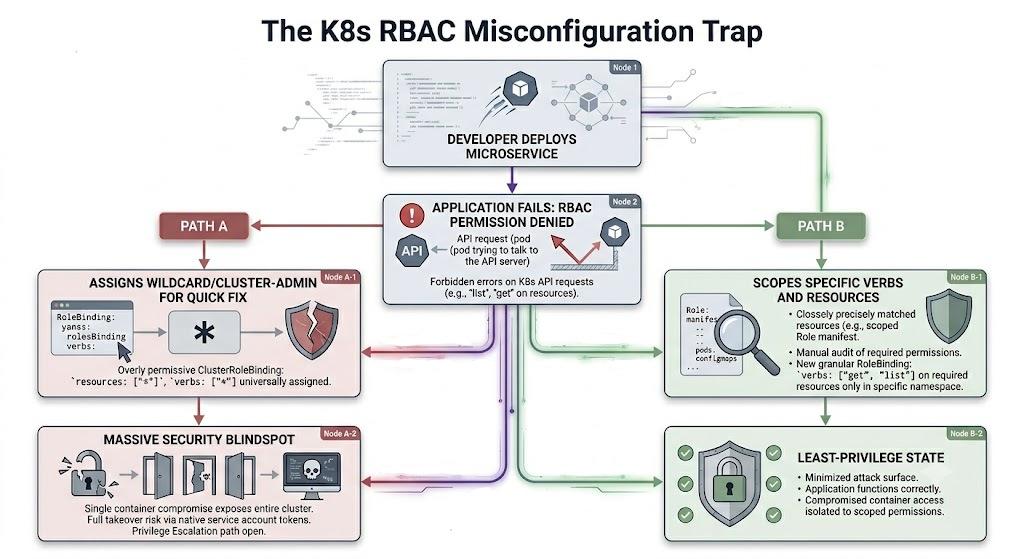
The core issue with Kubernetes security is that the RBAC framework is notoriously unforgiving. To get a simple monitoring tool or a CI/CD runner to operate correctly inside a cluster, developers must navigate a labyrinth of Roles, ClusterRoles, RoleBindings, and ClusterRoleBindings.
When a deployment fails at 2:00 AM because a pod cannot list resources in a specific namespace, the temptation to bypass the complexity is overwhelming. Developers focused on uptime and delivery, often default to assigning broad, cluster-wide administrative privileges just to make the application work. They use the wildcard operator (resources: ["*"], verbs: ["*"]), inadvertently granting a single pod the power to read secrets, delete deployments, or spawn new privileged containers across the entire environment.
This friction between security and velocity is exactly what modern threat actors rely on.
The Anatomy of a Breach: From Service Account to Full Cluster Takeover
To understand the gravity of K8s RBAC misconfigurations, we have to view the cluster from an attacker’s perspective. Threat actors no longer need zero-day exploits to breach your infrastructure; they just need your native configurations.
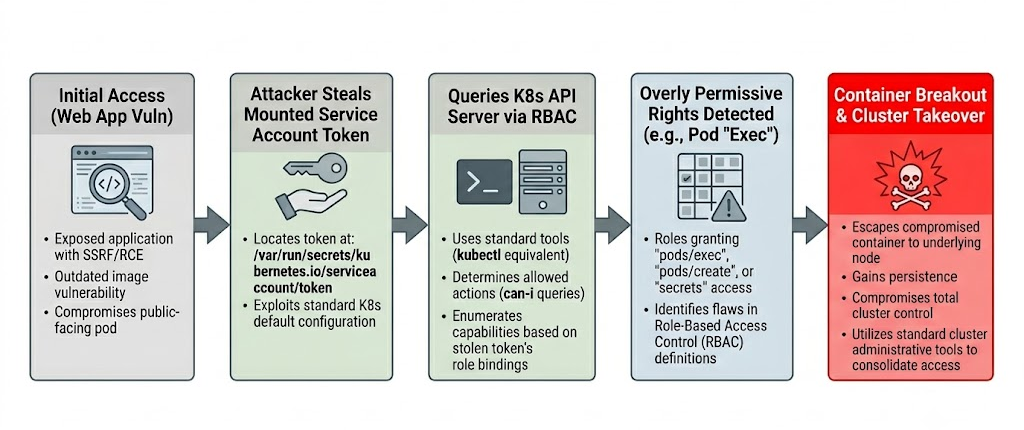
When a pod is spun up in Kubernetes, it is automatically mounted with a default Service Account token (located at /var/run/secrets/kubernetes.io/serviceaccount/token). If your developers haven't explicitly set automountServiceAccountToken: false, that token is sitting right there in the container, ready to be used.
The Privilege Escalation Vector
Here is exactly how the attack unfolds:
- Initial Access: An attacker finds a vulnerability in a public-facing web application, perhaps a basic Server-Side Request Forgery (SSRF) or a remote code execution (RCE) flaw in an outdated Node.js library.
- Token Harvesting: Once inside the container, the attacker reads the automatically mounted Service Account token.
- Reconnaissance: The attacker uses the token to query the Kubernetes API server. They ask the API server, "What can I do?" (using the kubectl auth can-i --list equivalent).
- Privilege Escalation: If that pod’s service account was granted overly permissive RBAC roles (such as the ability to create pods or exec into existing ones), the attacker weaponizes it. They can now deploy a new, highly privileged malicious container, often mounting the underlying node's filesystem to escape the container entirely.
What started as unrelated vulnerability in a peripheral marketing application has rapidly escalated into a total compromise of your container orchestration platform.
Blueprinting a Zero Trust Architecture in Kubernetes
Securing your clusters in 2026 requires shifting away from implicit trust and moving toward a strict zero trust model. You must assume that any container can and will be compromised. The goal is to limit the blast radius.
Here is the blueprint for fortifying your Kubernetes security posture:
1. Enforce True Least Privilege
Stop treating the cluster-admin role as a troubleshooting tool. Roles must be ruthlessly scoped. If a pod only needs to read configuration maps in the frontend namespace, its RoleBinding should explicitly permit get and list verbs solely on configmaps within that specific namespace. Furthermore, universally disable automountServiceAccountToken across all pod specifications unless a specific application explicitly requires API access.
2. Implement Automated Policy Enforcement
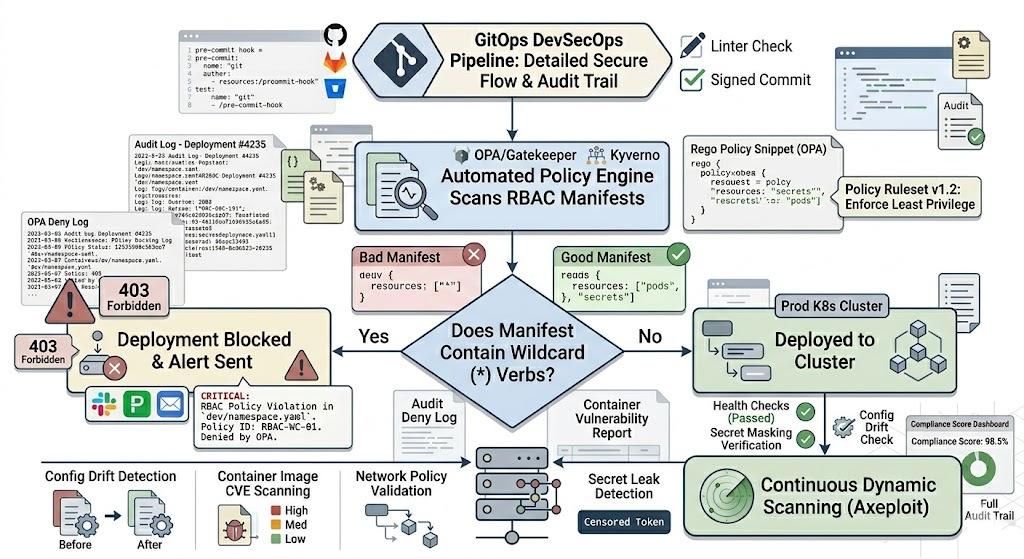
You cannot rely on humans to manually review thousands of lines of RBAC YAML during an active CI/CD pipeline. Deploy admission controllers and policy engines (like OPA Gatekeeper or Kyverno) to programmatically block deployments that violate security baselines. If a developer attempts to push a manifest containing wildcard permissions or a privileged container context, the pipeline should automatically reject it before it ever touches the cluster.
Beyond Static YAML: The Need for Active Defense
Locking down your RBAC configurations and deploying admission controllers are critical first steps, but static analysis has a fatal flaw: it only checks how things look on paper. In a live, constantly mutating Kubernetes environment, configurations drift, new APIs are exposed, and business logic flaws emerge that static scanners simply cannot see.
This is where passive defense ends and active testing begins.
Axeploit bridges the gap between infrastructure configuration and runtime reality. While your Platform Engineering teams ship code at maximum velocity, Axeploit’s dynamic automated vulnerability scanner actively attacks your live external perimeters, web applications, and APIs from the outside, mimicking the exact behavior of an advanced threat actor.
If an upstream Helm chart quietly opens an unauthenticated port, or a developer temporarily elevates an RBAC policy during a late-night debugging session and forgets to revert it, Axeploit’s dynamic engine will immediately discover the exposed exploit path. We don't just alert you; we provide actionable remediation insights to patch the vulnerability at the source before the hackers find it.
Conclusion: Defuse the RBAC Minefield, Maintain the Velocity
K8s RBAC will always be inherently complex, but it shouldn't be the reason your infrastructure falls to a catastrophic breach. The reality of modern CI/CD pipelines is that manual YAML audits are dead, they simply cannot keep pace with the speed of modern cloud-native development.
To survive in a landscape where attackers actively weaponize your native configurations, you must eliminate the friction between security and deployment. By locking down service accounts with a strict zero trust philosophy, deploying automated admission controllers, and continuously testing your live environments to catch configuration drift, you can permanently neutralize the threat of privilege escalation.