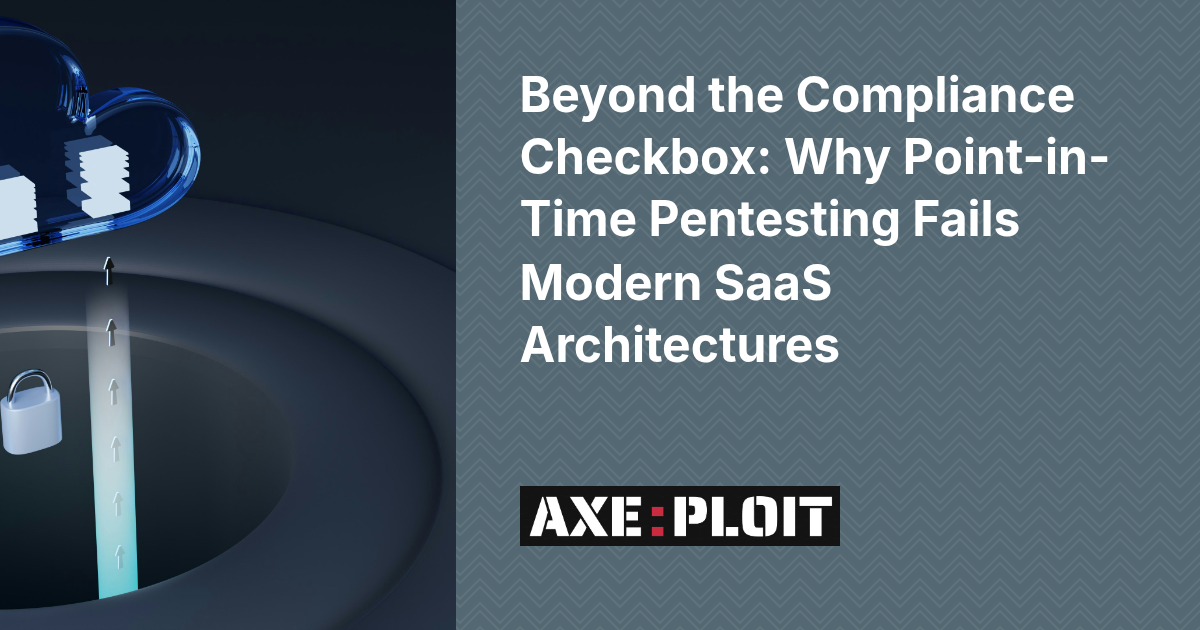
In the hyper-accelerated world of SaaS engineering in 2026, development teams are pushing code to production multiple times a day. Yet, when we examine how organizations measure their security posture, a glaring contradiction emerges. Standard frameworks often mandate only an annual penetration test to satisfy auditors. This creates a dangerous paradigm: you can check the box, pass your audit, and still leave your architecture completely exposed for 364 days of the year.
For modern CISOs, CTOs, and Compliance Officers, being compliant no longer equates to being secure. Threat actors operate continuously, adapting to your environment the moment new code is shipped. Defending a dynamic SaaS platform requires dynamic defenses. This article explores why legacy point-in-time assessments are failing modern organizations and how embracing AI-driven continuous penetration testing bridges the gap between regulatory checkboxes and true, audit-ready security.
The Point-in-Time Trap: Compliant but Compromised
The foundation of most enterprise security programs relies on established frameworks. However, a traditional SOC2 compliance pentest or the standard ISO 27001 requirements were designed for an era of waterfall development, not modern DevOps.
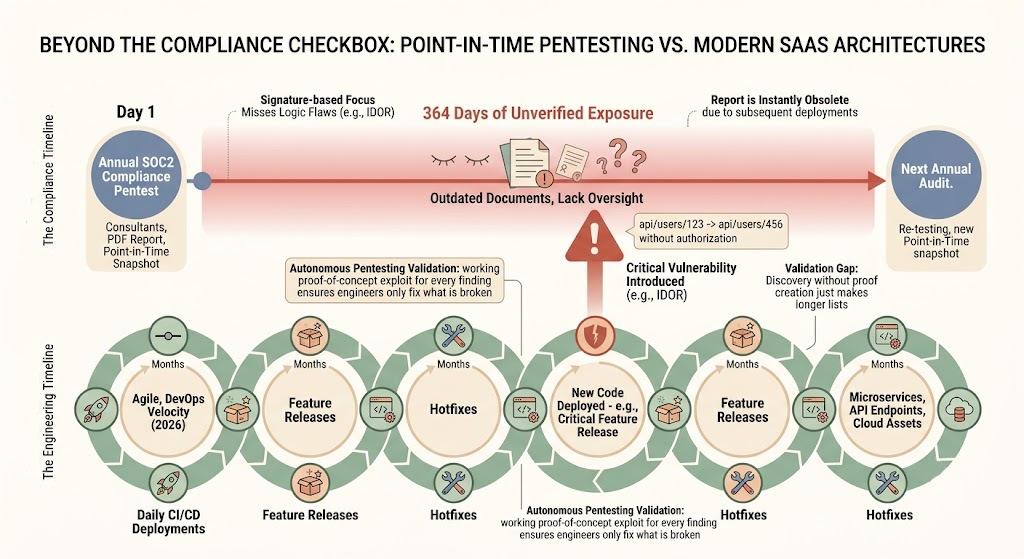
When a SaaS company hires a consulting firm for an annual manual pentest, they receive a point-in-time snapshot of their risk. The problem? The moment that PDF report is generated and the engineering team ships the next sprint, the environment has fundamentally changed. The report is instantly obsolete.
This mismatch creates a massive window of exposure. If an engineer accidentally deploys an Insecure Direct Object Reference (IDOR) vulnerability two weeks after the annual pentest concludes, that critical flaw will sit in production, entirely undetected, for the next 50 weeks until the next audit. Attackers do not wait for your scheduled security assessment; they hunt continuously. To achieve true agile security, organizations must abandon the illusion that an annual check provides year-round protection.
Vulnerability Scanning vs Pentesting: Understanding the Difference
When compliance officers realize the limitations of annual pentesting, they often attempt to fill the gap with automated scanners. This leads to a critical misunderstanding regarding vulnerability scanning vs pentesting.
The Limits of Legacy Scanners
Traditional vulnerability scanners operate by checking your systems against a database of known signatures (CVEs). If you are running an outdated version of a server library, the scanner will flag it. While useful for basic hygiene, scanners lack context. They cannot understand complex business logic, meaning they entirely miss the most devastating flaws in modern SaaS applications, such as complex authentication bypasses or multi-stage logic vulnerabilities.
The Power of Pentesting
A true penetration test involves active exploitation. A pentester (or an advanced AI agent) attempts to string together subtle application behaviors to achieve an objective, like modifying a JWT token to escalate privileges. Automated pentesting aims to bring the depth of manual exploitation to the speed and frequency of a daily scanner, uncovering the hidden flaws that signature-based tools blindly skip over.
CTEM: The New Standard for Agile Security
To rectify the failures of point-in-time testing, the cybersecurity industry in 2026 has widely adopted Continuous Threat Exposure Management or CTEM. CTEM is a structured, five-stage framework designed to transform risk management from a periodic audit into an ongoing, living process.
The 5 Stages of the CTEM Framework
- Scoping: Defining the critical elements of your infrastructure that matter most to business functioning, including external APIs and cloud assets.
- Discovery: Continuously gathering intelligence and enumerating the attack surface to uncover vulnerabilities and misconfigurations.
- Prioritization: Ranking threats based on actual business context, exploitability, and attack path analysis rather than just relying on generic CVSS scores.
- Validation: Proving whether a prioritized exposure is actually exploitable in your specific environment. This is where the validation gap lies, discovery without validation just creates a longer list of alerts.
- Mobilization: Driving cross-functional remediation by delivering verified findings with clear ownership and SLAs directly to engineering.
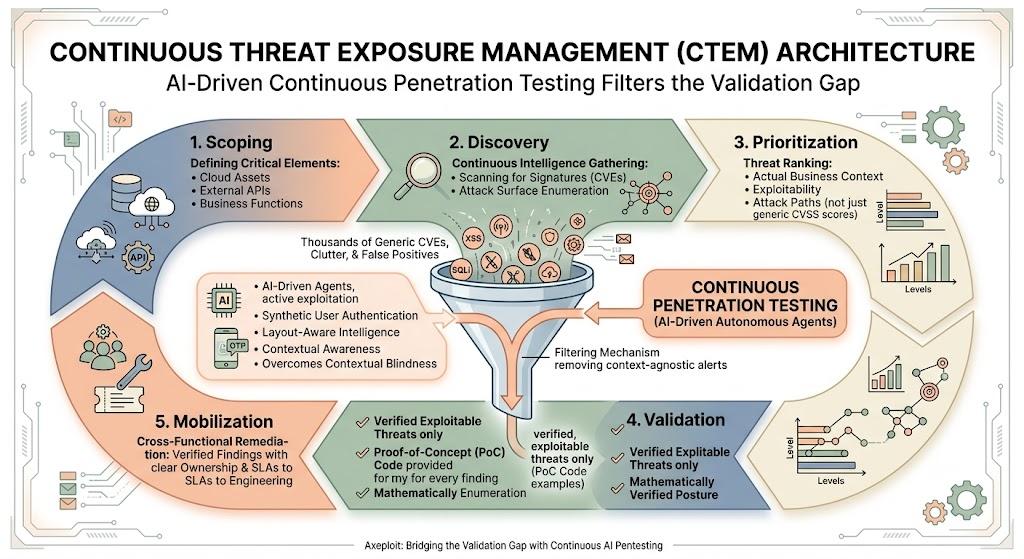
Within this framework, continuous penetration testing sits squarely in the Validation stage. Instead of merely guessing if a flaw is dangerous, continuous automated validation produces a working proof-of-concept exploit for every finding, ensuring your development teams only fix what is genuinely broken.
Axeploit: AI-Driven Continuous Penetration Testing
If the mandate of 2026 is to validate threats continuously, human teams simply cannot scale to test every single CI/CD deployment. This is where Axeploit fundamentally changes the paradigm for SaaS security. Axeploit replaces the constraints of legacy tools by deploying a fleet of autonomous AI agents designed to seamlessly execute automated pentesting.
Autonomous Navigation and Authentication
Traditional dynamic scanners break the moment a frontend UI changes or an API route is updated, requiring endless manual configuration. Axeploit leverages Layout-Aware Intelligence; it natively understands semantic UI changes and adapts in real-time without breaking the test flow. Furthermore, it acts as a synthetic user, independently provisioning its own mobile numbers and emails to register, receive OTPs, and bypass complex login flows automatically.
Comprehensive Vulnerability Coverage
While legacy tools look for basic CVEs, Axeploit’s intelligence engine actively hunts for over 7,500 vulnerability types. It executes tailored payloads to uncover:
- Insecure Direct Object References (IDOR)
- Server-Side Request Forgery (SSRF)
- Blind SQL Injection and Remote Code Execution (RCE)
- Advanced Business Logic Flaws
The “No Exploit, No Report” Model
To prevent alert fatigue, Axeploit ensures that it generates reproducible proof-of-concept (PoC) code for each vulnerability found. AI-powered analysis reduces false positives by 90% compared to traditional scanners. If the AI cannot actively exploit the vulnerability, it does not burden your engineers with the alert.
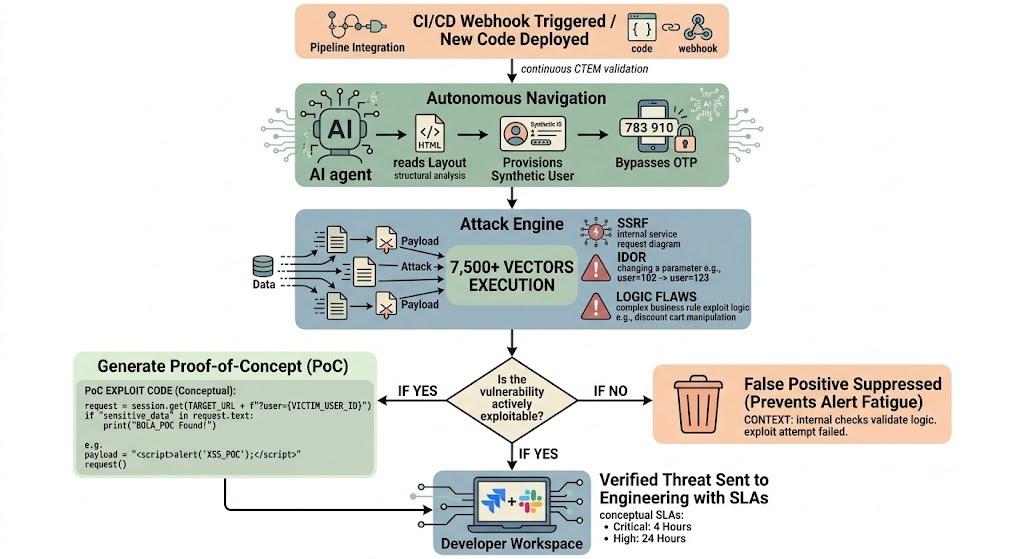
By integrating this continuous validation loop directly into your DevOps pipeline via API webhooks, Axeploit ensures that you are not just checking a box for an annual audit, but maintaining a mathematically verified, audit-ready security posture 24/7.
Conclusion
In 2026, the distinction between checking a compliance box and actively securing your SaaS platform has never been starker. Relying on an annual SOC2 compliance pentest to protect a daily-shipping CI/CD pipeline is fundamentally flawed, leaving your enterprise blind for 364 days a year. To protect modern architectures, security must operate at the speed of development.
By transitioning to a CTEM framework and adopting continuous penetration testing, Compliance Officers, CISOs, and CTOs can finally align their defense strategies with their engineering velocity. Axeploit’s autonomous AI agents transform security from a disruptive, point-in-time audit into an invisible, continuous shield that verifies exploits and eliminates false positives. It is time to move beyond the compliance checkbox.