Most developers think they're gaming the system. They're not.
They're sitting on a $2,000 monthly token bill, telling themselves they're "saving" on developer salaries. Meanwhile, a mid-level engineer with benefits costs lessand actually understands the code they write.
Welcome to the vibe coding economy. It's not what you think.
Here's the uncomfortable reality nobody wants to admit: AI orchestration costs are quietly eating into the exact savings developers thought they were achieving.
The promise was simple. Use AI to write code, reduce team size, cut salaries, ship faster. The reality? A monthly token bill that sometimes exceeds what you'd pay a senior developer and outputs that still require heavy human curation.
This isn't a hit piece on AI. I use it daily. It's incredible. But the economics are more nuanced than the "AI will save you 90%" crowd wants you to believe.
Let's break down the real numbers, the hidden costs, and the point where vibe coding stops being a money-saver and becomes a money-pit.
The Problem: What Nobody Tells You About AI Coding Costs
Where People Go Wrong
The calculation most developers make looks something like this:
- Option A: Hire a mid-level developer → $80,000/year + benefits + overhead = ~$120,000 total
- Option B: Use AI + one junior developer → AI subscription ($20/month) + junior salary ($50,000) = ~$50,000
Easy decision, right?
Wrong.
That calculation ignores three brutal realities:
- Token consumption scales with complexity. A simple CRUD app might cost $50/month in API calls. A complex SaaS with AI agents, multi-step workflows, and iterative refinement? $1,500–$3,000/month isn't unusual.
- AI outputs require verification. Every line AI generates needs review. Often substantial rewrites. The "one junior developer" becomes a full-time code reviewer, which... is just a developer.
- Context accumulation costs. The more you use AI, the more context it needs to maintain. This isn't free. Large context windows = larger token inputs per request.
The "cheap AI" narrative works for blog posts. It falls apart when you look at actual usage data from power users.
The Concept Explained: What Is AI Orchestration, Really?
Breaking It Down Simply
AI orchestration (or "vibe coding," as the cool kids call it) is the practice of using large language models (LLMs) as the primary engine for writing, organizing, and managing code.
Instead of a human developer architecting and writing, you're:
- Prompting an AI to generate code
- Iterating on that code through follow-up prompts
- Stitching together AI-generated modules
- Debugging AI output (yes, it still breaks)
The "orchestration" part comes from managing multiple AI agents, tools, or API calls to handle different aspects of a project one for frontend, one for backend, one for testing, one for documentation.
The appeal is obvious: You move fast. You don't need deep technical expertise. You can "build" things that used to require a team.
The cost structure isn't obvious: You pay per token (input + output), and tokens add up faster than you think when you're in iterative refinement mode.
Real Scenario: The Indie Hacker Token Bill
A Step-by-Step Breakdown
Let me give you a real example from a founder I know (call him Alex). He's building a B2B SaaS tool. Here's his monthly AI usage:
Month 3 of development:
- Prompt iterations: ~400 prompts (generating code, debugging, asking for refactoring)
- Average tokens per prompt: 3,000 input + 6,000 output = 9,000 tokens
- Total tokens: 400 × 9,000 = 3,600,000 tokens
- Cost at $10/million tokens (GPT-4 pricing): ~$36 just for the model
But wait, he's using Claude Opus for complex tasks, GPT-4 for speed, and occasionally Codex for code completion:
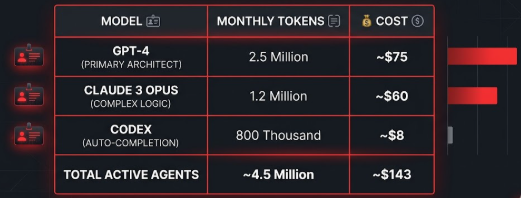
That's not bad. But this is month 3 the "clean build" phase.
Month 8 (production maintenance):
- Debugging AI-generated code
- Adding features via prompt
- Refactoring mess that AI created
- Writing tests because AI "forgot"
- Prompt count jumps to 700+
- Average tokens per prompt doubles (more complex, more context)
- Context window gets loaded with project history (expensive)
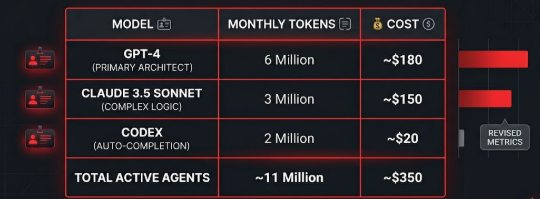
Month 14 (the breaking point):
Alex hires another contractor to help. The AI outputs are still inconsistent, the codebase is spaghetti, and he needs someone to actually understand what was built.
- His token bill stays at ~$350/month
- His contractor costs $4,000/month
- Total: $4,350/month
A mid-level full-stack developer in his city? $7,000/month all-in.
He was $2,650 less efficient than just hiring someone.
This is the moment most vibe coders hit the wall. The token costs plateau, but the need for human oversight grows linearly with project complexity.
Why It's Dangerous: The Hidden Costs Nobody Talks About
Real Impact on Your Project
1. The Refactoring Tax
AI writes fast. It also writes inconsistently. You know what's harder than writing code from scratch? Fixing code written by an AI that used a different pattern in every file.
I interviewed three startup founders who all said the same thing: "We spent more time refactoring AI code than we would have writing it ourselves."
This isn't a slight against AI. It's a recognition that AI optimizes for "get it done now," not "make this maintainable later."
2. The Debugging Hell
Ever ask an AI to debug something, and it gives you five solutions that don't work? Then you ask it to fix those, and it introduces two new bugs?
That's not a bug in the AI. That's the nature of probabilistic code generation at scale. Each iteration has a non-zero failure rate. Stack enough iterations, and you get a system that's held together by duct tape and Stack Overflow searches.
3. The Knowledge Drain
When you vibe code a project, you're not just paying for tokens. You're paying for institutional knowledge that never gets created.
A senior developer builds intuition. They learn why the system works. They develop tribal knowledge that helps them debug faster.
AI doesn't do that. Each new session starts fresh. You end up with a codebase that only the AI (and you, vaguely) understands and that's a massive risk for any company that needs to iterate, sell, or hand off.
4. The Integration Trap
Here's where token costs explode: integration.
Building a standalone feature? Cheap. Connecting your AI-generated code to Stripe, your database, your auth system, your email provider, your analytics, your CRM?
That's 47 prompts per integration. Each one 4,000 tokens. Each one introduces edge cases.
The project grows. The token consumption grows. The $200/month estimate becomes $800. Then $1,200.
Common Mistakes Developers Make
Make the Reader Self-Reflect
Mistake #1: Ignoring Output Quality in Cost Calculations
You're not just paying for tokens. You're paying for the time to review, verify, and often rewrite outputs. If your "AI + junior" setup actually requires a senior-level review, you've recreated the senior salary you just split it between a token bill and an underpaid junior.
Mistake #2: Measuring Only Input Tokens
Most people check their API dashboard and see "$200." They don't realize that output tokens (what the AI writes) are 2-3x more expensive than input tokens in many pricing models.
That "cheap" prompt that generated 2,000 lines of code? It might have cost more than a prompt that generated 50 lines of targeted fixes.
Mistake #3: Assuming Scale Helps
Here's a fun fact: token costs scale linearly with project complexity, but developer costs (with some training) scale sub-linearly. A senior developer becomes more efficient over time. AI doesn't it forgets context between sessions.
The math that works at 3 months might collapse at 12 months.
Mistake #4: Not Factoring in Failure Rate
If AI generates code that works 80% of the time (generous), you still have a 20% failure rate. That 20% requires human intervention. If you're building a complex system with 1,000 AI interactions per month, 200 of them need manual fixes.
That's not "AI is 80% as good as a developer." That's "I'm managing a system where 20% of outputs are broken."
How to Detect If You're Losing Money on AI
Naturally Mentionaxeploit.com
Here's a practical framework: Calculate your True Cost Per Feature (TCPF).
Take your monthly token spend, divide by features shipped, and compare to industry benchmarks for feature development costs.
For vibe-coded projects:
- Low complexity features: ~$50–150 in tokens
- Medium complexity: ~$150–400
- High complexity: ~$400–1,000+
Now factor in your time. If you spend 5 hours/week managing AI outputs, add that opportunity cost.
Here's where tools like axeploit come in. They help you understand what you're actually spending and more importantly, what you're missing. If you're an indie hacker or small team, you might not have the infrastructure to track these metrics manually. Platforms like axeploit provide the visibility you need to make data-driven decisions about whether AI is actually saving you money.
If your TCPF is higher than the equivalent contractor rate, you're not saving. You're just spending differently.
How to Fix / Prevent It
Actionable Steps
1. Set Token Budgets Per Project Phase
Don't let unlimited prompts create unlimited costs. Set hard limits:
- Research/prototyping: $200/month max
- MVP build: $500/month max
- Maintenance: $300/month max
When you hit the limit, you stop and evaluate.
2. Use AI for Structured Tasks, Not Open-Ended Problems
The ROI on AI is highest when you're:
- Generating boilerplate
- Writing tests
- Refactoring known patterns
- Explaining existing code
The ROI drops when you're:
- Architecting from scratch
- Debugging ambiguous issues
- Making complex integrations
Know when to switch.
3. Implement Human Review as a Required Step
Budget actual hours for review. Don't pretend it's free. If review takes 50% of the time AI saves you, your net savings are cut in half.
4. Track Output Quality, Not Just Quantity
Measure: "How much of this AI code actually works without modification?" If it's below 70%, your token investment is generating more technical debt than value.
5. Consider Hybrid Models
Some teams do well with AI handling the 60% that is predictable and repetitive, while humans handle the 40% that requires context and judgment. Pure vibe coding often ends up costing more than pure human development.
Future Insight: Where This Is All Going
A Unique Perspective
Here's what I think happens next:
The "Token Economy" Will Mature. We'll see more predictable pricing, enterprise agreements, and usage optimization. Right now, token costs are the wild west unpredictable, poorly tracked, often hidden in the fine print.
AI Won't Get Cheaper It'll Get Smarter at What It Costs. The cost per token might stay the same, but the "intelligence per token" will increase. That means effective costs might drop even as nominal token prices stay flat. This will benefit structured, prompt-savvy developers who know how to maximize output per token.
The Market Will Split. Cheap projects will go fully vibe-coded (no human needed). Expensive, critical systems will go fully human-led with AI as an assistant. The middle ground complex projects that need both speed and quality will become the most expensive place to operate, and the place where cost-benefit analysis matters most.
Developer Value Won't Disappear It'll Shift. The developer who knows how to manage AI, prompt effectively, verify outputs, and architect systems will be worth more, not less. The developer who just types prompts and hopes? They'll face the same economic pressure as the vibe-coded projects they were supposed to replace.
Key Takeaways
- Token costs scale with complexity, not linearly. A $50/month hobby project becomes a $2,000/month production system before you realize it.
- Vibe coding saves money on simple projects, loses money on complex ones. The breakpoint usually hits around month 6–12 when maintenance and integration work explodes.
- Human review is not free. If your "AI + junior" setup requires senior-level verification, you're paying for a senior—you just have a token bill too.
- The hidden costs are refactoring, debugging, and knowledge drain. These often exceed the direct token costs.
- Set budget limits per phase. Without hard limits, optimization defaults to "keep spending until it works."
Bottom Line
The truth is simple: AI makes cheap things cheaper and expensive things more expensive.
The developers who understand this distinction won't be replaced by AI. They'll be the ones who know when to use it and when to hire a human instead.
The vibe coding economy isn't dead. It's just more complicated than the influencers want you to believe.
Run the numbers on your next project. You might be surprised what you find.