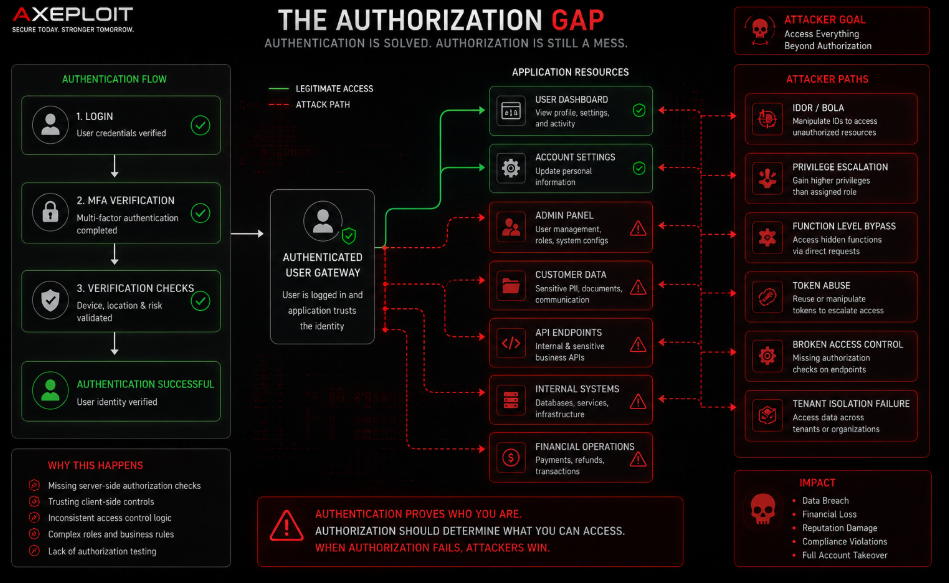
Authentication has become one of the most mature areas of application security.
Most organizations have invested heavily in secure login systems, multi-factor authentication, password policies, identity providers, and single sign-on solutions. Logging in securely is no longer the challenge it once was.
Authorization, however, tells a very different story.
Security assessments, penetration tests, and bug bounty programs consistently reveal one uncomfortable truth: many applications do a good job verifying who a user is but struggle to determine what that user should actually be allowed to do.
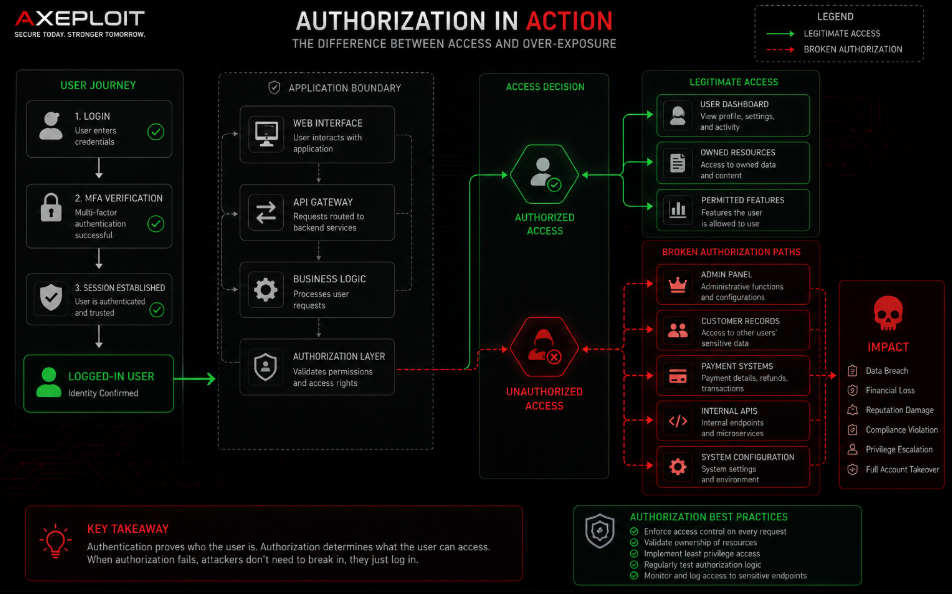
This gap between authentication and authorization has become one of the most common sources of critical vulnerabilities in modern applications.
Authentication vs Authorization
Although the terms are often used together, they solve entirely different problems.
Authentication answers:
Who are you?
Authorization answers:
What are you allowed to access?
Authentication confirms identity through mechanisms such as:
- Username and password
- Multi-Factor Authentication (MFA)
- Single Sign-On (SSO)
- OAuth providers
- Biometric verification
Authorization determines access to:
- User accounts
- Sensitive records
- Administrative functions
- APIs
- Financial operations
- Internal business resources
The reality is simple.
A perfectly authenticated user can still become a dangerous threat if authorization controls fail.
Why Authorization Continues to Fail
Unlike authentication, authorization is deeply connected to business logic.
Every application has unique access requirements.
A banking application handles permissions differently from a healthcare platform. A SaaS product handles access differently from an e-commerce marketplace.
As applications grow, authorization rules become increasingly complex:
- Different user roles
- Tenant isolation
- Resource ownership
- Department-based permissions
- Temporary privileges
- Third-party integrations
Over time, these rules become difficult to manage consistently.
That complexity creates opportunities for attackers.
The Most Common Authorization Vulnerabilities
Insecure Direct Object References (IDOR)
IDOR remains one of the most frequently discovered authorization flaws.
Consider a request:
/api/orders/1001
An attacker changes it to:
/api/orders/1002
If the application fails to verify ownership of the resource, unauthorized access becomes possible.
The user is authenticated.
The authorization check is what failed.
Broken Object Level Authorization (BOLA)
Modern APIs often expose individual resources through endpoints.
Attackers manipulate identifiers to access:
- Other user profiles
- Customer information
- Internal records
- Financial data
This issue consistently ranks among the most severe API security risks because of its direct impact on sensitive data.
Privilege Escalation
Applications frequently implement role-based permissions such as:
- User
- Manager
- Moderator
- Administrator
Improper authorization validation can allow users to perform actions beyond their assigned role.
Examples include:
- Accessing admin dashboards
- Viewing confidential information
- Managing other users
- Executing privileged operations
Missing Function-Level Authorization
Some applications hide administrative functionality from standard users through the user interface.
Attackers simply bypass the interface and access backend endpoints directly.
If server-side authorization checks are missing, hidden functionality becomes accessible.
Multi-Tenant Access Failures
SaaS platforms rely heavily on tenant isolation.
A single authorization mistake can allow one customer to access another customer's:
- Data
- Reports
- Documents
- User accounts
- Internal configurations
These vulnerabilities often result in severe data exposure incidents.
Why Authentication Gets More Attention
Authentication is visible.
Users interact with login screens daily.
Organizations invest heavily in:
- MFA deployments
- Password policies
- Identity management platforms
- Single Sign-On integrations
Authorization operates behind the scenes.
When implemented correctly, users rarely notice it.
As a result, authorization receives less scrutiny despite protecting the most sensitive parts of the application.
The API Revolution Has Made Authorization Harder
Modern applications increasingly rely on APIs.
Mobile applications, microservices, and cloud-native architectures expose hundreds of endpoints that require consistent authorization enforcement.
The challenge is no longer protecting a handful of web pages.
Organizations must secure:
- REST APIs
- GraphQL endpoints
- Microservices
- Internal APIs
- Third-party integrations
A single missing authorization check can expose critical functionality.
Attackers understand this and frequently target APIs directly rather than interacting through application interfaces.
Why Automated Security Tools Miss Authorization Flaws
Most security scanners excel at finding technical vulnerabilities.
Authorization issues often involve business context.
For example:
- Should User A access User B's invoice?
- Should a manager access another department's records?
- Should a customer view another organization's data?
These questions require understanding application logic.
Automated scanners cannot easily determine intended access controls.
This is why authorization vulnerabilities are frequently discovered during:
- Manual penetration testing
- Security reviews
- Bug bounty programs
- Business logic assessments
What Security Researchers Consistently Find
Across modern web applications, APIs, and SaaS platforms, authorization flaws remain one of the most common sources of critical findings.
Researchers regularly uncover:
- IDOR vulnerabilities
- Broken Object Level Authorization
- Privilege escalation paths
- Tenant isolation failures
- Missing server-side authorization checks
- API access control weaknesses
The pattern is remarkably consistent.
Authentication systems are often implemented correctly.
Authorization logic is where applications break down.
Building Strong Authorization Controls
Organizations can significantly reduce risk by:
- Enforcing authorization checks on every request
- Validating resource ownership server-side
- Applying least-privilege access principles
- Regularly reviewing role definitions
- Testing tenant isolation boundaries
- Conducting business logic security assessments
- Monitoring unusual access patterns
- Performing authorization-focused penetration testing
Authorization should never depend solely on client-side controls or hidden user interface elements.
Every access decision must be verified by the server.
Conclusion
Authentication answers the question of identity.
Authorization determines trust.
While the security industry has made tremendous progress in securing authentication workflows, authorization remains one of the most misunderstood and frequently exploited areas of application security.
Many of today's most impactful breaches do not begin with bypassing login systems.
They begin after successful authentication, when applications fail to properly enforce what users are allowed to access.
Organizations that focus only on verifying identities while neglecting authorization create a dangerous security gap.
Attackers know this.
That is why authorization remains one of the most valuable attack surfaces in modern applications.