If you are a developer, a Security Operations Center (SOC) analyst, or a Cloud Security Engineer operating in 2026, you already know that artificial intelligence is revolutionizing how we build and deploy applications. We use Large Language Models (LLMs) to write code, analyze data, and automate our DevSecOps pipelines. But the very technology that is accelerating our workflows has now been fully weaponized by advanced threat actors.
For years, when hackers breached a network, they relied on manual exploration or pre-written scripts to navigate the compromised environment. They would execute standard bash commands, hunt for files, and attempt to escalate privileges. Today, that manual process is dangerously obsolete. In a terrifying new attack chain, cybercriminals recently exploited a critical Remote Code Execution (RCE) vulnerability in Marimo (tracked as CVE-2026-39987), a popular open-source Python notebook, to deploy an autonomous LLM agent directly onto a victim's server.
Instead of a human hacker sitting at a keyboard, this deployed AI agent autonomously explored the system, identified sensitive directories, and successfully harvested highly privileged AWS credentials from the compromised environment. This is not a theoretical sandbox exercise; it is a live, machine-speed intrusion. Here is a human-readable, technical breakdown of exactly how attackers exploited the Marimo vulnerability to gain shell access, how the LLM agent maneuvered through the environment, and the step-by-step actions you must take to secure your cloud infrastructure today.
The Entry Point: Exploiting the Marimo Vulnerability (CVE-2026-39987)
To understand the attack, we first have to look at the entry point. Marimo is a reactive Python notebook built for data scientists and AI researchers. It allows developers to execute code in an interactive, web-based environment. Because these notebooks are often connected to high-performance cloud clusters and massive datasets, they are prime targets for cybercriminals.
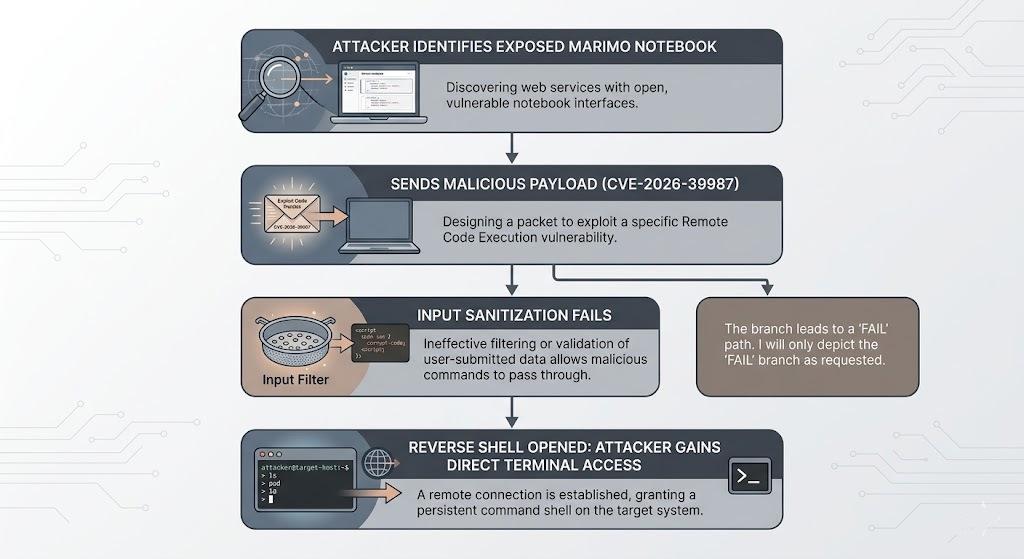
The vulnerability, CVE-2026-39987, is a critical Remote Code Execution (RCE) flaw. In simple terms, an RCE allows an attacker to send a specially crafted, malicious input to a vulnerable application, tricking the server into executing the attacker's own commands. In the case of Marimo, a failure to properly sanitize user inputs within the notebook's execution environment allowed attackers to bypass the standard application logic.
By sending a malicious payload through the exposed web interface, the hackers successfully tricked the Marimo backend into opening a reverse shell. A reverse shell is essentially a direct, unauthorized command-line connection back to the attacker's server. In an instant, the attacker bypassed the network perimeter and gained direct terminal access (shell access) to the host machine.
The AI Pivot: Deploying an Autonomous Hacker
Gaining shell access is only the first step. Usually, an attacker would now spend hours manually running commands like ls, cat, and grep to figure out where they are and what they can steal. However, interacting manually with a compromised server is noisy and slow, significantly increasing the chances of the SOC team detecting the intrusion via endpoint detection systems.
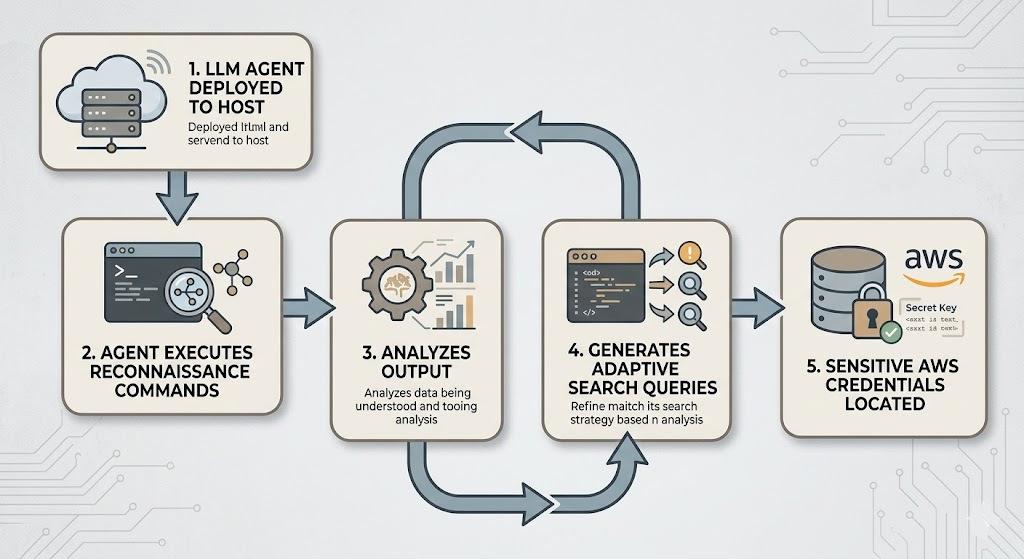
This is where the attack takes a massive evolutionary leap. Instead of manual reconnaissance, the hackers uploaded a lightweight Python script containing an autonomous LLM agent. They essentially dropped a digital hacker onto the server.
This AI agent was programmed with a single, overarching objective: “Map the host environment and find cloud credentials.” Because it was powered by a language model, the agent didn't need pre-programmed, rigid paths. It could think and adapt in real time.
How the Agent Navigated the System
- Contextual Reconnaissance: The LLM agent immediately began reading the system's architecture, analyzing the bash history, and enumerating user directories to understand the layout of the server.
- Adaptive Hunting: When it encountered unfamiliar file structures or permission denied errors, it didn't crash. It dynamically generated new bash scripts to search deeper into hidden directories.
- Pattern Recognition: The agent was specifically trained to recognize the patterns of sensitive files, hunting for .env files, .aws/credentials folders, and exposed API access tokens left behind by developers.
Harvesting AWS Credentials and Data Exfiltration
The autonomous agent quickly hit the jackpot. It located a hidden .aws directory containing plaintext IAM (Identity and Access Management) access keys and secret keys. These are the master keys to the cloud kingdom.
But the AI didn't stop there. It read the configuration files, identified the specific AWS regions in use, and bundled the credentials into a compressed package. To evade the enterprise's Data Loss Prevention (DLP) systems and outbound firewalls, the agent utilized living-off-the-land techniques. It disguised the outbound traffic as a standard DNS query or routed it through a trusted Content Delivery Network (CDN), effectively bypassing the Web Application Firewall (WAF).
With the AWS credentials successfully harvested, the hackers could now pivot from the compromised Marimo server directly into the company's broader cloud environment, gaining the ability to spin up rogue servers, steal proprietary databases, or deploy ransomware.
Step-by-Step Guide: How to Stay Safe from Autonomous AI Hackers
The terrifying reality of this breach is its speed. An autonomous LLM agent can map an environment and steal credentials in seconds long before a human SOC analyst can respond to a dashboard alert. To survive in 2026, you must lock down your infrastructure against machine-speed attacks. Here is your step-by-step guide to defending your cloud environment:
Step 1: Patch and Isolate Data Science Environments
Data science tools like Marimo, Jupyter, and standard Python notebooks are inherently dangerous because they are specifically designed to execute code.
- Action: Immediately audit your environment and patch Marimo to the latest version to mitigate CVE-2026-39987. Never expose these notebooks directly to the public internet. Ensure they are placed behind strict VPNs and require Multi-Factor Authentication (MFA) to access.
Step 2: Eliminate Hardcoded Cloud Credentials
The LLM agent succeeded because a developer left long-term AWS keys sitting in plaintext on the server.
- Action: Enforce the principle of least privilege. Do not use static IAM access keys. Instead, use short-lived, dynamically generated AWS Security Token Service (STS) credentials, or assign strict IAM execution roles directly to the underlying virtual machine or container. If an AI agent breaches the box, there should simply be no keys for it to find.
Step 3: Implement Zero Trust and Microsegmentation
You must design your architecture assuming the perimeter will eventually be breached.
- Action: Implement a strict Zero Trust architecture. If your Marimo notebook server is compromised, it should not have unrestricted outbound internet access, nor should it be able to freely communicate with your production databases. Use network microsegmentation to trap the attacker in an isolated, highly restricted network bubble.
Step 4: Deploy Behavioral Monitoring and Dynamic Scanning
Traditional antivirus software struggles to detect an LLM agent because the agent's actions (running standard bash commands) look like normal administrative behavior.
- Action: Upgrade your endpoint detection to monitor for behavioral anomalies, such as a sudden, rapid spike in directory enumeration. Furthermore, continuously test your own perimeter. Use dynamic vulnerability scanners to safely attack your live environment, identifying RCE flaws and exposed APIs before the hackers do.
Conclusion: Fighting AI with Active Defense
The exploitation of the Marimo CVE-2026-39987 vulnerability marks a dark, permanent milestone in cybersecurity. The transition from manual, human-driven attacks to the deployment of autonomous LLM agents means that cybercriminals are now operating at a velocity that humans simply cannot match. If your cloud security relies entirely on passive firewalls, static credentials, and reactive patching, you are bringing a knife to a gunfight.
For developers, cloud security engineers, and SOC analysts, the mandate is clear: you must build your applications assuming the perimeter is already compromised. By eliminating static credentials, enforcing strict network boundaries, and adopting proactive, automated security testing, you can neutralize the threat of autonomous intrusions.