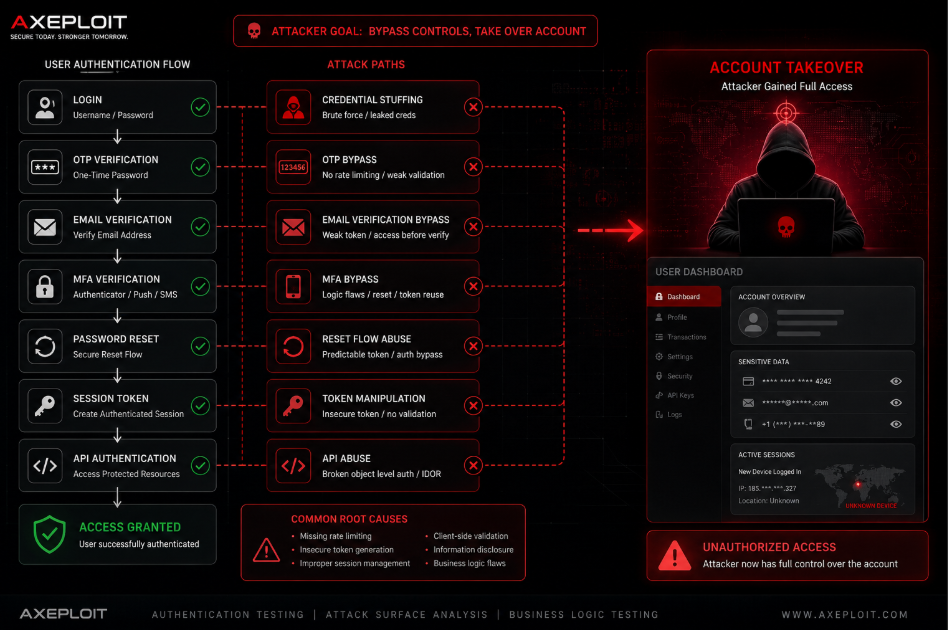
Most security discussions focus on vulnerabilities that immediately capture attention, such as SQL injection, remote code execution, and privilege escalation. While these issues deserve attention, some of the most damaging security flaws often emerge from an area organizations assume is already secure: authentication workflows.
Modern applications rely on complex identity verification systems involving OTPs, password reset mechanisms, email verification processes, session tokens, magic links, and multi-factor authentication. While each component may appear secure individually, weaknesses in their implementation frequently create attack paths that lead directly to account takeover.
What makes these vulnerabilities particularly dangerous is that they often stem from business logic flaws rather than traditional coding errors, making them difficult for automated scanners to detect and easy for security teams to overlook.
The Growing Authentication Attack Surface
Authentication is no longer limited to a username and password.
Modern applications commonly include:
- One-Time Passwords (OTPs)
- Email Verification
- Password Reset Flows
- Multi-Factor Authentication (MFA)
- Session Management
- Magic Links
- OAuth Integrations
- Device Verification
- API-Based Authentication
Every additional verification step introduces new logic that developers must implement correctly. While individual components may appear secure, attackers often focus on the trust relationships connecting these systems together.
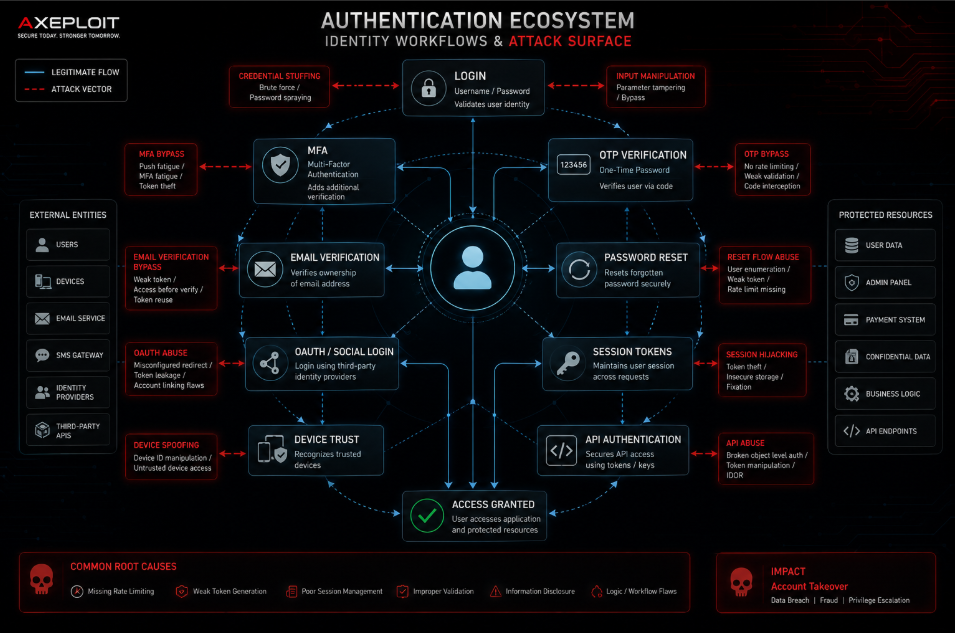
OTP Bypass: A Small Weakness with Critical Impact
One-Time Passwords are widely used during registration, login, password recovery, and transaction approval processes. Despite their popularity, OTP implementations often contain weaknesses that attackers can exploit.
Common OTP Weaknesses
Lack of Rate Limiting
If applications allow unlimited OTP attempts, attackers can brute-force short codes until they discover the correct value. A six-digit OTP may seem secure, but without rate limiting, its effectiveness drops significantly.
Client-Side Validation
Some applications mistakenly validate OTPs on the client side instead of enforcing verification on the server. Attackers can manipulate requests, intercept API calls, or alter application behavior to bypass verification entirely.
OTP Reuse
An OTP intended for one-time use should become invalid immediately after successful verification. Poor implementations sometimes allow reuse, creating opportunities for unauthorized access.
Predictable OTP Generation
Weak random number generation can make OTPs easier to predict, reducing their effectiveness as a security control.
Why OTP Bypasses Matter
Successful OTP bypasses can allow attackers to:
- Take over user accounts
- Bypass MFA protections
- Access sensitive information
- Perform unauthorized actions
- Escalate privileges within applications
In many assessments, OTP systems fail not because code generation is broken, but because surrounding security controls are missing or improperly enforced.
Weak Tokens: The Silent Account Takeover Vector
Tokens are used extensively across authentication workflows. Password reset links, session identifiers, email verification links, and API authentication mechanisms all depend on secure token generation and validation.
Characteristics of Secure Tokens
Secure tokens should be:
- Random
- Unique
- Difficult to predict
- Time-limited
- Bound to specific actions
- Invalidated after use
Common Token Vulnerabilities
Predictable Token Generation
If tokens are generated using timestamps, user identifiers, or predictable sequences, attackers may be able to guess valid tokens and gain unauthorized access.
Long-Lived Tokens
Tokens that remain valid for extended periods increase the risk associated with token leakage or theft.
Missing Token Validation
Some applications verify only the existence of a token without validating ownership, expiration status, or intended purpose.
Information Disclosure
Tokens exposed through URLs, logs, browser history, or third-party analytics tools can be harvested and abused.
Why Weak Tokens Are Dangerous
A compromised token often grants direct access to authenticated functionality without requiring passwords or MFA verification. For attackers, obtaining a valid token can be more valuable than obtaining user credentials.
Email Verification Is a Security Control, Not a User Experience Feature
Many organizations treat email verification as a simple onboarding step. In reality, email ownership often serves as the foundation of account recovery, password resets, notifications, and identity validation.
Common Email Verification Weaknesses
Access Before Verification
Some applications allow users to access sensitive functionality before confirming ownership of an email address. Attackers can exploit this behavior to create fraudulent accounts or abuse platform features.
Email Changes Without Verification
Applications sometimes allow users to change email addresses without verifying ownership of the new address. If an attacker gains access to an account, they can redirect future communications and password reset requests.
Reusable Verification Links
Verification links intended for one-time use may remain valid indefinitely, creating unnecessary attack opportunities.
Weak Verification Tokens
Just like password reset workflows, email verification systems depend heavily on secure token generation and validation.
Why Automated Security Tools Miss These Vulnerabilities
Traditional security scanners excel at identifying known technical vulnerabilities. Authentication flaws are different because they often involve workflow manipulation and business logic abuse.
The Business Logic Challenge
Security researchers frequently uncover authentication vulnerabilities by asking questions such as:
- Can a verification step be skipped?
- Can requests be replayed?
- Can parameters be manipulated?
- Can application states be altered?
- Does the backend truly enforce validation?
These questions require human reasoning and workflow analysis rather than automated scanning alone.
Authentication APIs: The New Attack Surface
Modern applications increasingly rely on APIs to manage authentication processes. Mobile applications, single-page applications, and microservice architectures expose numerous endpoints responsible for login requests, OTP validation, password resets, session management, and token generation.
Attackers frequently interact directly with APIs rather than application interfaces, allowing them to bypass client-side restrictions and test authentication logic at scale.
For security teams, reviewing only the user interface is no longer sufficient. Authentication APIs require the same level of scrutiny as any other critical attack surface.
What Security Researchers Consistently Find
Authentication vulnerabilities continue to appear in penetration tests, bug bounty programs, and responsible disclosure reports across organizations of all sizes.
The most severe findings rarely involve broken cryptography. Instead, they often stem from:
- OTP verification bypasses
- Weak password reset implementations
- Predictable token generation
- Email verification logic flaws
- Session management weaknesses
- Missing server-side validation
The common theme is simple: modern authentication systems fail more often because of implementation mistakes than cryptographic failures.
Best Practices for Preventing Authentication Flaws
Organizations can significantly reduce risk by:
- Implementing strong rate limiting for authentication-related actions
- Enforcing all critical validation on the server side
- Using cryptographically secure token generation methods
- Applying appropriate token expiration policies
- Conducting manual business logic testing
- Monitoring authentication-related events and anomalies
- Performing regular security reviews of authentication workflows
Conclusion
Authentication systems represent the foundation of application security, yet they remain one of the most overlooked areas during security assessments.
OTP bypasses, weak token implementations, and email verification flaws may appear minor in isolation. In practice, they frequently provide attackers with direct paths to account takeover, unauthorized access, and privilege escalation.
As authentication workflows become increasingly complex, organizations must evaluate not only whether security controls exist, but whether they can be bypassed, manipulated, or abused under unexpected conditions.
The next critical vulnerability may not originate from a sophisticated exploit chain. It may begin with a single verification step that everyone assumed was secure.