In 2026 cloud-native landscape, agility is the absolute baseline. Marketing teams spin up promotional landing pages overnight, and engineering squads rapidly deploy, scale, and tear down ephemeral microservices. However, this velocity creates a massive blind spot: while the underlying cloud resources are deleted, the DNS records pointing to them are often forgotten. This oversight creates a silent but highly exploitable flaw known as a subdomain takeover vulnerability.
For CISOs, Security Architects, and Threat Intelligence Analysts, the threat is severe. When a company abandons a subdomain without deleting the associated DNS routing, attackers can quickly claim the underlying third-party service, effectively hijacking a trusted piece of the enterprise's corporate identity. This is not just a defacement risk; it is a gateway to widespread session hijacking, malware distribution, and severe reputational damage.
This breakdown explores the highly technical mechanics behind a subdomain takeover, details the devastating impact on your cloud security posture, and provides an actionable blueprint for integrating continuous monitoring and AI-driven defense mechanisms like Axeploit into your DevSecOps pipeline.
What is CNAME Hijacking? The Mechanics of a Subdomain Takeover
To understand the vulnerability, we must look at how modern domain routing integrates with third-party cloud services. The root cause of a subdomain takeover is almost always a DNS misconfiguration involving a “dangling” Canonical Name (CNAME) record.
The Ephemeral Cloud Problem
Organizations heavily rely on external platforms like AWS S3 buckets, Heroku apps, GitHub Pages, or Zendesk portals to host specialized content. To brand these services, engineers create a CNAME record. For example, promo.enterprise.com might point to enterprise-promo.herokuapp.com.
When the promotional campaign ends, the DevOps team deletes the Heroku application to save costs. However, because DNS management and cloud infrastructure are often handled by different teams (or different automated terraform states), the CNAME record in AWS Route 53 or Cloudflare is left intact.
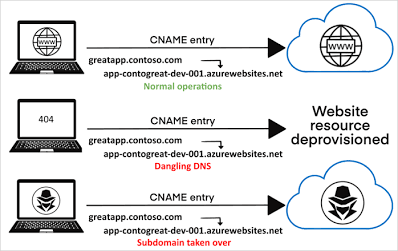
The Subdomain Takeover Lifecycle: From normal operation to an attacker claiming the dangling resource. Source: Microsoft Learn
The Exploit Execution
This creates a “dangling DNS” scenario. The DNS server still explicitly tells the internet: “To view promo.enterprise.com, go look at enterprise-promo.herokuapp.com.”
Because the original Heroku app was deleted, the name enterprise-promo is now available in Heroku's global registry. An attacker running automated attack surface management scripts continuously scans the internet for these exact dead ends. Once found, the attacker simply logs into Heroku, creates a new app, and claims the name enterprise-promo.
Instantly, the attacker gains full control over the content served at promo.enterprise.com. This technique, often referred to as CNAME hijacking, requires zero advanced hacking skills, just speed, automation, and an opportunistic eye for misconfigurations.
The Devastating Impact: From Cookie Theft to Phishing
A hijacked subdomain is exponentially more dangerous than a standard typo-squatted phishing domain. Because the attacker operates under your legitimate, trusted root domain, they inherit the cryptographic trust and browser permissions associated with your organization.
Bypassing Authentication and Cookie Harvesting
The most critical risk of a subdomain takeover involves session hijacking. Modern web applications frequently utilize Single Sign-On (SSO) and set authentication cookies wildcarded to the root domain (e.g., Set-Cookie: session_id=xyz; Domain=.enterprise.com).
When a user, or an employee, visits the attacker-controlled promo.enterprise.com, their browser automatically sends these highly privileged session cookies to the attacker's server.
The attacker can then harvest these session tokens, inject them into their own browser, and bypass Multi-Factor Authentication (MFA) to access the core application (app.enterprise.com) as the compromised user. In an era where identity is the primary perimeter, this complete bypass of authentication controls is catastrophic.
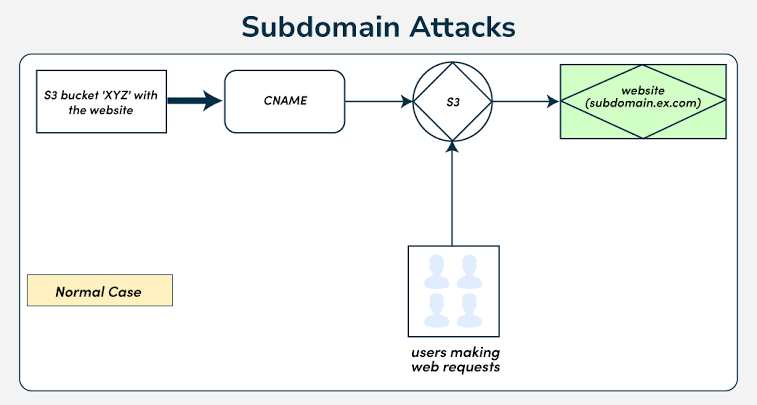
Cookie Theft via Subdomain Takeover: How root domain session cookies are exposed to attacker-controlled subdomains. Source: GeeksforGeeks
Malware Distribution Under a Trusted Banner
Security tools, Secure Web Gateways (SWGs), and email filters inherently trust reputable enterprise domains. If an attacker hosts malware on promo.enterprise.com, it will likely bypass automated phishing filters because the domain age is mature and the SSL/TLS certificates (often automatically provisioned via Let's Encrypt by the third-party host) appear perfectly valid. Attackers frequently use these hijacked subdomains to launch highly targeted spear-phishing campaigns against a company’s own employees or customer base.
Why Legacy Attack Surface Management Fails
To understand how enterprise perimeters remain so vulnerable to CNAME hijacking, we must examine the structural limitations of the tools security teams have relied on for the past decade. Legacy Attack Surface Management (ASM) and traditional vulnerability scanning are fundamentally misaligned with the speed of modern DevSecOps.
Against automated threat actors continuously fuzzing for dangling DNS records, legacy security postures fail across three critical domains:
1. The Snapshot Illusion: Point-in-Time Scans vs. Ephemeral Cloud
As highlighted in recent threat intelligence, the scope of a penetration test or a scheduled quarterly ASM scan is simply your digital footprint at a specific moment in time. However, the scope of your actual attack surface is continuously updated by every Terraform application, marketing campaign, and microservice release.
A CNAME record can become dangling on a Tuesday afternoon when an engineer tears down an AWS S3 bucket. If your legacy vulnerability scanner only runs on the first of every month, you leave a 30-day “unreviewed gap.” In 2026, an automated threat actor script will find and hijack that dangling pointer by Tuesday evening. The gap between your periodic assessment and your actual production state is exactly where modern adversaries operate.
2. The Integration and Configuration Bottleneck
Traditional Dynamic Application Security Testing (DAST) and legacy ASM tools require extensive manual configuration. Security engineers must manually define scope, integrate API routes, and whitelist specific domains for scanning.
When a marketing team rapidly spins up a promotional landing page on Heroku and routes traffic via promo.enterprise.com, they rarely submit a ticket to update the ASM scope. Because legacy tools require manual oversight to track new infrastructure, these shadow IT assets remain completely unmonitored. If a security tool requires constant manual intervention just to maintain baseline visibility, it is structurally incapable of securing elastic cloud environments.
3. The False Positive Epidemic and Alert Fatigue
Legacy scanners operate on a philosophy of volume, relying heavily on basic banner grabbing or simple DNS resolution checks. If a traditional tool detects a CNAME pointing to an external service returning a 404 Not Found, it instantly fires a “High Severity” alert for a subdomain takeover.
However, many enterprise-tier SaaS platforms (such as Azure App Services or Zendesk) implement strict tenant isolation and require custom TXT records for domain verification, making re-registration impossible. Traditional scanners cannot differentiate between a genuinely hijackable Heroku endpoint and a securely verified Azure configuration. The result? SOC teams are buried in thousands of false positives. When security tools throw alerts for theoretical vulnerabilities without providing verifiable exploitation paths, trust in the tooling collapses, and critical alerts are ultimately ignored.
Axeploit: Continuous Monitoring and Automated Threat Discovery
To defend against automated adversaries hunting for dangling DNS records, enterprises must deploy equivalent, or superior, automation. Legacy tools that rely on static, scheduled scans leave massive temporal blind spots. Axeploit redefines how security teams approach the subdomain takeover vulnerability by leveraging a fleet of AI security agents built specifically for speed, precision, and continuous, event-driven visibility.
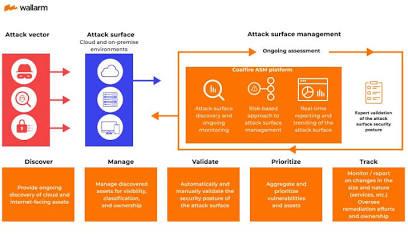
Axeploit’s Continuous Attack Surface Management: Automated discovery, PoC validation, and DevSecOps alerting. Source: Wallarm
By fundamentally transforming attack surface management from a reactive audit into a proactive, intelligent defense mechanism, Axeploit operates on three highly technical pillars:
Autonomous Reconnaissance and Deep Fingerprinting
Axeploit does not wait for a monthly compliance scan to trigger. It operates an autonomous, continuous reconnaissance loop designed to discover ephemeral assets the moment they touch the internet. The platform actively ingests data from Certificate Transparency (CT) logs, passive DNS datasets, and intelligent fuzzing algorithms to construct a real-time, dynamic graph of your external attack surface.
When a new or modified subdomain is discovered, Axeploit doesn’t just map the IP address. Its AI engine actively analyzes the complete CNAME resolution chain and fingerprints the backend infrastructure using HTTP response signatures. By reading the exact error states, such as recognizing an AWS S3 NoSuchBucket XML error, a GitHub Pages 404, or a Heroku No such app routing page, the AI instantly correlates the orphaned DNS record with its specific third-party cloud provider. This deep fingerprinting identifies the exact attack vector a threat actor would use.
The “No Exploit, No Report” Verification Engine
The most significant pain point for Security Architects and SOC Analysts is alert fatigue caused by theoretical vulnerabilities. A standard vulnerability scanner might flag a dangling CNAME to a cloud service, but the provider (such as an enterprise-hardened Azure App Service configuration) might enforce strict domain verification (e.g., requiring custom TXT records) that inherently prevents re-registration. Traditional scanners cannot tell the difference, resulting in a flood of false positives.
Axeploit’s AI agents solve this through its strict Discovery → Hypothesis → Exploitation → Verification loop. Before throwing a high-severity alert to your SIEM or ticketing system, the Axeploit agent securely interacts with the specific third-party provider's architecture to determine if the namespace is genuinely vulnerable to hijacking.
The agent safely attempts to stage a benign, non-destructive payload to validate the takeover. If the underlying service allows the resource to be claimed, Axeploit generates a verifiable Proof of Concept (PoC). If the takeover is blocked by provider-side controls, the AI suppresses the alert. This “No Exploit, No Report” philosophy guarantees that your DevSecOps team only spends time remediating mathematically verified threats, eliminating false positives entirely.
CI/CD Native Remediation and IaC Drift Detection
Visibility without immediate action is just noise. Axeploit bridges the gap between Threat Intelligence and DevOps by pushing security directly into the engineering workflow.
When an AI agent confirms a subdomain takeover vulnerability, Axeploit leverages native CI/CD webhooks to instantly generate rich, context-aware tickets containing the validated PoC and exact remediation steps.
Furthermore, Axeploit acts as a safeguard against Infrastructure as Code (IaC) drift. If a developer's Terraform script destroys a temporary promotional server but fails to tear down the corresponding AWS Route 53 or Cloudflare CNAME record, Axeploit detects the discrepancy in real-time. By continuously monitoring the delta between what is active in your cloud environment and what is broadcasted by your DNS servers, Axeploit ensures that your digital perimeter is hardened at the speed of modern engineering.
The DNS Lifecycle Checklist for Security Architects
Technology alone cannot solve process failures. To fortify your cloud security posture against CNAME hijacking, security teams must implement strict governance over the DNS lifecycle. Use the following checklist to harden your environment:
- Bind DNS to Infrastructure as Code (IaC): Ensure that DNS records are coupled directly with the infrastructure they point to using Terraform, Pulumi, or AWS CloudFormation. If the cloud resource is destroyed, the corresponding DNS record must be programmatically destroyed in the same state execution.
- Implement Continuous Subdomain Enumeration: Deploy continuous monitoring platforms like Axeploit to track your external attack surface 24/7/365. You cannot protect assets you do not know exist.
- Enforce Strict Cookie Scoping: Never use wildcard domain scoping (Domain=.enterprise.com) for sensitive authentication cookies unless absolutely necessary. Scope session cookies strictly to the specific subdomains that require them (e.g., Domain=app.enterprise.com).
- Audit Third-Party Service Configurations: Leverage Cloud Security Posture Management (CSPM) tools to ensure that third-party services require custom domain verification (such as adding a unique TXT record) before allowing a user to route traffic to a specific app name.
- Establish a Deprecation Process: Create a mandatory, documented offboarding process for marketing campaigns, legacy applications, and deprecated APIs that explicitly mandates a DNS audit before a project is closed.
Conclusion
The subdomain takeover vulnerability represents a perfect storm of modern engineering practices: the high-speed deployment of ephemeral cloud resources colliding with legacy, fragmented DNS management. As we navigate the complexities of 2026 threat landscape, attackers are heavily relying on automated scripts to exploit these overlooked DNS misconfigurations, turning abandoned marketing pages into powerful launchpads for session hijacking and malware distribution.
Defending against this requires more than just careful documentation; it requires absolute, real-time visibility over your digital footprint. CISOs and Security Architects must integrate continuous monitoring and intelligent attack surface management directly into their operations. By leveraging AI-driven platforms like Axeploit, which automatically enumerate subdomains, safely verify takeover risks, and deliver verified PoCs, organizations can eliminate blind spots, silence false positives, and secure their perimeter at the speed of the cloud.