If you are a Chief Information Security Officer (CISO), a Director of IT Security, or a Risk Manager operating in 2026, you already know the harsh reality of the modern threat landscape. Threat actors are no longer relying on manual scripts; they have fully weaponized autonomous AI agents to probe, exploit, and exfiltrate data at machine speed.
To defend against this, your security operations require equally autonomous, AI-driven defense mechanisms. But when you walk into the boardroom to request the necessary cybersecurity budget to modernize your stack, you hit a wall.
The board does not care about “polymorphic malware,” “API fuzzing,” or the technical nuances of zero-day exploits. They care about financial exposure, regulatory liability, and operational uptime. The disconnect between the Security Operations Center (SOC) and the boardroom is one of the greatest vulnerabilities a company faces today.
The 2026 Disconnect: Why Technical Metrics Fail in the Boardroom
For years, security leaders have relied on technical metrics for board reporting. Dashboards flooded with “number of attacks blocked,” “phishing emails quarantined,” or “Mean Time to Detect (MTTD)” are standard practice. However, to a CEO or a Board Director, a chart showing 10,000 blocked firewall intrusions is meaningless noise. It does not answer their primary question: “Are we secure enough to operate, and is our investment yielding a return?”
When presenting your CISO strategy, leading with technical jargon actively works against you. The board views cybersecurity not as an IT problem, but as a core business risk, no different than supply chain disruptions, market volatility, or credit risk. To secure funding for advanced AI defense tools, you must pivot from reporting threats to quantifying financial impact.
Cyber Risk Quantification (CRQ): Speaking the Board's Language
The key to successful boardroom negotiation is cyber risk quantification (CRQ). CRQ is the process of translating technical vulnerabilities into monetary values, allowing the board to weigh the cost of a defense tool against the potential financial loss of a breach.
Instead of saying, “We have a critical vulnerability in our customer portal,” the CRQ approach says, “There is a 40% probability that our customer portal will be compromised this quarter. If exploited, the resulting downtime, regulatory fines, and customer churn will cost the business $4.5 million. Investing $150,000 in continuous automated testing reduces that financial risk by 90%.”
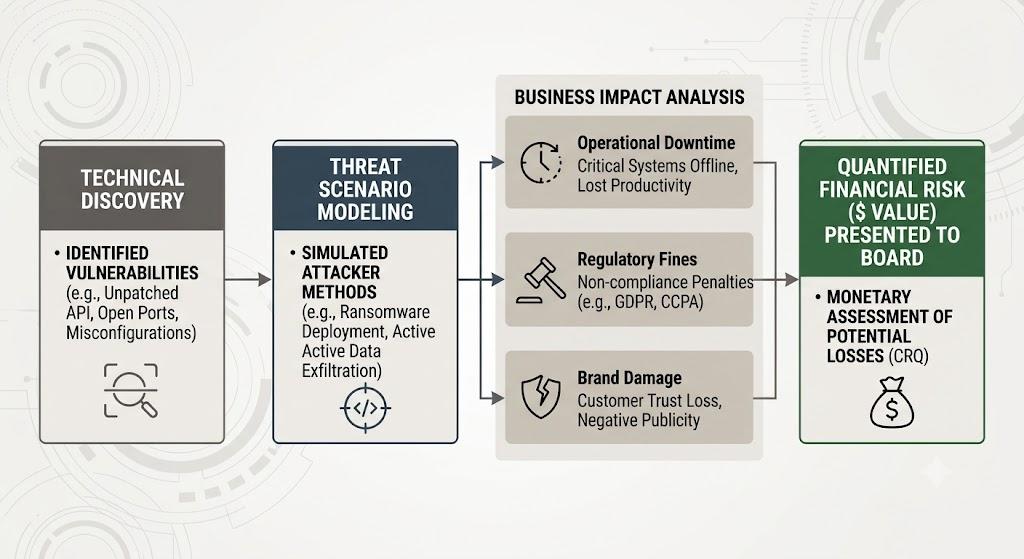
By utilizing CRQ, you transform cybersecurity from a pure cost center into an active financial mitigation strategy.
Proving AI Defense ROI: Financial Exposure and Downtime
In the era of automated attacks, passive defense is no longer enough. Threat actors are moving too fast for human-led penetration testing and manual code reviews. Investing in autonomous AI defense, like dynamic vulnerability scanners is mandatory. But how do you prove the AI defense ROI?
You prove it by highlighting the financial devastation of operational downtime. In 2026, the average cost of IT downtime for a mid-to-large enterprise easily exceeds $10,000 per minute. When human analysts are drowning in alert fatigue, it can take hours or days to identify and isolate a genuine breach.
Autonomous defense systems flip the script. By actively testing your live, running applications from the outside, exactly how a malicious hacker would, these tools uncover blind spots before they are exploited.
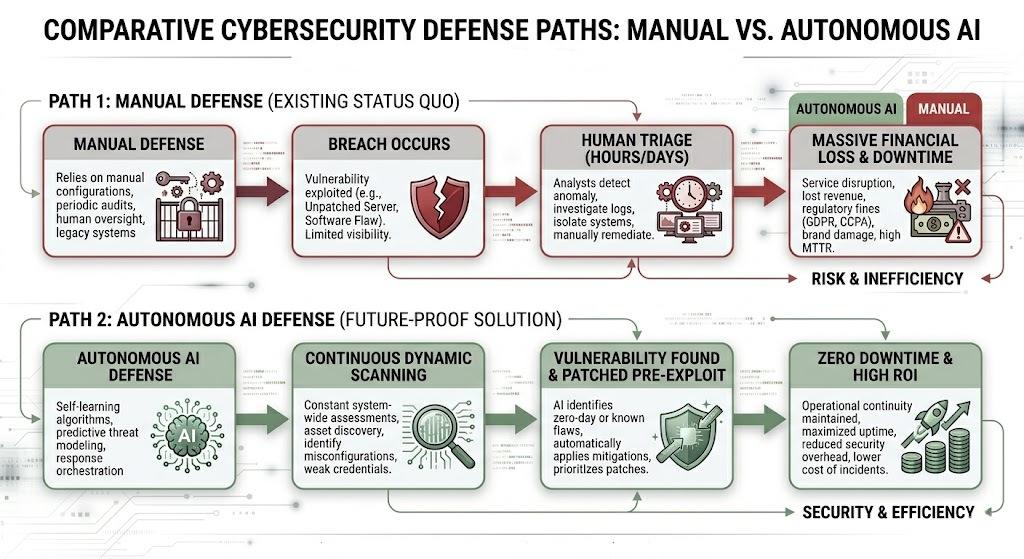
When presenting this to the board, focus on the delta between the two paths. The ROI of an autonomous security tool is not just the cost of the software; it is the millions of dollars in preserved revenue and avoided recovery costs.
The Hidden ROI: Slashing Cyber Insurance Premiums
There is another powerful, often overlooked financial lever to pull in the boardroom: cyber insurance.
As ransomware payouts and data breaches have skyrocketed, insurance carriers in 2026 have fundamentally changed their underwriting processes. They no longer accept simple compliance checklists. Carriers now demand proof of Continuous Threat Exposure Management (CTEM) and active, automated defense mechanisms.
If your organization still relies on annual manual pen-tests, your premiums will be astronomically high, if you can secure coverage at all. However, by demonstrating to your underwriters that you have deployed autonomous vulnerability scanners that continuously probe your external perimeters and APIs, you drastically reduce your perceived risk profile.
For many enterprises, the reduction in annual cyber insurance premiums alone completely offsets the cybersecurity budget required to purchase the AI defense platform. That is a hard, undeniable ROI that any Chief Financial Officer (CFO) will immediately support.
Translating the Axeploit Advantage to the Board
This is precisely where Axeploit becomes an essential asset for your executive strategy. Axeploit bridges the gap between rapid application development and robust DevSecOps.
Axeploit does not just sit passively on your network reading static configuration files. Our automated vulnerability scanner actively and safely attacks your live external perimeters, web applications, and endpoints. If an upstream IaC module quietly opened an unauthenticated port, or an overly helpful AI code assistant left a REST API exposed, Axeploit’s dynamic engine discovers it instantly.
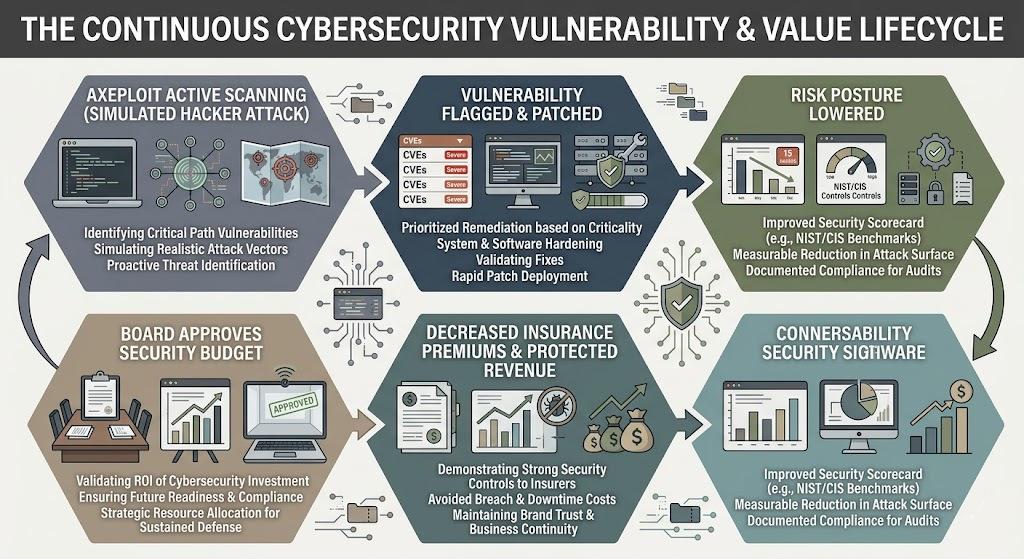
We provide your engineering team with actionable remediation insights, but more importantly, we provide you, the CISO, with the continuous, verifiable risk-reduction data you need to justify your strategy to the board.
Conclusion: Redefining Security as a Business Enabler
In 2026, the boardroom doesn't speak in IP addresses or zero-day exploits, they speak in risk, revenue, and resilience. If your board reporting continues to rely on technical jargon and meaningless alert counts, your requests for a critical cybersecurity budget will inevitably fall flat.
It is time to change the narrative. By embracing cyber risk quantification (CRQ) and clearly demonstrating the AI defense ROI of autonomous tools, you elevate your role from a technical defender to a strategic business partner. The reality is simple: modern threat actors are entirely automated, and your CISO strategy must reflect that by fighting AI with AI.
Stop telling the board what might happen, and start showing them how proactive, automated defense actively protects their bottom line. Equip your security teams with the autonomous tools needed to continuously test and validate your live environments before attackers do.