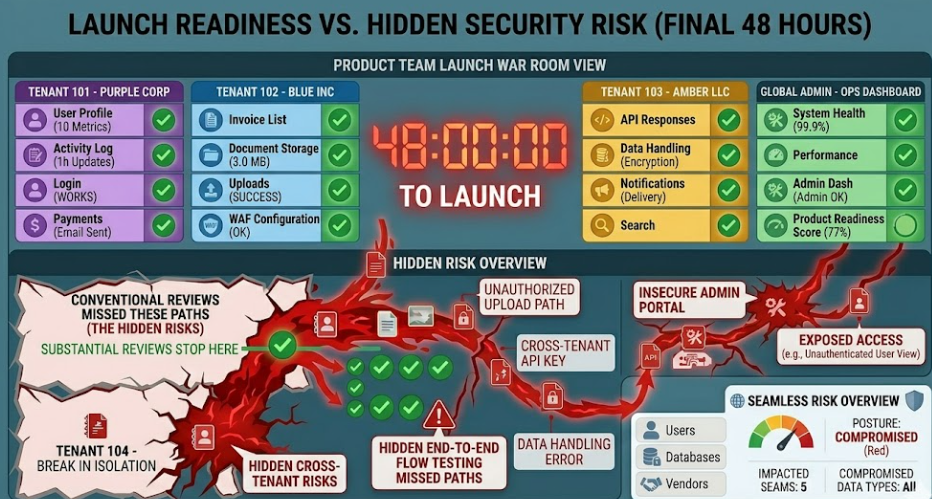
The last 48 hours before launch are usually filled with confidence and denial in equal measure. The team has spent months building, the demo works, and everyone wants to believe the hard part is over. That is exactly when a security audit before launch matters most, because final-stage mistakes are rarely about bad code alone. They are usually about things the team assumed would be fine.
Launch risk hides in the gaps between features
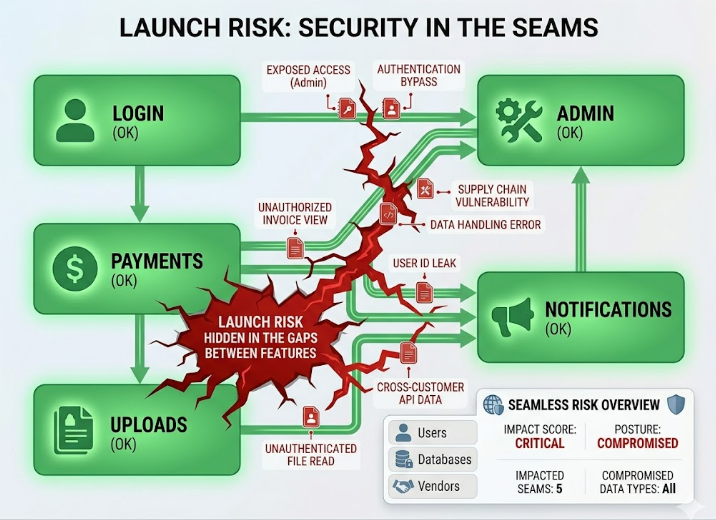
Most launch checklists focus on product readiness. Are the buttons working, are the emails sending, are the payments flowing, are the dashboards loading. Those are necessary questions, but they are not enough. Security problems almost always live in the spaces between those checks, where one system trusts another a little too much or one workflow skips a rule because “it was just temporary.”
That is why the final 48 hours are so important. Before launch, the product is no longer a prototype. It becomes a system that real people can push, break, and misunderstand. A small flaw in authorization, file handling, admin access, or API logic stops being a code issue and becomes a customer issue. At launch speed, those issues spread fast because everyone is watching the same release path.
The deeper problem is that teams often treat security as something to finish earlier. In reality, launch is when pressure peaks and shortcuts become tempting. People skip edge-case testing, reuse credentials, leave debug paths active, or assume low-traffic systems will not be targeted. Attackers do not care about launch timelines. They only care that the product is now reachable.
What tends to break right before launch
The most common launch-day failures are usually boring in the worst possible way. Authentication flows look correct until a forgotten test account still has elevated access. An API seems safe until one object ID can be swapped for another. A file upload works perfectly until someone sends a file that should never have been accepted.
Another launch risk is hidden in temporary infrastructure. Staging data copied into production, old webhook endpoints still enabled, permissive CORS settings left in place to “fix one last issue,” or admin panels exposed without enough protection. These are the kinds of flaws that do not show up in a product demo, but they show up immediately when the wrong person finds them.
The final 48 hours should also include a look at business logic, not just technical controls. Can a coupon be reused infinitely. Can a refund be triggered without a purchase. Can one user see another user’s data by changing a parameter. These are the flaws that turn a launch from a marketing event into an incident.
Why standard launch reviews miss the real danger
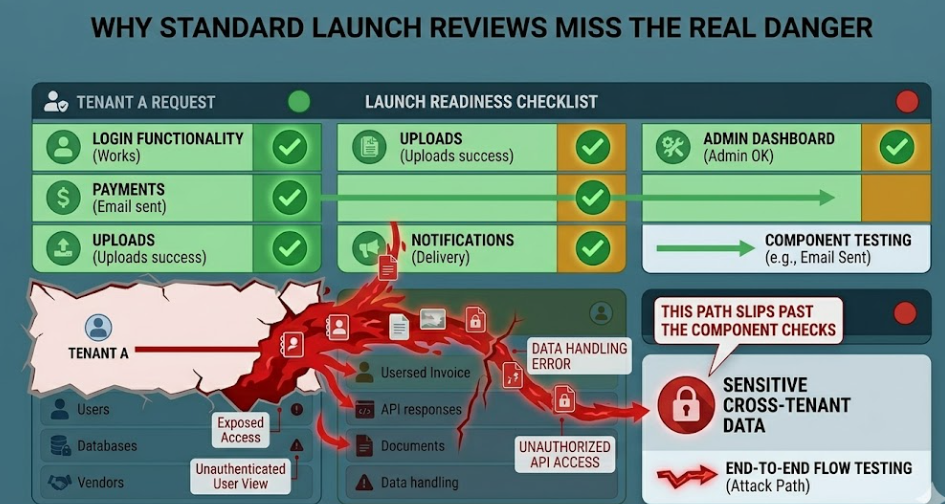
Most launch reviews are built to confirm readiness, not to challenge assumptions. Teams check whether the product works on the happy path, then assume the unhappy path will be rare enough to ignore. That is a mistake. Security failures often happen because a system works exactly as designed, just for the wrong person or in the wrong context.
Another gap is that many teams review by component instead of by flow. A login page can look secure while the downstream API is vulnerable. A file upload can be checked for size and type while the storage bucket is public. A payment flow can be protected while customer data still leaks through logs. The review passes because each piece looks acceptable alone, even though the end-to-end path is not safe.
There is also a human problem. At the end of a launch cycle, people are tired, optimistic, and ready to move on. That combination makes it easy to miss small signs of trouble. This is why teams need a short but focused security audit before launch that tests the paths most likely to create real damage, not just the ones easiest to verify.
What actually helps in the final 48 hours
The best pre-launch security work is narrow and concrete. Start with identity and access. Confirm that admin accounts are protected, test users are isolated, and debug credentials have been removed. Then move to object access and API behavior. Verify that one user cannot reach another user’s data, even by changing IDs or replaying requests.
Next, inspect the edges. Test file uploads, redirects, webhook handling, reset links, and background jobs. These are often the places where launch rush leaves hidden mistakes. Then review logs and error handling to make sure sensitive data is not being exposed to places it should not go. Finally, test a few real attack paths instead of relying only on checklists. That is where Axeploit fits naturally, because it can help surface issues like IDOR, auth bypass, SQL injection, and business logic flaws before launch pressure turns them into production problems.
The goal is not to make launch perfect. The goal is to make launch boring in the right way. A safe launch is one where the team already knows what can go wrong, already fixed the obvious issues, and already has enough evidence to trust the product under real traffic.
Launch is where trust starts
The 48 hours before go-live are not the time to hope the product is secure. They are the time to prove it against the highest-risk paths. If a team can verify access, object ownership, uploads, errors, and business logic before launch, it starts with far fewer surprises. If you want a way to test those paths quickly, you can run an automated scan with Axeploit.