If you are a Tech Founder, a Platform Engineer, or a DevSecOps professional operating in 2026, you have witnessed a rapid and profound architectural shift. The era of manual shipping is dead. We have evolved past the days of meticulously configuring Jenkins pipelines, writing endless YAML files, and manually babysitting deployments.
Today, autonomous AI agents and zero-config deployment platforms ship our code the moment it is committed. The traditional CI/CD pipeline, once the backbone of modern engineering, is dissolving into a seamless, invisible process. This velocity is incredible for product growth, but it leaves behind a terrifying question for your security team: If shipping is entirely automated and instantaneous, where exactly do you put the security gates?
When you remove the manual pipeline, you also remove the traditional checkpoints. In a CI/CD-less world, security testing must become as autonomous as the code generation itself. Welcome to the rise of SecOps. Here is how modern teams are replacing outdated roadblocks with zero-config vulnerability scanners, integrating Continuous Threat Exposure Management (CTEM), and letting automation secure what automation builds.
The Security Gap in Autonomous Shipping
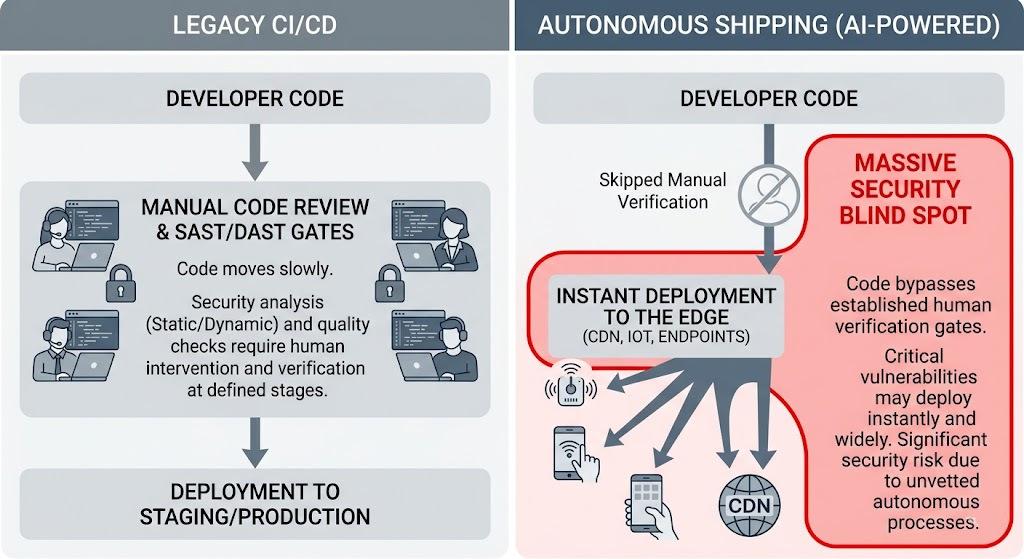
To understand the solution, we must first define the problem. In the classic DevOps model, security was integrated as a distinct “step” in the pipeline. You wrote code, you ran a static analysis scan, you staged the build, you ran a dynamic scan, and finally, a human approved the release.
In 2026, that linear progression is obsolete. Autonomous agents can write, test, and push microservices to edge networks in seconds.
Speed vs. Visibility
The fundamental issue is that traditional security tools were designed for humans to read and configure. When a platform automatically spins up a new serverless function or alters a database schema on the fly, a legacy security scanner simply cannot keep up. It requires manual configuration, deliberate targeting, and time, three things that no longer exist in an autonomous shipping environment.
If an AI hallucinates an insecure routing protocol or accidentally exposes a database, the code will be live in production before a human security engineer even pours their morning coffee. The gap between deployment and discovery is the exact window cybercriminals exploit.
Enter Continuous Threat Exposure Management (CTEM)
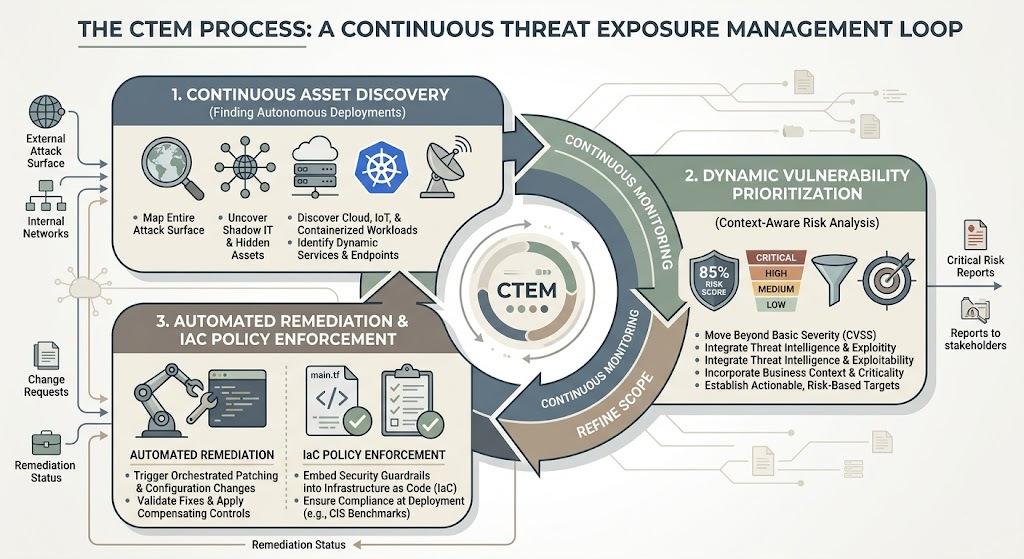
You cannot secure a continuous, invisible deployment process with periodic, manual audits. You need a paradigm shift. This is where Continuous Threat Exposure Management (CTEM) becomes the foundation of modern DevSecOps.
CTEM is a proactive security framework designed to continuously discover, prioritize, and validate threats across your entire digital ecosystem without waiting for a scheduled scan or a pipeline trigger.
Moving Beyond Static Checks
Unlike traditional vulnerability management (which just gives you a massive list of theoretical software flaws), CTEM assumes your infrastructure is constantly shifting. It continuously maps your active attack surface, identifying exactly which vulnerabilities actually pose a real-world threat based on how your live application behaves.
In an autonomous world, CTEM acts as an ever-watchful overwatch system. It doesn't need a CI/CD pipeline to tell it when to scan; it independently monitors your live environment 24/7, adapting instantly as new AI-generated microservices pop into existence.
Securing Infrastructure as Code (IaC) on the Fly
One of the most dangerous byproducts of autonomous shipping is the rapid, machine-driven alteration of cloud infrastructure. When AI agents manage your deployments, they are dynamically writing and executing infrastructure commands.
This makes infrastructure as code (IaC) security paramount. If a deployment agent autonomously provisions an AWS S3 bucket but fails to apply the correct IAM policy, you instantly have a data leak.
Modern SecOps requires IaC security tools that evaluate infrastructure changes at the speed of thought. These tools must autonomously analyze the intent of the deployment agent, ensure the principle of least privilege is enforced, and block any configuration that violates your baseline security posture, all without requiring a human to review a pull request.
The Rise of Autonomous SecOps: Automated Pen-Testing
If the deployment process is zero-config and instantaneous, the final validation of that deployment must be equally autonomous. You cannot rely solely on static analysis (SAST) to catch logic flaws or misconfigurations generated by AI. You must test the final, assembled product in real-time.
This is the domain of automated pen-testing.
Instead of hiring a human red team once a year to poke at your perimeter, automated pen-testing tools continuously assault your live applications using the exact same methodologies as advanced cybercriminals.
Why Axeploit is the Missing Link
In a CI/CD-less architecture, defense-in-depth means assuming that eventually, a misconfiguration will slip into production. Axeploit’s automated vulnerability scanner is designed for this exact reality.
While your autonomous agents handle the building, Axeploit acts as your final, active line of defense. Our automated scanner actively tests your live, running application. Instead of waiting for a breach, Axeploit safely attacks your app from the outside exactly how a malicious hacker would.
Because it requires zero complex pipeline configurations, it fits perfectly into the CTEM framework. If a compromised or hallucinating AI agent manages to deploy a hidden API endpoint or a hardcoded secret, Axeploit’s dynamic scanner will catch it, flag it, and show you exactly how to fix it before you go live.
Conclusion: Let Automation Fight Automation
The “End of DevOps” is not something to fear; it is an incredible opportunity to ship value to your users faster than ever before. But we must acknowledge that the old ways of securing code are completely incompatible with this new velocity.
By embracing the rise of autonomous SecOps, integrating DevSecOps principles directly into your live environments, and leveraging frameworks like CTEM, you can safely navigate the CI/CD-less world. You must fight automation with automation.