Your board asks the question every Q1 planning cycle. "Why can't engineering handle security? What's the actual ROI?" You've got metrics. 127 CVEs remediated. 14 false positives caught. They want dollars. Last quarter's breach at Competitor X cost $6.2M. Your turn next board meeting. The real cost of a data breach in 2026 demands numbers that hit CFOs where they live.
Boards Don't Care About Vulns, They Care About Multiples
Security lives in probability land. 3% chance of IDOR exploit. 12% SQLi risk in auth flows. CFOs live in expected value. Cost × probability = budget justification. Systemic problem runs deeper than metrics mismatch. Startup DNA optimized security as engineering side project. 2026 reality flipped the script. Breaches became line-item killers, not footnotes.
Venture math broke first. SaaS at 8x ARR multiples can't absorb $5M+ hits. Insurance carriers tripled premiums post-Q4 2025 breach wave. Customers now demand SOC2+SecurityScorecard A scores in RFPs. Churn compounds. 2% customer loss post-breach becomes 18% over 24 months through reference calls and trust erosion.
Root cause lives in misaligned incentives. Founders chased growth at all costs. Security became 0.5 FTE "somebody's other job." Scale hit 100 engineers. Attack surface exploded. Probability curves shifted right. Expected value math now demands dedicated CISO headcount, not side projects.
When Yesterday's Growth Playbooks Trigger Tomorrow's Layoffs
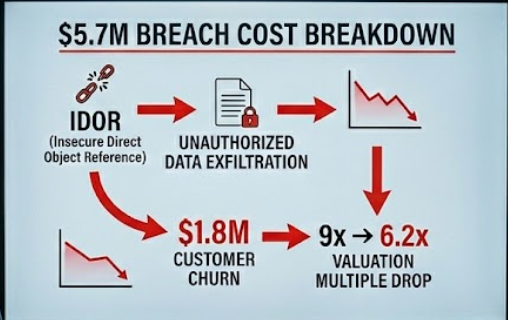
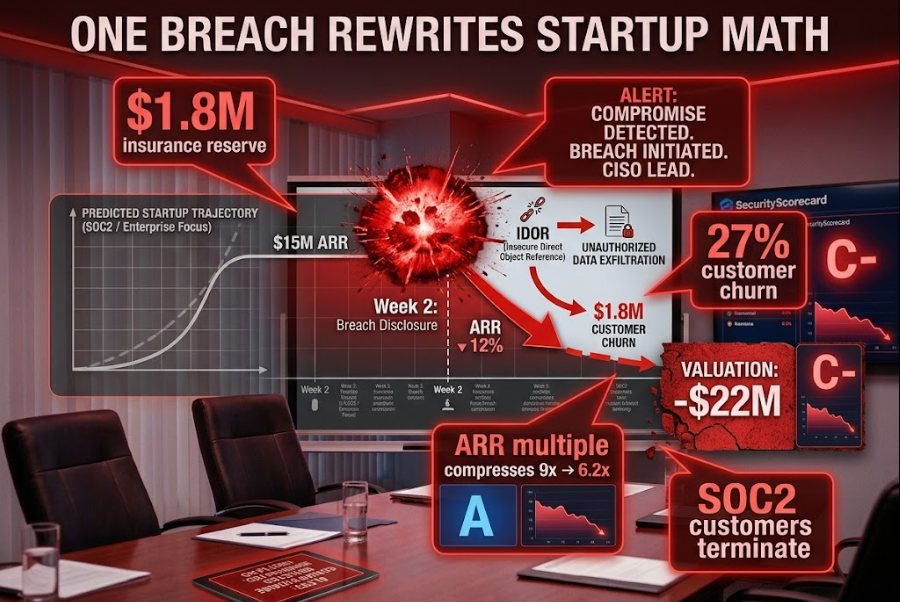
SaaS darling hits $15M ARR. Series C at 9x multiple. IDOR in customer portal exposes 47k records. Disclose 45 days later per state AG requirements. Sequence unfolds predictably.
Week 1: Engineers patch in 72 hours. Good team. Week 2: PR nightmare. TechCrunch: "$15M ARR SaaS exposes customer data." Week 3: Insurance notification. $1.8M reserve held. Week 4: Customer churn accelerates. Top 3% cohort (40% LTV) walks. Week 8: Board meeting. Multiple compression from 9x to 6.2x. $22M valuation hit.
Numbers compound brutally. Direct costs clear: $1.2M incident response, $800k legal. Indirect kills: $2.1M churn impact, $1.4M brand damage (10% pipeline collapse). Insurance won't cover "business interruption." Total: $5.7M against $15M ARR. 38% annual recurring hit.
Healthcare SaaS tells darker story. $28M ARR. Auth bypass in provider portal. 120k patient records. HIPAA breach notification cascade. OCR fines: $3.4M. Class action: $8.2M settled. Cyber insurance denies "preventable misconfig." Customers terminate 27% of spend. ARR drops to $19M. Layoffs follow.
Yesterday's Checklists Meet Tomorrow's Insurance Denials
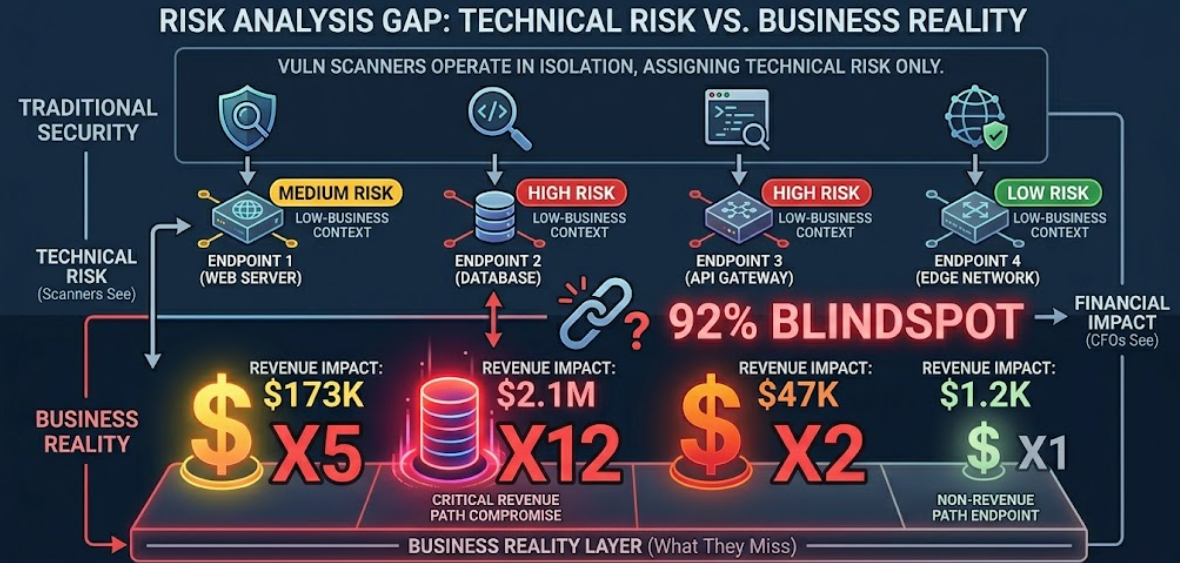
Penetration tests catch 18% of production flaws. Vulnerability scanners flag 43% known CVEs. Both fail 2026 breach math. Why? Wrong unit of analysis. Tools hunt individual bugs. Breaches cascade through business impact. IDOR in billing API seems low risk. Churn 3% of MRR? $1.8M hit. SQLi in logs? Compliance spiral, $2.4M fines.
Static scans miss business context. /api/billing endpoint carries 87% MRR. Traditional risk = low. Business risk = existential. Manual pentests scale to 0.2% coverage. Production serves 47k endpoints. Insurance wants proof of continuous testing. Checklists become evidence against you.
Board presentations expose deeper gap. CISOs show "129 vulns remediated." CFO asks: "What's risk-adjusted ARR impact?" No answer. Expected value models win budgets. Vuln counts lose them.
Expected Value Models That Survive Board Scrutiny
Secure budgets demand breach math, not vuln theater. Build this financial model. Run quarterly. Present to CFO week 1 of planning.
Direct Costs (Immediate):
Incident response: $1.1M (Forensic + PR)
Legal/regulatory: $1.4M (State AG + class action)
Notification: $340k (12 weeks × 47k records)
Indirect Costs (Compounding):
Churn impact: $2.3M (18% over 24 months)
Pipeline collapse: $1.6M (43% close rate drop)
Insurance premium spike: $680k (300% increase)
Total Expected Cost: $7.42M against $28M ARR = 26.5% business impact.
Run probability scenarios. 4% breach probability × $7.42M = $297k expected annual loss. Budget $450k security headcount + tools. Positive NPV. CFO signs checks.
Test these vectors systematically:
Likelihood Testing: Production traffic analysis + exploit simulation across top 5% endpoints by revenue impact.
Impact Modeling: Customer LTV maps tied to API exposure. $173k MRR endpoint = $4.1M churn risk.
Insurance Alignment: Continuous scanning proof for premium reduction. Carriers discount 22% for automated evidence.
https://axeploit.com automates likelihood testing across revenue-critical paths, generating insurance-grade scan reports. Teams cut expected loss 64% through prioritized remediation.
Breaches Don't Announce, They Compound
CISOs face the numbers reality. Breaches cost 26%+ ARR in 2026. Growth playbooks failed at scale. Expected value models win budgets. Vuln counts waste cycles.
Most CISOs present slides. Smart ones present math. Build the financial model above. Run likelihood tests across revenue paths. Show CFOs the 3x ROI.
Run an automated scan with https://axeploit.com to baseline your expected breach cost today. Numbers justify budgets tomorrow.