
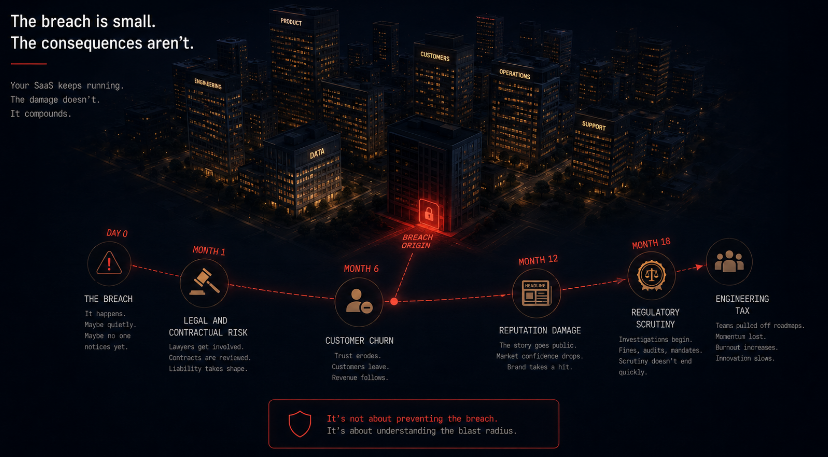
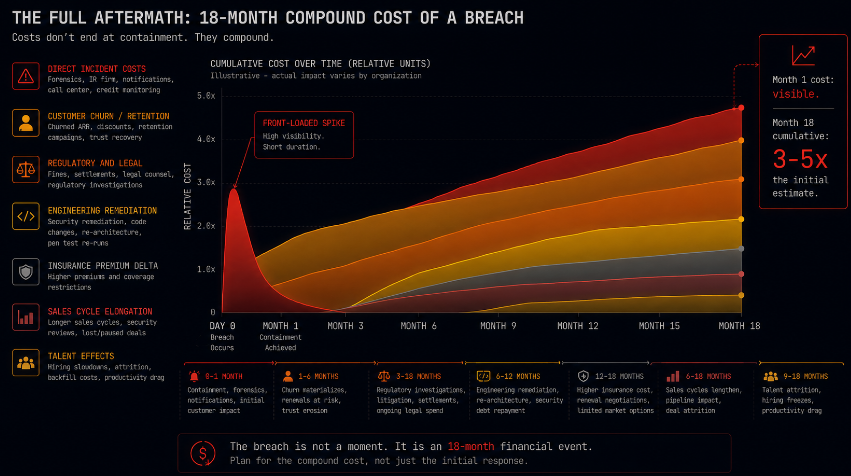
The number that gets reported in breach post-mortems is usually the direct cost: the incident response firm, the forensic investigation, the notification vendor, the credit monitoring services for affected users. That number is real. It is also, in most cases, the smallest component of the total economic impact.
The reason the reported number understates the real cost is structural. Direct costs appear quickly, are invoiced, and are easy to measure. The costs that follow the customer churn, the sales cycle extensions, the engineering distraction, the regulatory proceedings, the insurance premium adjustments, the talent retention challenges, the reputational effects that suppress growth accumulate over eighteen months or more, are hard to attribute to a single event, and are rarely surfaced in any public accounting of what the breach actually cost.
Organizations that use the reported breach cost as the benchmark for security investment decisions are making decisions based on the most visible fraction of the actual economic exposure. The full number is larger, more distributed in time, and significantly harder to recover from than the initial incident suggests.
This is a mapping of that full number where it comes from, when it arrives, and what determines its magnitude.
Day Zero to Day Thirty: The Visible Damage
The first thirty days after a breach is confirmed are the period that gets documented. Incident response begins. Forensic investigators are engaged to determine scope, entry point, and duration of attacker access. Legal counsel is retained. The breach notification timeline thirty days in many jurisdictions, seventy-two hours under GDPR for processors, specific timelines under CCPA and state regulations begins immediately.
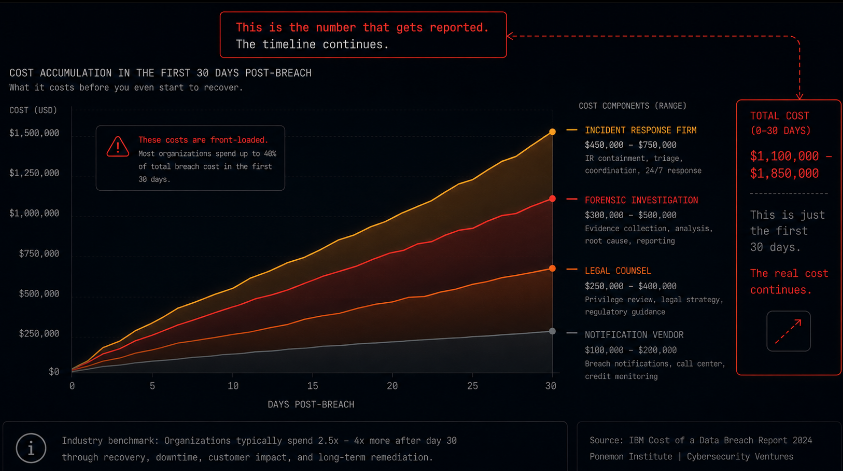
The direct costs in this window are the ones that become line items: incident response retainer activation, typically ranging from tens of thousands to hundreds of thousands of dollars depending on firm and scope. Forensic investigation, which for a breach affecting a meaningful number of records commonly runs six to twelve weeks of billable time from a specialized firm. Legal counsel engaged simultaneously in multiple jurisdictions if the affected user base crosses state or national boundaries. Notification vendor costs for sending breach notifications to affected individuals at scale.
These costs are significant. For a mid-sized SaaS company with a breach affecting one hundred thousand users, the direct incident costs in the first thirty days can range from two hundred thousand to well over a million dollars depending on scope and complexity of the investigation.
What is not yet visible at day thirty: the customer response, the regulatory proceedings, the sales pipeline effects, the engineering cost of remediation and hardening. These are forming but have not yet materialized as measurable costs. The organization is in the period where the crisis feels manageable because the scope of what follows has not yet become concrete.
Month One to Month Three: When Customers Decide
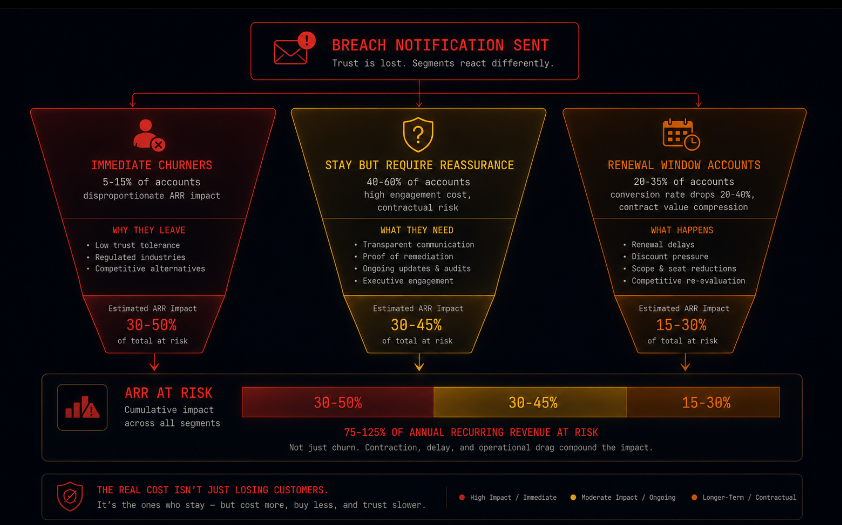
The sixty to ninety days following a breach are the period when the customer response becomes measurable. Three distinct customer segments respond differently, and understanding the distinction matters for projecting the economic impact.
Customers who leave immediately. A fraction of the customer base the size depends heavily on the nature of the breach, the sensitivity of the data affected, and the perception of the organization's response will not wait to see how the situation develops. They submit cancellation requests within weeks of the notification. For B2B SaaS companies, this segment is typically small in number but disproportionate in ARR if it includes enterprise accounts that had been evaluating risk during their renewal period and use the breach as the trigger for a decision that was already under consideration.
Customers who stay but require reassurance. The larger segment will not immediately churn but will demand evidence that the vulnerability has been remediated, that the organization understands what happened, and that adequate controls are now in place to prevent recurrence. This segment generates a different kind of cost: intensive customer success engagement, executive-level conversations, third-party security assessments that customers now require as a condition of continued business, and contractual modifications that add security commitments with financial consequences for future non-compliance.
Customers who are in renewal conversations. Accounts approaching their renewal window at the time of the breach are in the most vulnerable position. A customer deciding whether to renew a significant contract while simultaneously receiving breach notification is making that decision with the breach as the most salient recent data point about the vendor. Renewal rates for accounts in this window decline, and the deals that do close often do so at reduced contract values reflecting the customer's changed risk perception of the relationship.
The customer response period is also when the organization's communication and incident response quality determines the magnitude of the loss. Organizations that communicate quickly, clearly, and with genuine transparency about what happened and what is being done about it retain a meaningfully higher fraction of at-risk customers than organizations whose communication is delayed, defensive, or technically incomplete. The quality of the notification letter, the availability of senior leadership for customer calls, and the credibility of the remediation narrative all affect the economic outcome during this window.
Month Three to Month Six: Regulatory Timeline and Legal Proceedings
By month three, the regulatory dimension of the breach has begun to materialize in concrete form. The breach notification was sent within the required window. Regulatory bodies that received those notifications have now had time to review them and, in many cases, to open formal inquiries.
The regulatory response varies significantly by jurisdiction and by the sensitivity of the data involved. Healthcare data in the United States triggers mandatory HHS notification and potential OCR investigation. Financial data triggers relevant financial regulatory review. European users' personal data triggers the national data protection authority in each affected member state, whose investigative processes can run eighteen to twenty-four months from the initial notification.
The regulatory cost in this window is not yet a fine regulatory proceedings take time. The cost is legal and compliance resources engaged in responding to inquiries, producing documentation, participating in interviews, and managing the regulatory relationship. For a breach affecting users in multiple jurisdictions, this is not one regulatory relationship but several, each running on its own timeline with its own documentation requirements.
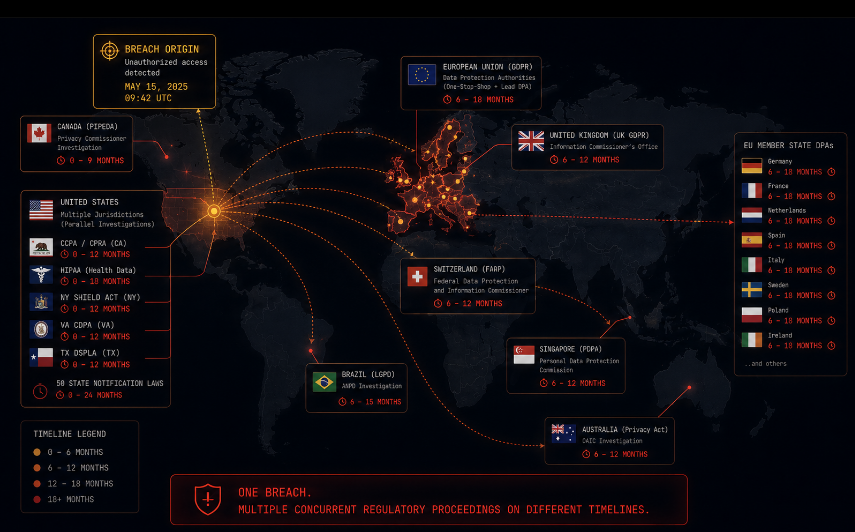
The legal dimension operates on a parallel track. Class action litigation following a data breach is now sufficiently common that most organizations engaging experienced breach counsel should anticipate it as a likely outcome rather than a risk to be evaluated. The timing is predictable: plaintiffs' attorneys monitor breach notifications, and class action complaints are commonly filed within thirty to sixty days of public notification. The litigation itself will not resolve for one to three years, but the defense costs begin immediately and accumulate through the entire period.
Settlement negotiations, if they occur, typically happen after discovery which means after significant legal spend on both sides has already accumulated. The settlement value depends on the number of affected individuals, the sensitivity of the data, the jurisdiction, and the nature of any demonstrated harm. Settlement amounts for mid-sized breaches affecting tens to hundreds of thousands of records have commonly ranged from single-digit millions to tens of millions of dollars, plus plaintiff's attorney fees.
Month Six to Month Twelve: The Engineering Debt of Remediation
The breach post-mortem has been completed. The entry point has been identified. The remediation has been scoped. Month six to month twelve is when that remediation gets built, and this period surfaces a cost category that is chronically underestimated in breach impact analyses: the engineering cost of unplanned security work at scale.
Breach remediation is not a single fix. A breach that entered through an exploited vulnerability typically reveals, on investigation, a broader pattern: the same class of vulnerability present in multiple places, access controls that were weaker than they should have been across a wider surface than the immediate entry point, logging and monitoring that was insufficient to detect the attacker's presence during the dwell period. Remediating the specific entry point takes days or weeks. Remediating the pattern takes months.
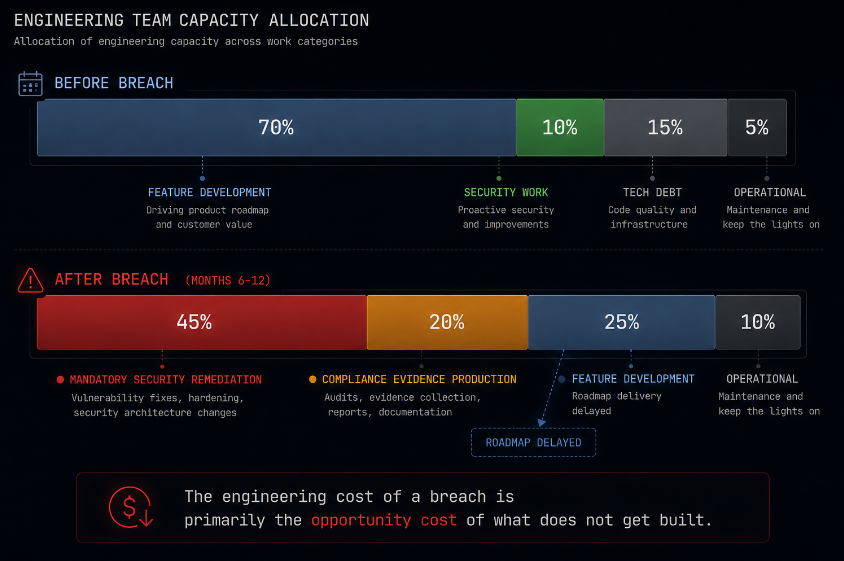
The engineering cost is primarily opportunity cost, and opportunity cost is the cost category that never appears in breach cost estimates but is the one most keenly felt by organizations experiencing it. A product roadmap that was twelve months long at the start of the year has been replaced by a twelve-month remediation and hardening program. Features that were scheduled to ship are deferred. Competitive position erodes relative to organizations that are continuing to ship features during the period when the breached organization is remediating its security posture.
For venture-backed companies, this opportunity cost has a direct valuation consequence. A company that misses its product milestones during a breach remediation period is a company whose growth story has been interrupted at the moment when its investors and the market are already questioning its security judgment. The valuation impact at the next funding round or in secondary market transactions reflects both the direct breach costs and the product position that was lost during remediation.
The other engineering cost in this window is compliance evidence production. Regulatory proceedings and ongoing legal discovery both require documentation that security controls are now in place. Producing that documentation penetration test reports, security architecture reviews, code audit results, access control matrices requires significant engineering and security team time that is not producing customer-facing value.
Month Twelve to Month Eighteen: The Long Tail Nobody Budgets For
By month twelve, most organizations believe the breach is behind them. The immediate crisis has passed. Customers who were going to leave have largely left. The regulatory proceedings are ongoing but have settled into a predictable cadence. The legal situation is in discovery or early settlement discussions. The remediation is largely complete.
The costs in months twelve to eighteen are the ones that are hardest to attribute to the breach because they are spread across multiple business functions and do not look like breach costs when they appear.
Cyber insurance renewal. The cyber insurance policy that was in place when the breach occurred will renew during this window, if the organization has maintained coverage. The renewal will occur on different terms. Premium increases of fifty to two hundred percent following a claim are common. Coverage limits may be reduced. Deductibles may increase. New exclusions may be added covering the specific vulnerability class that was exploited. The insurance cost line in the P&L for months twelve onward reflects the breach, permanently, until years of clean claims history justify renegotiation.
Enterprise sales cycle elongation. Enterprise prospects who were in the pipeline at the time of the breach, or who discover the breach during their vendor security evaluation, conduct security due diligence that is more intensive and takes longer than it would have in the absence of the breach. Sales cycles that were averaging ninety days extend to one hundred and fifty or one hundred and eighty days as prospects request third-party security assessments, reference calls with other customers about their experience, and executive-level security briefings before closing. Sales team productivity decreases because a higher fraction of selling time is spent on security conversations rather than on value and fit discussions.
Talent acquisition and retention effects. Security engineers and senior software engineers evaluate their employers' security culture when making career decisions. An organization that has experienced a breach and that is perceived to have had preventable security failures will find that some fraction of the talent it needs to compete particularly the talent with options makes different choices about where to work. The effect is not dramatic but it is real: longer time-to-hire, higher compensation required to close candidates, and some attrition from existing employees who recalibrate their employer risk assessment.
Regulatory fines, when they arrive. Regulatory proceedings that began at month three to six will commonly reach a resolution a formal finding, a settlement, or a fine somewhere in the twelve to twenty-four month range. GDPR fines for significant breaches are calculated as a percentage of global annual revenue up to four percent which means the fine for a company with meaningful revenue is significant regardless of the specific facts of the breach. US state regulatory settlements, FTC proceedings, and sector-specific regulatory actions (OCR for HIPAA, relevant financial regulators) each have their own timing and calculation methodology.
The regulatory outcome arrives as a lump-sum cost after twelve to eighteen months of legal spend defending the investigation which means the total regulatory cost is the legal defense spend plus the fine or settlement, not the fine alone.
What the Full Cost Actually Implies for Security Investment Decisions
The case for preventive security investment is typically made by comparing the cost of the investment to the cost of a breach. This comparison is usually made with the direct breach cost as the breach side of the equation the incident response, the forensics, the notifications.
Using the full eighteen-month cost including customer churn, regulatory and legal exposure, engineering remediation, insurance adjustments, sales cycle elongation, and talent effects changes the comparison substantially.
A mid-sized SaaS company with five million dollars in ARR and a breach affecting one hundred thousand users might face direct incident costs of five hundred thousand to one million dollars. The eighteen-month full cost of that same breach accounting for customer churn at ten to twenty percent of ARR, regulatory and legal proceedings in multiple jurisdictions, engineering remediation absorbing a significant fraction of engineering capacity for six to twelve months, and the compounding effects on growth may reach three to five times that figure or more, depending on the company's regulatory exposure and customer concentration.
Against that figure, a continuous security testing program at a fraction of a percent of revenue looks different than it does when compared only against the direct incident cost. The comparison that supports the security investment is not "cost of the program versus cost of the incident response." It is "cost of the program versus the expected value of the full eighteen-month aftermath, discounted by the probability of a breach in any given year."
That calculation is harder to make precisely, but it is the right calculation. The organizations that reach the right answer are the ones that have mapped the full cost of a breach rather than stopping at the first invoice.
Closing: The Breach Is the Beginning, Not the Event
The breach is not the story. It is the inciting event. The story is the eighteen months that follow, when every business function that was operating normally before the breach customer success, sales, engineering, legal, HR, finance is operating with the breach as a constraint, a cost center, or a distraction.
The organizations that recover fastest from breaches are not the ones that had the smallest breach. They are the ones that communicated well, had practiced their incident response before they needed it, had the security architecture to contain the breach radius when it occurred, and had the documentation to satisfy regulatory inquiries efficiently. These are not qualities that appear overnight. They are the product of ongoing security investment, testing, and operational discipline that existed before the breach made them urgently necessary.
The cost of a breach, fully accounted, is the strongest argument for the security investment that prevents it. Not the cost of the notification letter. The cost of the eighteen months that follow the notification letter the one that goes to your customers, your regulators, and the legal system, all at once.
That cost is knowable. It is worth knowing before it is personal.
Axeploit finds the vulnerabilities that produce breach events before they produce breach costs. Its AI agents test running applications through authenticated workflows, surface the authorization gaps and input handling failures that create exploitable entry points, and provide continuous coverage at the cadence that modern applications demand. The cost of finding a vulnerability in testing is a fix and a deployment. The cost of finding it in a breach post-mortem is the eighteen months described above.