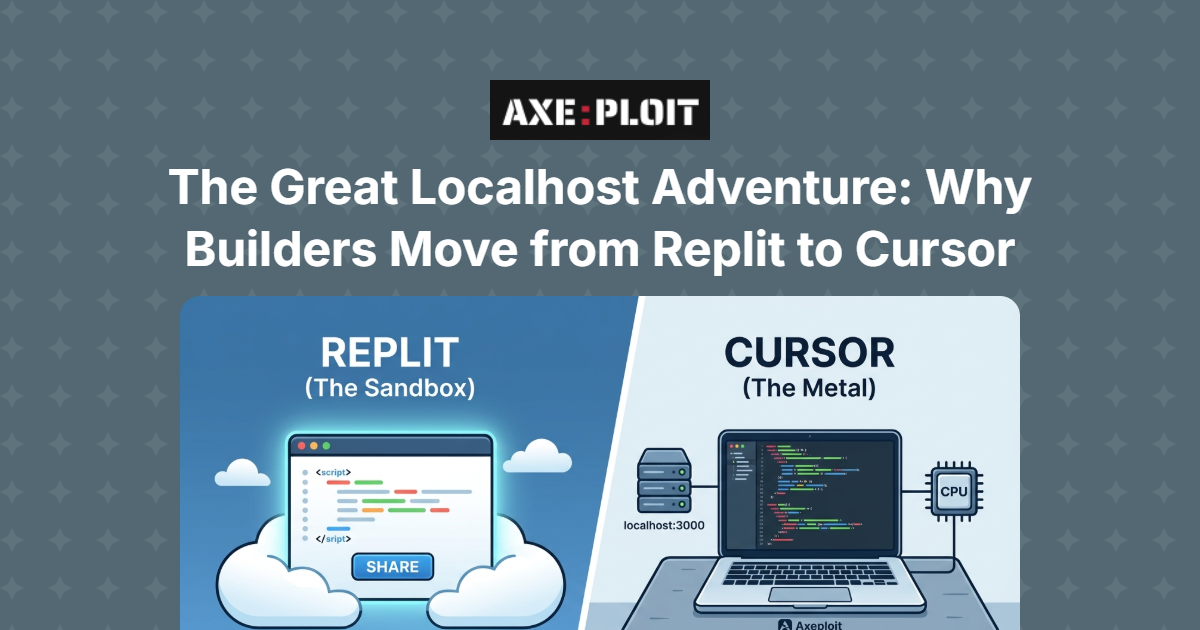
There is a certain magic in the "First Hello World." In the old days, that magic required installing a C compiler, figuring out why your PATH was broken, and praying to the linker gods.
Then came Replit.
Replit is the ultimate "Cloud City." You click a button, and suddenly you have an IDE, a server, and a URL. It’s a managed utopia where the infrastructure is invisible. For a non-technical builder, it’s a godsend. You’re not a "SysAdmin"; you’re a Creator.

But as any seasoned developer will tell you, abstractions are leaky. Eventually, your app grows. You need more specialized libraries, faster compute, or perhaps you’re tired of the "Wake Up" lag on free tiers. You realize that to build a skyscraper, you have to stop playing in the sandbox and start digging in the dirt.
Welcome to the Migration Pathway: The journey from Replit to Cursor.
1. The "Localhost" Culture Shock
In Replit, "running" your app is a binary state: it’s either on or off in the cloud. When you move to Cursor, you are introduced to the Localhost Adventure.
Suddenly, you aren't just writing code; you are managing an environment. You have to care about node_modules, python virtual environments, and why Port 3000 is already in use by some forgotten AirPlay service.
Why do it? Because of Latency and Power. Cursor, being a fork of VS Code, gives you the full power of your machine’s processor and the world’s best AI coding features. You aren't typing into a browser tab; you’re wielding a professional instrument. It’s the difference between playing a plastic keyboard and a Steinway.
2. The Secret Sauce: Environmental Variable Management
In the managed world of Replit, there’s usually a nice "Secrets" tab. You paste your API key, and it just works.
When you migrate to a local setup with Cursor, you meet the .env file. This is the moment most builders realize that security is a shared responsibility.

- The Trap: Accidentally pushing your
.envto GitHub and watching your OpenAI credits vanish in forty-five seconds. - The Discipline: Learning to use
.gitignore.
Managing your own environment variables feels like extra work, but it’s the "granular control" that separates a hobbyist project from a production-grade application. You can have different keys for development, staging, and production. You are finally the architect, not just the tenant.
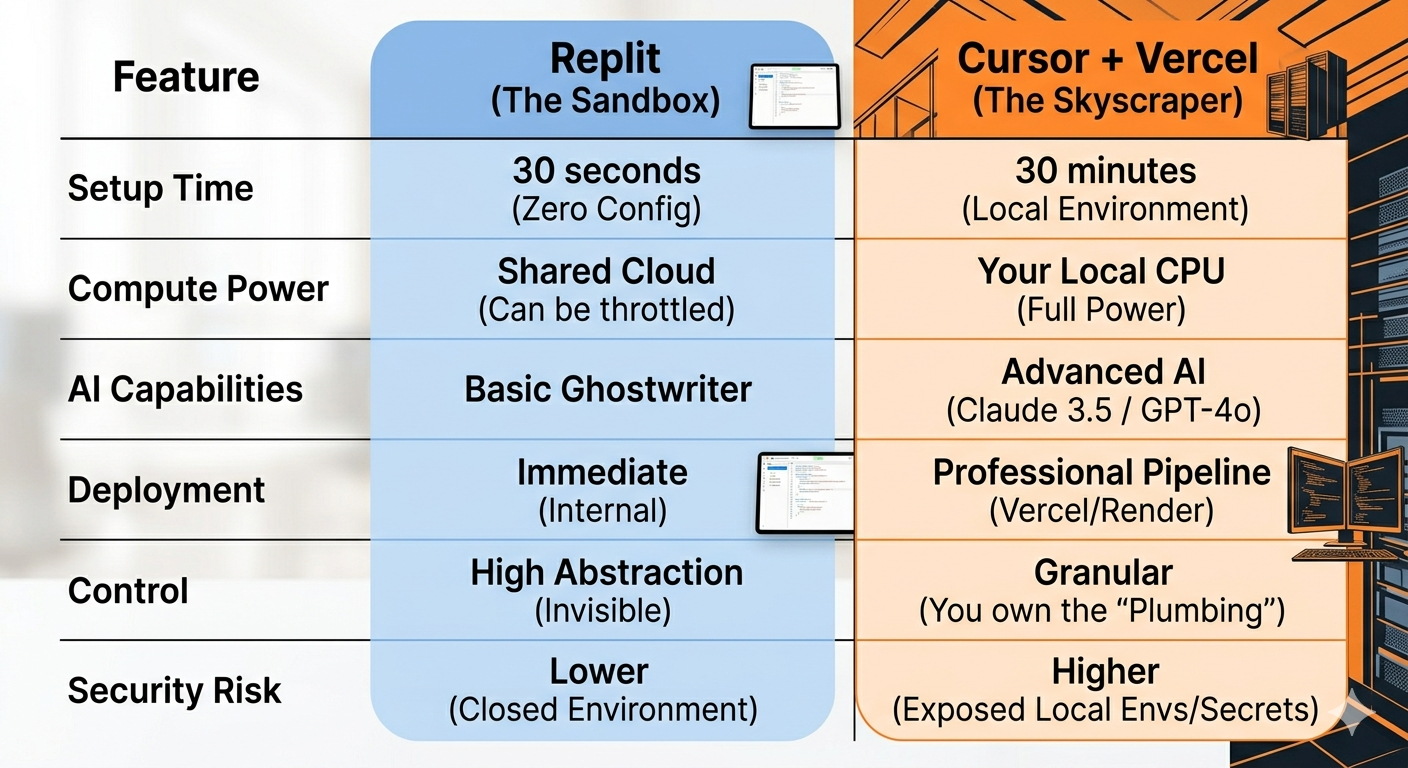
Comparison: The Builder's Crossroads
To help you decide when it's time to pack your bags and move from the cloud sandbox to the local powerhouse, here is how the two worlds stack up:
3. The Deployment Divorce: Vercel, Render, and the Real World
The hardest part of leaving Replit is losing the "Auto-Deploy" button. In Replit, the code is the deployment. In the professional world, the code and the hosting are two different things.
This is where Vercel or Render come in.
Setting up a deployment pipeline via GitHub means that every time you git push, the "Industrial Machinery" kicks in. It runs tests, builds your assets, and pushes them to the edge. It’s more complex than Replit, yes. But it’s also robust. If your site hits the front page of Hacker News, a Vercel-backed app won't just fall over; it will scale.
4. Securing Your New Empire
As you move into this "Skyscraper" phase, your attack surface grows. In Replit, you were behind their walls. Now, with your own Vercel deployment and custom API endpoints, you are out in the open.
This is exactly why we built Axeploit. As you graduate to Cursor and Vercel, you need a security partner that is as "zero-config" as the tools you just left, but as powerful as the infrastructure you’re moving into. While you focus on the "Localhost Adventure," Axeploit’s AI agents autonomously scan your new deployment for the 7,500+ vulnerabilities that come with professional-grade complexity.
Ready to make the jump? Ask yourself:
- Is my cloud IDE holding me back?
- Do I need custom background tasks or specialized hardware?
- Am I overpaying to host a small app?
Moving from Replit to Cursor isn't just a change of tools; it’s a change of mindset. You’re moving from "making it work" to "making it scale." It’s a bit more "shoveling coal," but the engine you’re building is finally your own.