The industry has spent the last year obsessed with the "Vibe." We were told that natural language had finally killed the need for technical precision. But as we move into 2026, the data tells a different story. Senior engineers and domain experts are outperforming "Vibe Coders" by a factor of ten.
The reason is the Articulation Barrier. We have entered an era where language is the hottest programming language. But like any language, it is only as powerful as the person speaking it. Most companies are currently failing because they treat AI like a mind reader rather than a high-precision execution engine.
The Villain: The Myth of "Plain English"
The most common failure in modern engineering is the reliance on Broad Intent. Companies are hiring generalists and telling them to "just describe the app" to the AI. This is a losing battle.
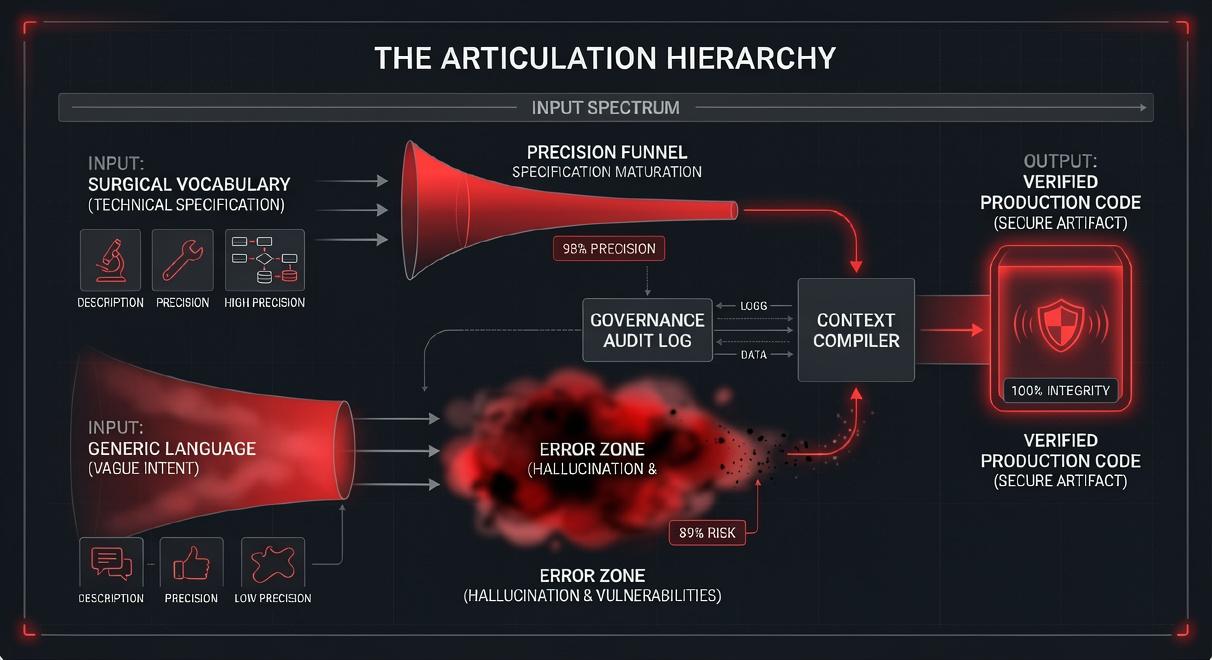
When you use generic language, you give the AI an infinite search space. A generalist asks for a "secure login." The AI interprets that as the most common, generic, and often vulnerable implementation it can find.
AI does not lack intelligence. It lacks Constraints. Without the specific vocabulary to narrow the search space, the AI defaults to "Technical Slop." If you cannot articulate the architecture, the AI will hallucinate a mediocre one for you.
The Fix: Domain-Specific Constraint
Research shows that medical doctors and high-level attorneys get better code from AI than junior developers. This is because they possess the Surgical Vocabulary to define the boundaries of the task. They don't just ask for a result. They articulate the constraints of the domain.
To break the Articulation Barrier, you must follow the Axeploit Way of Precision Prompting.
Step 1: Replace "Vibes" with Specifications
Stop using adjectives. Use Technical Constants. Don't ask for a "fast database." Ask for "Inductive Row-Level Security with sub-200ms latency on a multi-tenant PostgreSQL schema." The more specific your vocabulary, the smaller the AI's margin for error.
Step 2: Define the "Identity Perimeter" First
The biggest risk in agentic workflows is an agent that doesn't know its limits. The Fix: Before you describe the function, describe the Access Scope. You must articulate the exact "Digital ID" permissions the agent holds. If you don't define what the agent cannot touch, you haven't written a program. You've written a security breach.
Step 3: Establish Characterization Benchmarks
Vocabulary isn't just for building. It is for verifying. Every "Agentic" task must start with a Behavioral Characterization. You define the vocabulary of success. If the output deviates from the technical terms you established in the spec, the code is rejected automatically.
Step 4: Continuous Governance of Intent
In 2026, your "Source Code" is actually a collection of Intent Strings. These strings must be managed with the same rigor as a C++ library. You need a centralized registry of "Verified Intents." If a developer uses a broad, unverified prompt to trigger a deployment, it must be flagged as Shadow AI.
The Bottom Line
The Articulation Barrier is the new divide between the leaders and the laggards. Language is indeed the hottest programming language, but it requires a Surgical Vocabulary to master.
If your team is still "Vibing," they are building technical debt at machine speed. At Axeploit, we provide the deep-scan technology to map your platform's intent and ensure your AI agents stay within their defined borders.
Precision is not an option. It is the framework.