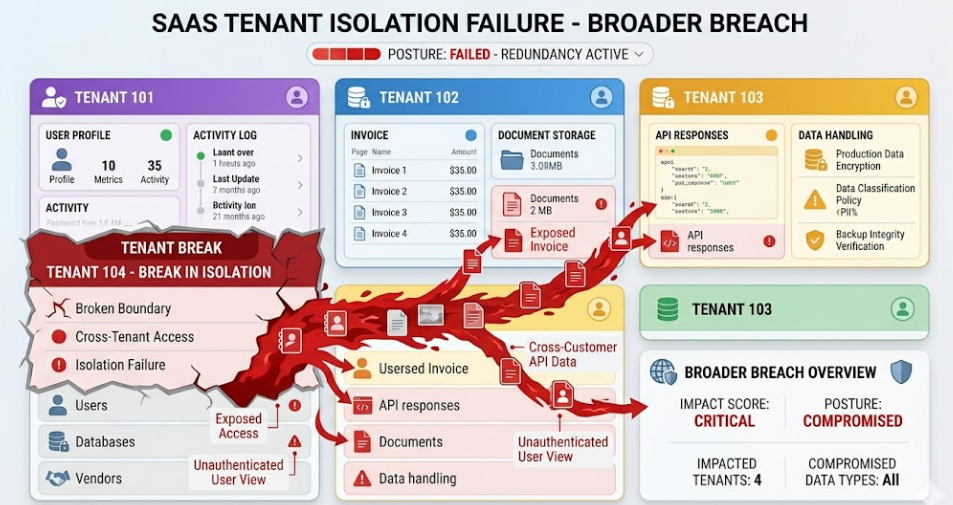
The hardest part of multi-tenant SaaS security is that everything looks fine until it does not. One request returns the wrong customer’s data, one admin panel exposes too much, one background job crosses a boundary it should never cross. At that point, the product is no longer just buggy. It is leaking trust at scale.
Isolation is the promise customers are actually buying
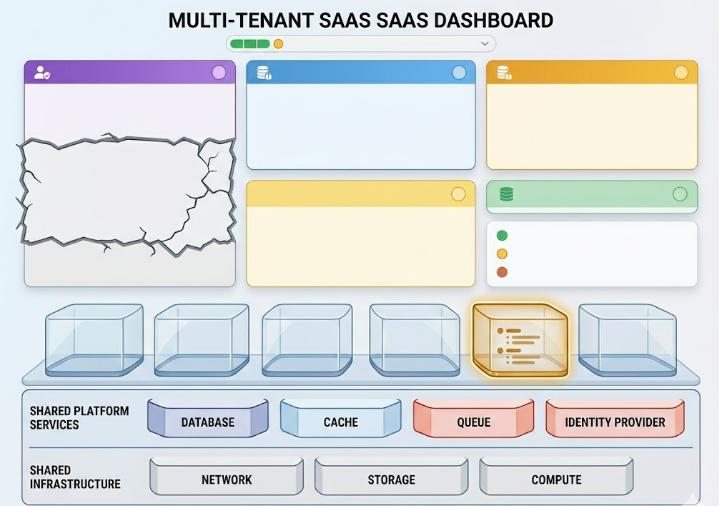
Most SaaS founders talk about uptime, speed, and features. Customers care about those too, but under the surface they are really buying isolation. They want confidence that their data lives in its own space, that their access is limited to their own tenant, and that one customer’s activity cannot affect another’s. That promise is what makes multi-tenant architecture valuable. It is also what makes it dangerous.
The systemic problem is that tenant isolation is not one control. It is a chain of assumptions across authentication, authorization, database queries, caching, logging, background jobs, storage, and support tooling. If any one of those layers forgets tenant context, the whole model weakens. Many teams build the happy path correctly and assume the rest will follow. In practice, that assumption is where breaches begin.
This is why isolation failures are so damaging. They do not always show up as a dramatic exploit. Sometimes they look like a support rep seeing the wrong account. Sometimes they look like an API response including another tenant’s object. Sometimes they are hidden in export jobs, search indexes, or shared logs. The bug may be technical, but the damage is human. Customers stop believing the product can protect them.
What tenant leaks look like in the real world
A classic failure is IDOR inside tenant-scoped endpoints. The product seems safe because users must log in, but the object lookup does not verify tenant ownership. A user changes an ID and suddenly sees another company’s invoices, tickets, or documents. The code looks normal. The logic is wrong.
Another common issue is shared infrastructure that forgets context. A cache key does not include tenant ID. A background worker processes records from multiple customers using the same queue. A search index returns results across tenants because the filter was applied in the UI, not in the query. None of these issues feel dramatic in isolation. Together, they become a breach pattern.
The real problem is that these failures often survive internal testing. Engineers test the obvious paths. They log in as a user, create records, and verify the workflow works. What they do not always test is whether one tenant can infer, enumerate, or access another tenant’s data through edge cases. That is why multi-tenant SaaS security needs deeper verification than normal feature QA.
Why normal security reviews miss the boundary
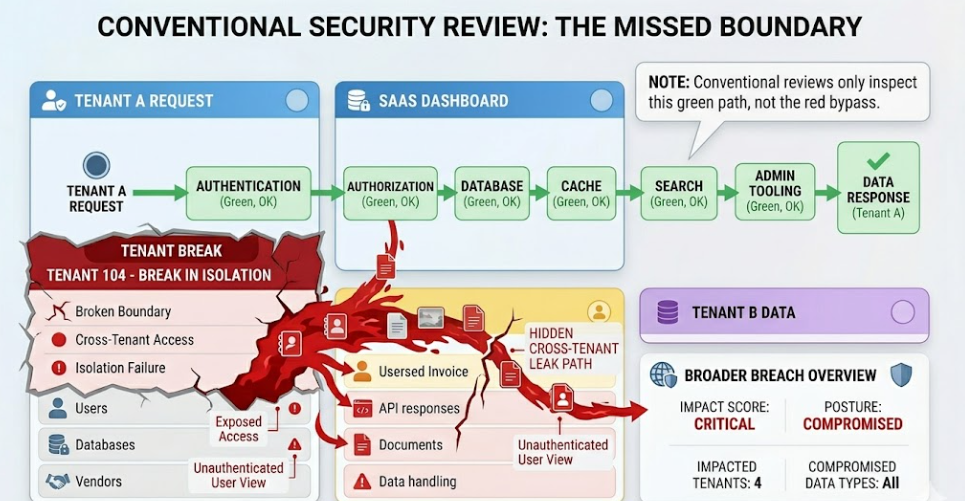
Security reviews often focus on the obvious. Is authentication enabled. Are passwords hashed. Are admin endpoints protected. Those are necessary checks, but they do not prove tenant isolation. A system can be authenticated and still be completely unsafe across customers.
The gap is that most review processes test controls in isolation rather than testing the boundary between tenants. That boundary is where failures happen. Authorization checks might exist, but only on one service. Database filters might work, but only for the main API. Export jobs, analytics pipelines, and support dashboards may all bypass the same rules because they were built by different teams with different assumptions.
Another reason reviews fail is that teams underestimate how quickly the attack surface grows. Every integration, every new feature flag, every admin workflow, and every customer support shortcut creates another place where tenant context can disappear. If the product serves regulated or enterprise customers, that risk becomes even more expensive. One leak can trigger churn, contract reviews, legal escalation, and a permanent trust problem.
What actually keeps tenants separate
Strong isolation starts with one rule. Tenant context must be enforced everywhere, not just in the UI. That means every query, every background task, every storage path, every cache key, and every support workflow should carry tenant identity as a first-class control.
The next step is to test the places teams usually ignore. Search, export, analytics, notifications, and admin tooling are frequent leak points because they are often built for convenience. These are exactly the places where a SaaS product should be most careful. If a support agent can see data across tenants, the isolation model is already too loose.
The best teams also treat tenant isolation as a product property, not only a security one. They document who can see what. They test cross-tenant access the same way they test uptime. They verify that customer-facing features do not accidentally become internal backdoors. And they use tools that can probe real workflows, not just static endpoints. That is where Axeploit fits naturally, because it helps teams find issues like IDOR, auth bypass, and business logic failures before customers do.
Bottom Line
Multi-tenant SaaS is powerful because it compresses cost and scales fast. It is fragile because one boundary mistake can expose every customer at once. The strongest products do not just authenticate users. They prove, over and over, that tenants stay isolated under real conditions. If you want to test that before production, you can run an automated scan with Axeploit.