If you are a Chief Information Security Officer (CISO), a startup owner, or a Cloud Security Architect navigating the threat landscape of mid-2026, you already know that the traditional network perimeter is dead. But the reality is far more dangerous: the very infrastructure designed to make the internet fast and reliable is now being actively weaponized against you.
For decades, Security Operations Center (SOC) analysts relied on a simple rule: if an IP address is malicious, you block it. But what happens when the malicious traffic is coming from the exact same IP address as your payment gateway, your primary SaaS provider, or your company’s own website?
Attackers have mastered the art of the “Invisible Proxy.” By abusing shared Content Delivery Network (CDN) infrastructure, hackers are seamlessly blending malicious traffic with normal, legitimate requests. They are intentionally blurring the line between what is dangerous and what is routine, turning trusted networks into their own personal Command and Control (C2) channels.
The Ultimate Camouflage: Blurring the Lines
To understand this attack, we must first look at how CDNs (like Cloudflare, AWS CloudFront, Fastly, or Akamai) operate. CDNs act as massive global proxies. When a user tries to access legitimate-startup.com, their request doesn't go straight to the startup's server. It goes to a highly trusted CDN IP address located geographically close to the user. The CDN then routes the request to the correct backend server.
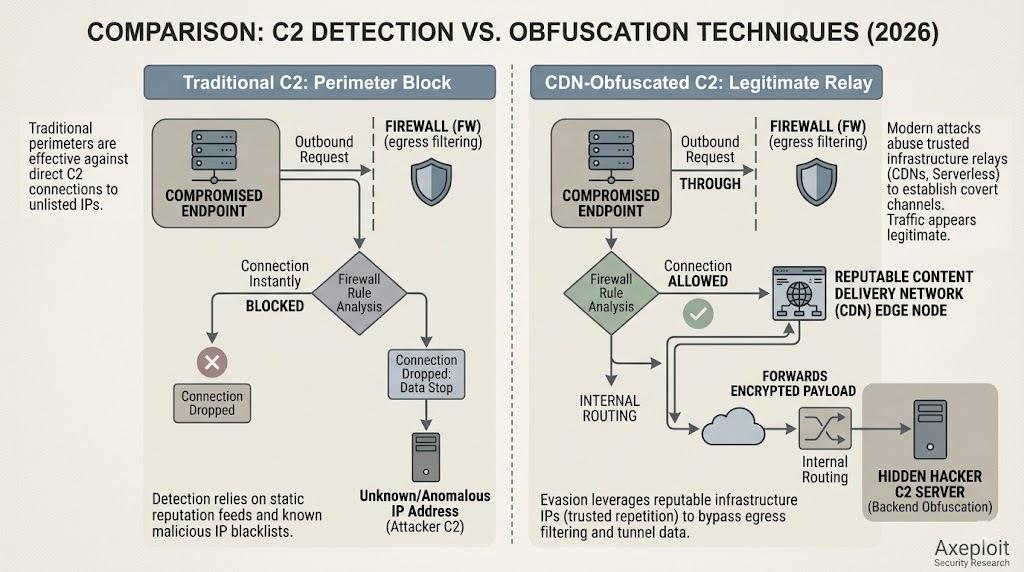
Because nearly half the internet sits behind these CDNs, enterprise firewalls are programmed to implicitly trust their IP addresses. Blocking a major CDN's IP range would effectively break the internet for your employees. Hackers are counting on this exact hesitation.
What is CDN Abuse?
CDN abuse, often utilizing a technique known as “Domain Fronting” or “CDN Routing Abuse,” happens when an attacker registers their own malicious domain (e.g., evil-hacker.com) on the exact same CDN platform that your company trusts.
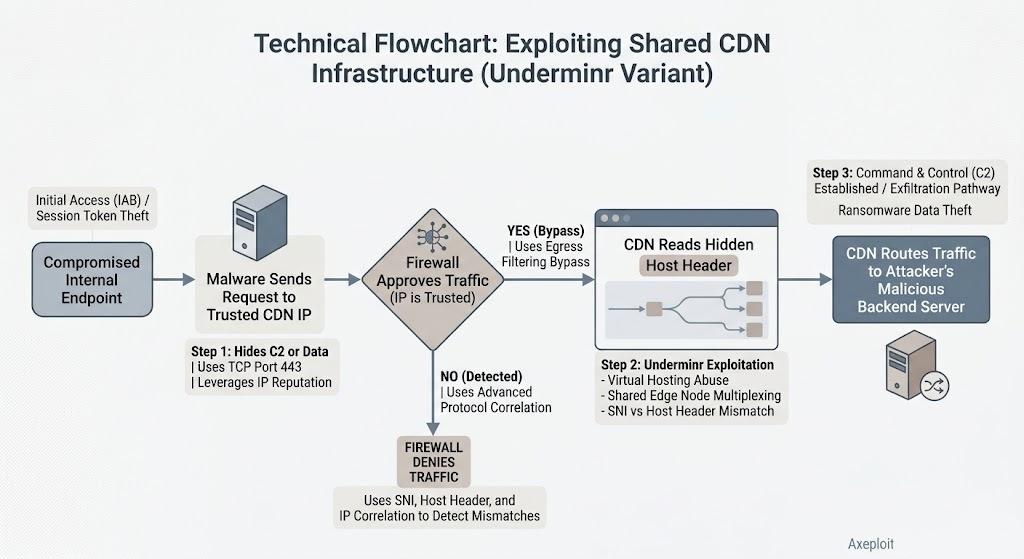
When the attacker’s malware infects a machine inside your network, it needs to phone home for instructions (a process called Command and Control, or C2 beaconing). Instead of reaching out directly to an untrusted offshore IP, the malware sends a request to the trusted CDN.
To your firewall, this outbound request looks like perfectly normal web traffic heading to a safe, reputable CDN. But buried deep inside the encrypted HTTP request is a “Host Header” directing the CDN to secretly forward that traffic to the attacker's hidden server. The CDN acts as an unwitting mule, carrying stolen data right past your security gates.
How Hackers Execute the Attack
To defeat this threat, SOC analysts and cloud architects must understand the attacker's playbook. Here is exactly how hackers set up and execute a CDN abuse campaign:
- Infrastructure Staging: The attacker creates an account on a major, reputable CDN provider and registers a malicious backend server.
- Payload Delivery: The attacker infects a corporate endpoint via phishing, a shadow API vulnerability, or a compromised open-source package.
- The “Legitimate” Connection: The malware initiates an HTTPS connection to a highly reputable domain hosted on the same CDN (e.g., trustedsite.com).
- The Host Header Swap: During the encrypted handshake, the malware modifies the HTTP Host header to say evil-hacker.com.
- Data Exfiltration: Your firewall only sees a connection to trustedsite.com and allows it. The CDN decrypts the traffic, reads the Host header, and quietly forwards your sensitive data to the attacker.
Step-by-Step Guide: How to Stay Safe from CDN Abuse
Because the attacker's traffic is cloaked in the reputation of a trusted provider, passive defenses and legacy IP blocklists are completely useless. You cannot rely on external reputation scores; you must verify the internal context of every request.
Here is a pragmatic, step-by-step guide for DevSecOps teams and SOC analysts to defend against shared infrastructure abuse.
Step 1: Shift from IP-Based to Identity-Based Filtering
If your security posture relies solely on IP blacklisting, you are already breached.
- Action: Transition your network defenses to a Zero Trust architecture. Stop trusting outbound connections just because the destination IP belongs to a reputable CDN. Your firewalls must be configured to evaluate the identity of the application making the request, not just the destination it is trying to reach.
Step 2: Implement TLS/SSL Inspection
Because the malicious Host header is hidden inside the encrypted HTTPS tunnel, your firewall cannot see it unless it breaks the encryption.
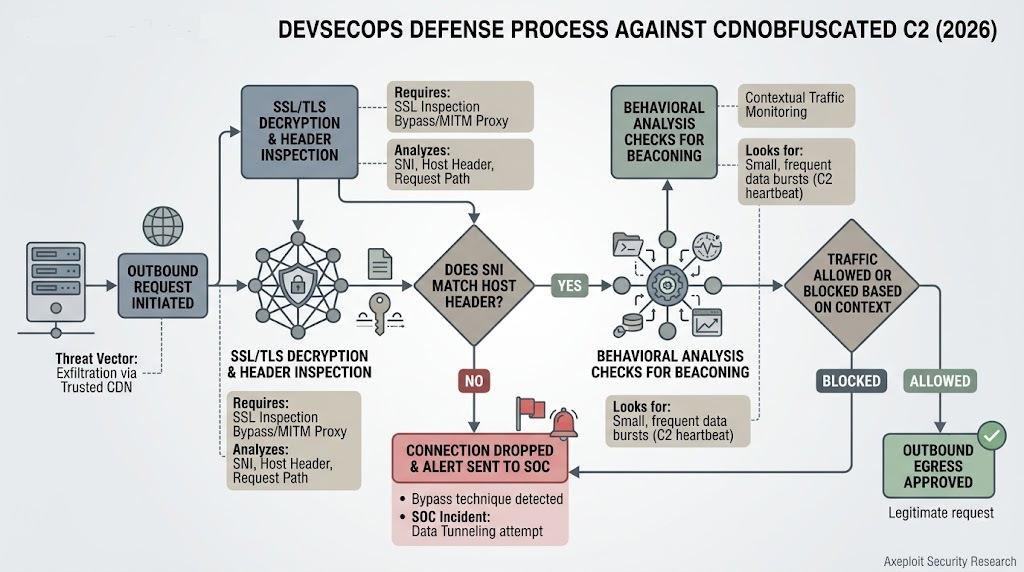
- Action: Deploy deep packet inspection (DPI) with TLS/SSL decryption at your network edge. By intercepting and decrypting outbound traffic, your security appliances can inspect the HTTP Host headers. If the SNI (Server Name Indication) in the initial connection does not match the encrypted Host header, drop the connection immediately.
Step 3: Monitor for Behavioral Anomalies (Beaconing)
Malware operating a C2 channel must repeatedly “phone home” to ask the attacker for new instructions. This creates a distinct, rhythmic pattern on your network known as beaconing.
- Action: Configure your SIEM (Security Information and Event Management) tools to monitor for highly repetitive, low-volume outbound connections. Even if the traffic is going to a trusted CDN, a device reaching out to the exact same IP address every exactly 45 seconds is a massive red flag.
Step 4: Enforce Strict Egress Firewalls
Your servers should not be allowed to talk to the open internet indiscriminately.
- Action: Implement default-deny egress policies. If an internal database or a backend microservice does not explicitly need to communicate with the public internet, block its outbound access entirely. If malware infects an isolated server, it will be trapped, unable to reach its CDN proxy.
Conclusion: Active Defense for a Shared World
As we navigate 2026, the internet is more consolidated than ever. The fact that the world's most critical infrastructure shares the exact same IP space as sophisticated cybercriminal networks is a daunting reality. Hackers will continue to abuse shared CDN infrastructure because it offers the ultimate camouflage, turning your trust in global tech giants into a fatal vulnerability.
For CISOs, startup owners, and SOC analysts, surviving this threat landscape requires abandoning outdated assumptions. You can no longer assume traffic is safe just because of where it is going. You must implement deep packet inspection, actively hunt for behavioral anomalies, and adopt a Zero Trust mindset that questions every single byte of outbound data. Passive monitoring is no longer enough. You must actively validate your network's resilience against these obfuscation techniques.