If you are a Fraud Investigator, a CISO, or an Identity Security Engineer operating in early 2026, the fundamental rules of trust have been rewritten. For the past decade, the cybersecurity industry treated biometric security and video-based identity verification as the ultimate gold standard. We assumed that while passwords could be stolen and tokens could be intercepted, a person's face and voice were immutable.
Today, that assumption is not just outdated; it is actively dangerous.
The commoditization of generative AI has armed threat actors with the ability to manufacture human identity at scale. We are no longer just dealing with stolen credentials; we are dealing with “Burner Identities.” By leveraging real-time deepfakes and highly sophisticated synthetic data, attackers are reliably executing biometric bypass operations against enterprise help desks and automated KYC fraud prevention systems.
The End of “Trust What You See”: The Rise of Synthetic Identities
Historically, identity theft meant stealing a real person's data and impersonating them. In 2026, attackers prefer to build people from scratch.
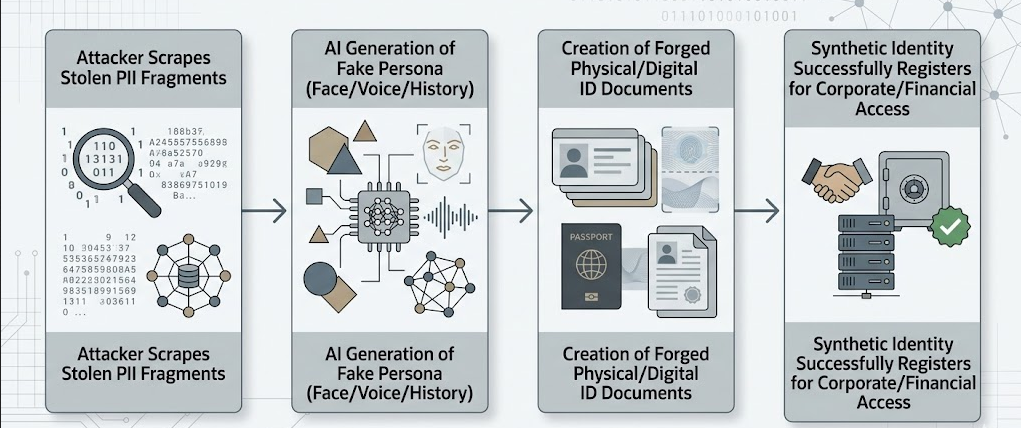
Synthetic identities are created by Frankenstein-ing real, stolen data fragments (like a legitimate Social Security Number or national ID) with fabricated information (a fake name, AI-generated face, and burner phone number). Because there is no “real” victim to notice their credit score dropping or their accounts being hijacked, these burner identities can mature quietly for months.
When it comes time to monetize or infiltrate, the attacker uses this synthetic identity to apply for corporate access, open financial accounts, or pass automated identity verification checks. Standard document scanners check the ID's barcode and security features, which the attacker has digitally forged or physically printed using dark web templates.
Weaponizing AI: The Mechanics of a Biometric Bypass
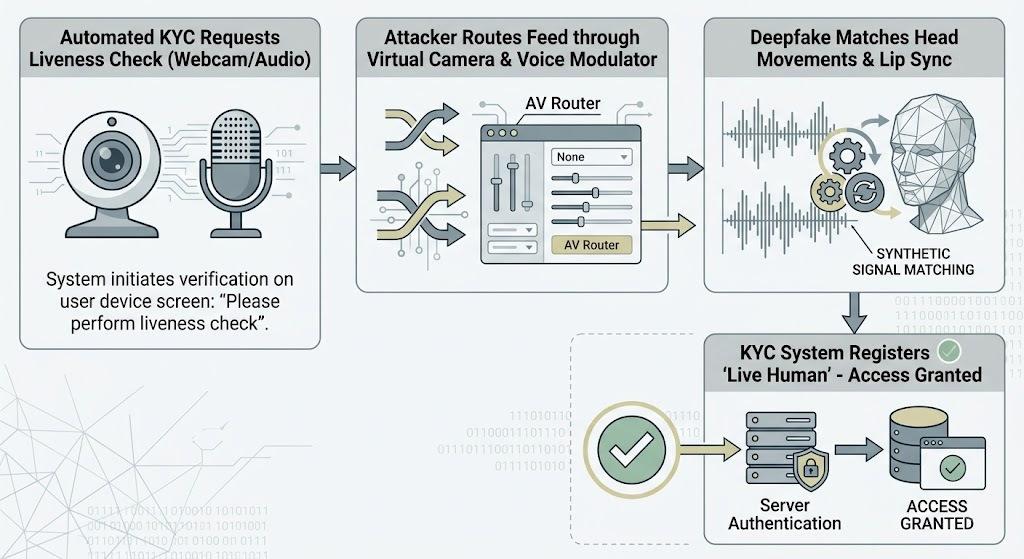
Having a fake ID is one thing, but how do attackers beat the “liveness” check? Most modern KYC (Know Your Customer) systems require the user to look into their webcam, turn their head, and read a randomized phrase to prove they are a live human.
In 2026, deepfakes have evolved from pre-recorded, glitchy videos into real-time, zero-latency digital masks.
Using specialized software that intercepts the virtual camera feed of a device, hackers can map a generated face onto their own. These real-time models perfectly track eye movement, blinking, and lip-syncing. When the KYC platform asks the attacker to “turn your head to the left,” the attacker turns their head, and the deepfake follows flawlessly.
Furthermore, voice cloning models now operate with near-zero latency. By typing into a text-to-speech engine or using a real-time voice modifier trained on a specific audio profile, the attacker can speak to a live human investigator or an automated system in the exact voice of their synthetic persona, or worse, in the exact voice of your company's CEO.
The Help Desk Heist: Social Engineering 2.0
While bypassing financial KYC is lucrative, the ultimate jackpot for cybercriminals is corporate network access. Attackers are using burner identities and deepfakes to execute devastating social engineering attacks against the weakest link in any enterprise: the IT Help Desk.
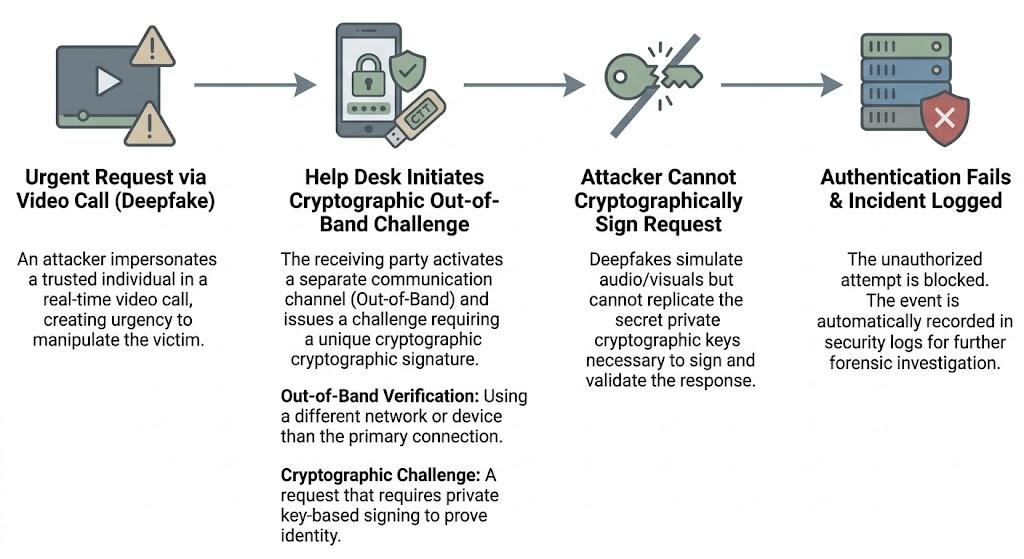
Imagine this scenario: Your Level 1 IT support tech receives an urgent video call on Microsoft Teams. The person on the screen looks exactly like a Senior VP of Finance, and they sound frustrated. They claim their laptop was stolen at an airport, their phone is locked, and they need their multi-factor authentication (MFA) reset immediately to approve an impending wire transfer.
The tech is looking right at them. The face matches the corporate directory. The voice matches. The urgency is high. Human empathy and corporate hierarchy kick in, and the tech resets the MFA, granting the attacker a fresh, authenticated session into the corporate VPN.
This isn't theoretical; it is the modern playbook. When an attacker successfully utilizes a burner identity to bypass human verification, they inherit the privileges of the person they are impersonating.
Defending the Perimeter in the Deepfake Era
To protect your organization against AI-supercharged identity fraud, you must implement systems that assume visual and audio identities can be easily spoofed. Relying purely on human intuition to spot AI anomalies is a losing battle, and traditional training frameworks are completely useless against a perfect deepfake.
1. Shift to Cryptographic Verification
Identity verification can no longer rely solely on a video feed or a voice on the phone. Modern teams must shift from human-based detection to cryptographic and technical verification. If an executive requests an urgent MFA reset or financial transfer, the request must be authenticated using hardware security keys (like YubiKeys) or out-of-band push notifications to pre-registered devices.
2. Enforce Strict Zero Trust Architecture
If an attacker successfully social engineers the help desk and gains a foothold using a deepfake, your internal architecture must limit their blast radius. A verified identity should not equate to infinite trust. Implement microsegmentation and strict role-based access controls (RBAC) so that even if a burner identity breaches the perimeter, they find themselves trapped in a watertight compartment.
How Axeploit Helps You Stay Ahead
You might be wondering: If identity fraud and social engineering are human problems, how does an automated security scanner help?
Because an attacker always needs your application to actually execute the payload, your infrastructure must be designed to implement systems that assume identity can be easily spoofed. When a deepfaked executive tricks an employee into altering a database or authorizing a payment, that employee interacts with your software. If your internal applications are misconfigured, lack strict role-based access controls (RBAC), or contain logic flaws, the social engineering attack succeeds effortlessly.
This is where Axeploit becomes your ultimate safety net. Axeploit actively tests your live, running applications by safely attacking your APIs and internal dashboards from the outside, exactly how a malicious hacker would.
If an internal tool allows unauthorized privilege escalation, or if a backend API is vulnerable to data exfiltration once an attacker gets past the login screen, Axeploit’s dynamic scanner will catch it. We show you exactly how to lock down your business logic so that even if an employee is completely fooled by a deepfake, your infrastructure refuses to let the catastrophic action occur.
Conclusion: Trust Cryptography, Not Your Senses
The commoditization of generative AI has irrevocably broken the foundation of visual and audio trust. As hackers continue to refine burner identities and deploy zero-latency deepfakes, traditional video-based KYC systems and human-led help desks will become increasingly vulnerable. We can no longer assume that a face on a screen or a voice on a call guarantees authenticity.
To survive in this new era, organizations must pivot from human-based detection to cryptographic verification and strict Zero Trust architectures. You must assume that any identity can be spoofed, ensuring that your internal systems are strictly segmented to limit the blast radius of a successful social engineering attack.
By proactively securing your business logic and continuously scanning your live applications with Axeploit, you can prevent attackers from weaponizing your infrastructure, even if they manage to completely fool your employees. The threat of synthetic identities is rapidly accelerating, and your application's armor must be thick enough to withstand the inevitable human error. We recommend checking out Axeploit Blog for more helpful resources on how to defend your organization from frequent and distinct hackers’ attacks.