The hardest security mistake at startup stage is not a dramatic breach. It is assuming that security can wait until the company feels “big enough.” By the time a startup is ready for Series A, the questions have already changed. Investors want to know whether the company can grow without creating hidden risk, and customers want proof that trust is being taken seriously.
Security debt grows faster than product debt
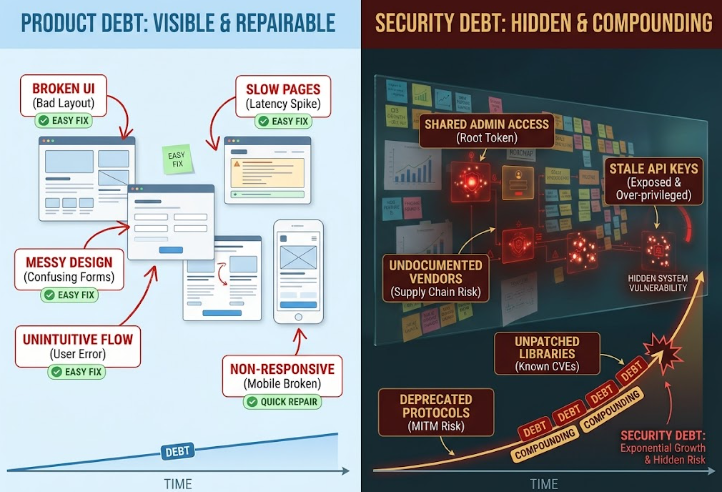
Founders usually track product debt closely. A clunky onboarding flow gets fixed. A broken dashboard gets redesigned. Security debt is different. It hides behind shipping speed and only becomes visible when someone asks for evidence. That is why a startup security posture assessment matters before Series A. It is not about becoming enterprise-ready overnight. It is about knowing where the company is exposed before growth multiplies the problem.
The systemic issue is simple. Early teams optimize for speed, and they should. But speed without structure creates fragile systems. Shared admin accounts, weak access controls, copied secrets, ad hoc vendor tools, and unclear ownership are normal in the early days. None of those choices feel dangerous when the team is five people. At fifty people, they become harder to unwind.
Security posture is really about whether the company can prove control over its own environment. Can it answer who has access to what. Can it detect if something unusual happens. Can it explain how customer data is handled. Can it show that vendors and internal tools are not silently expanding the attack surface. Those questions define whether a startup looks disciplined or improvising.
What investors and customers quietly look for
Series A investors rarely expect perfect security. They do expect signs of maturity. They want to see that the company understands its risks and can manage them without drama. Enterprise buyers are similar. They may not ask for every detail on day one, but they notice whether the startup has a real process or just good intentions.
A founder should think about this in practical terms. If a customer asks for a security review tomorrow, can the team respond with confidence. If an engineer leaves the company, can access be revoked cleanly. If a vendor is compromised, can the blast radius be explained quickly. These are not theoretical questions. They are the ones that separate a business that looks investable from one that looks brittle.
That is also why many startups get surprised later. They assume security only matters after a breach or after enterprise sales begin. In reality, the posture is already being judged. The difference is whether the company is seeing that judgment early enough to act on it.
The checklist that surfaces real risk
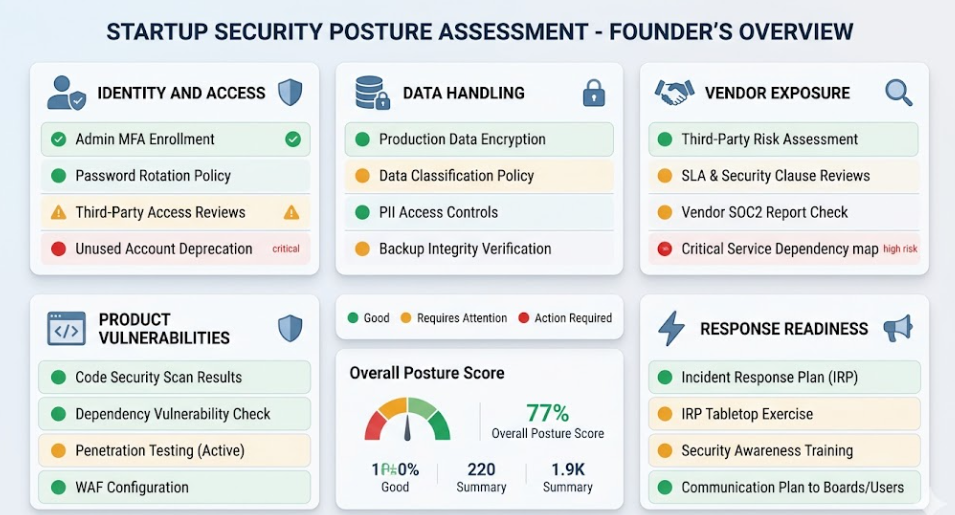
A useful startup security posture assessment should stay close to reality. Start with identity and access. Every important system should have named ownership, unique accounts, and multi-factor authentication. Shared credentials and leftover admin access should be treated as debt, not convenience.
Then look at data handling. Know where customer data lives, who can export it, and which systems store logs or backups. Many startups discover too late that “temporary” data copies became permanent. That is not just a technical issue. It is a trust issue.
Vendor exposure matters too. Startups often stack third-party tools quickly because each one solves a real problem. But every tool extends trust. If the company cannot explain what each vendor touches, what data it receives, and how access is revoked, the posture is weaker than it looks.
Finally, test the product itself. The most common startup flaws are not exotic. They are auth bypass, IDOR, broken access control, insecure file uploads, and business logic gaps. These are the kinds of issues that do not show up in a pitch deck but matter deeply in the real world.
What actually helps before the round
The best founders do not try to solve everything at once. They focus on the few controls that change the story. That means tightening access, documenting data flows, removing obvious weak points, and showing that security has owners. It also means using automation where possible, because manual reviews do not scale well in a startup environment.
A strong posture is less about perfection and more about evidence. Can the company show that it has looked at the real risks. Can it catch obvious issues before customers do. Can it prove that the product is being tested instead of merely hoped into safety. Tools that surface real vulnerabilities early, like Axeploit, help founders see what is exposed without needing a full security team on day one.
Bottom Line
A Series A round does not require a perfect security program. It does require a company that knows its weak points and is actively fixing them. That is what makes a startup look serious to investors, safe to customers, and harder to knock off course later. If you want to understand where your product stands before the next round, you can run an automated scan with Axeploit.