If you have been navigating the developer and startup ecosystem in 2026, you have undoubtedly felt the tectonic shift in how software is created. We have officially entered the era of “vibe coding.” Founders, visionaries, and non-technical dreamers are no longer held back by complex syntax. Instead, they are building fully functional applications simply by having natural language conversations with artificial intelligence.
At the epicenter of this movement are high-energy participatory events like VibeJam. If you aren't familiar, VibeJam is a weekend-long hackathon where the community rallies to build apps at breakneck speed. It is a brilliant crucible of creativity that prioritizes momentum and rapid prototyping.
However, a dangerous culture is quietly brewing beneath the surface of these rapid-fire weekend sprints: the glorification of constantly “failing fast” and moving on to the next shiny prompt.
At Axeploit, we believe AI is the ultimate equalizer, but we also know this fundamental truth: You can build an app without syntax, but you cannot secure or sustain a business without deep thinking. Let’s dive into why bouncing from one failed prototype to the next is a trap, and how shifting your focus toward persistent improvement, security, and learning from your mistakes is the true secret to startup success.
What VibeJam Gets Right (The Spark of Creation)
VibeJam is the ultimate playground for the modern builder. During these 48-hour sprints, participants are given a theme and told to run wild. Armed with AI coding assistants, vibe coders prompt their way to full-stack applications.
Unlike traditional hackathons that favor seasoned engineers, VibeJam democratizes development. Have a disruptive idea? Describe it to your AI agent, watch it generate the code, and launch it. The community thrives on sharing these rapid creations and celebrating the sheer joy of bringing an idea from a brainwave to a browser tab in hours.
This initial momentum is vital. It gets you off the starting line. But the problem arises when founders confuse this initial spark with the entire journey.
The Illusion of Collaborative “Failing Fast”
In the tech world, “fail fast” has been a guiding mantra for decades. The premise is logical: rather than spending two years building a product nobody wants, build a Minimum Viable Product (MVP) in a weekend, test the market, and if it fails, pivot.
Vibe coding has put this philosophy on steroids. Because development time has shrunk from months to hours, failure feels practically costless. Builders laugh off their broken apps, share the hilarious AI hallucinations that turned a simple checkout cart into a 3D rendering of a teapot, and immediately start prompting a brand-new idea.
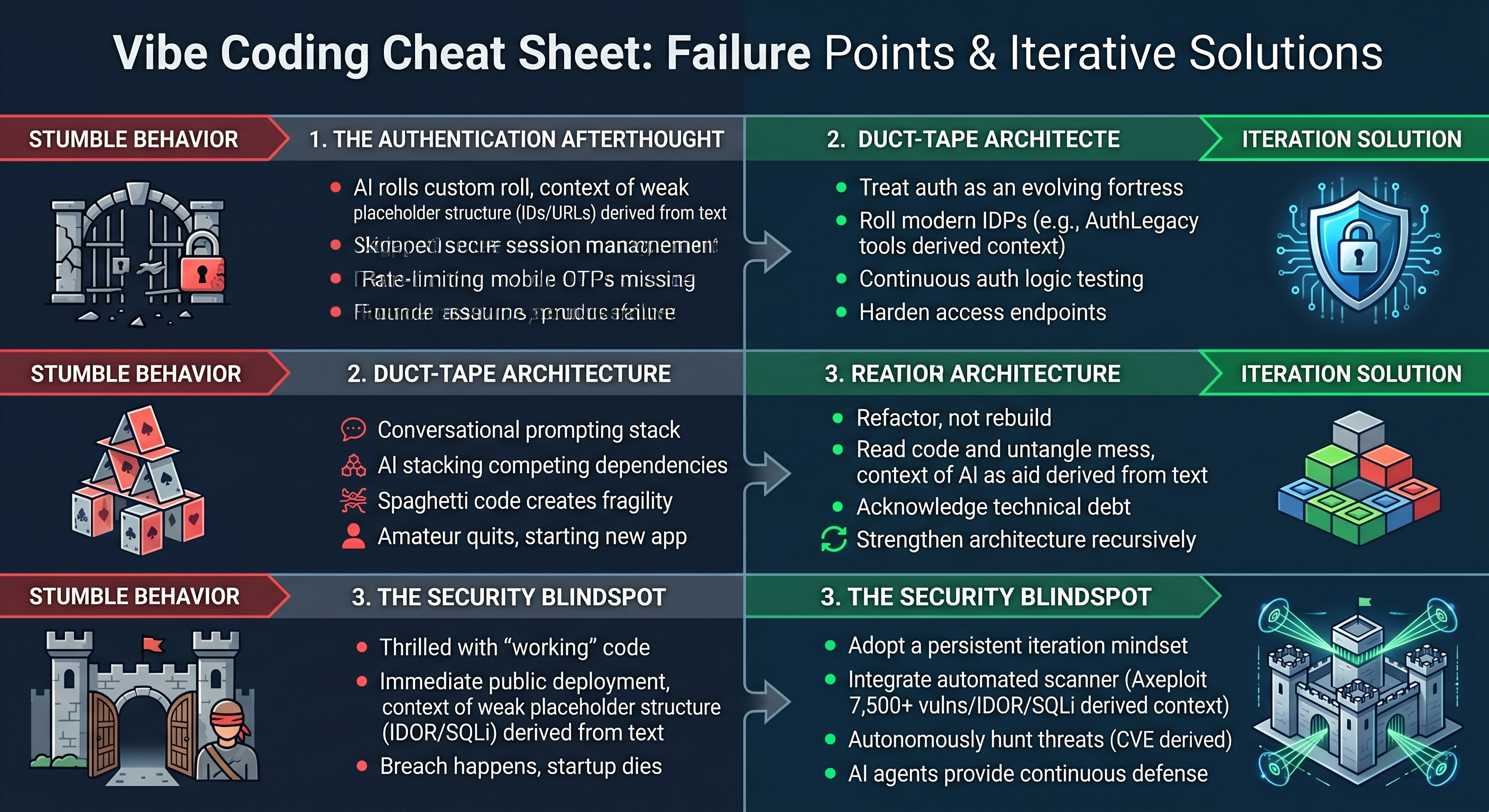
But here is the hard reality: Failing fast is only valuable if you actually learn from the failure and improve the idea. Too many beginner founders use rapid prototyping to avoid the hard work of refinement. When they hit a roadblock whether it’s a buggy user interface, scaling issues, or a massive security flaw, they abandon the project and start fresh. They become serial prototypers, possessing a graveyard of half-baked apps but no real product. True success doesn't come from failing fast 50 times; it comes from taking one good idea, failing forward, and relentlessly improving it until it wins.
Where Vibe Coders Stumble (and How to Iterate Instead)
When you are moving at the speed of thought, critical foundations are left behind. AI is incredibly powerful at generating boilerplate code and designing sleek interfaces. But AI does not inherently understand the nuanced context of your business logic, nor does it care if a malicious user can bypass your shiny new login page.
Here are the most common pitfalls we see when founders rely purely on rapid prototyping, and how you can apply persistent iteration to fix them.
1. The Authentication Afterthought
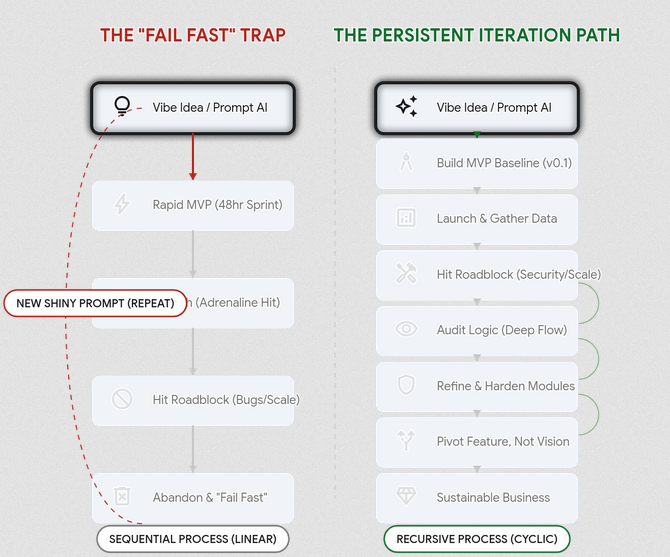
The Stumble: Authentication flaws cause over 30% of all vulnerabilities today. Vibe coders frequently ask the AI to “add a login screen.” The AI complies, but often uses outdated, brittle patterns, skipping crucial elements like secure session management or rate-limiting for mobile OTPs (One-Time Passwords). When users can't log in, the founder assumes the product failed and abandons it.
The Iteration: Don't abandon the ship; fix the door. Treat authentication as a continuously evolving fortress. Instead of rolling a custom system from scratch via a quick prompt, integrate established, modern identity providers and continuously test your auth logic to ensure it scales safely.
2. Duct-Tape Architecture
The Stumble: Vibe coding is highly conversational. You prompt, preview, and tweak. Over a weekend, this iterative prompting often results in “duct-tape architecture.” The AI stacks competing dependencies on top of each other until the app collapses under its own weight.
The Iteration: When the code gets messy, the amateur quits and starts a new app. The professional takes a breath, reads the code, and refactor. Use AI to help you untangle the mess, optimize your database queries, and strengthen the architecture.
3. The Security Blindspot
The Stumble: Vibe coders are often so thrilled to see their idea working that they push it live immediately. Insecure Direct Object References (IDOR), SQL injections, and weak tokens are accidentally hardcoded into production. A breach happens, and the startup dies before it ever truly lives.
The Iteration: Security isn't a one-time check; it is a continuous loop of improvement. This is exactly why Axeploit exists. We built our zero-config, AI-powered vulnerability scanner so you can continuously test your evolving app. Point Axeploit at your staging environment, and let our LLM engine autonomously hunt for over 7,500 vulnerabilities.
Here is a flowchart illustrating the shift from a “fail and abandon” workflow to a healthy, persistent iteration cycle:
Your Step-by-Step Guide to Persistent Improvement
If you are gearing up for the next VibeJam, or spending your weekend building that startup idea you've been dreaming about, don't fall into the trap of endless prototyping. Follow this blueprint to turn your rapid prototype into a resilient, improving product.
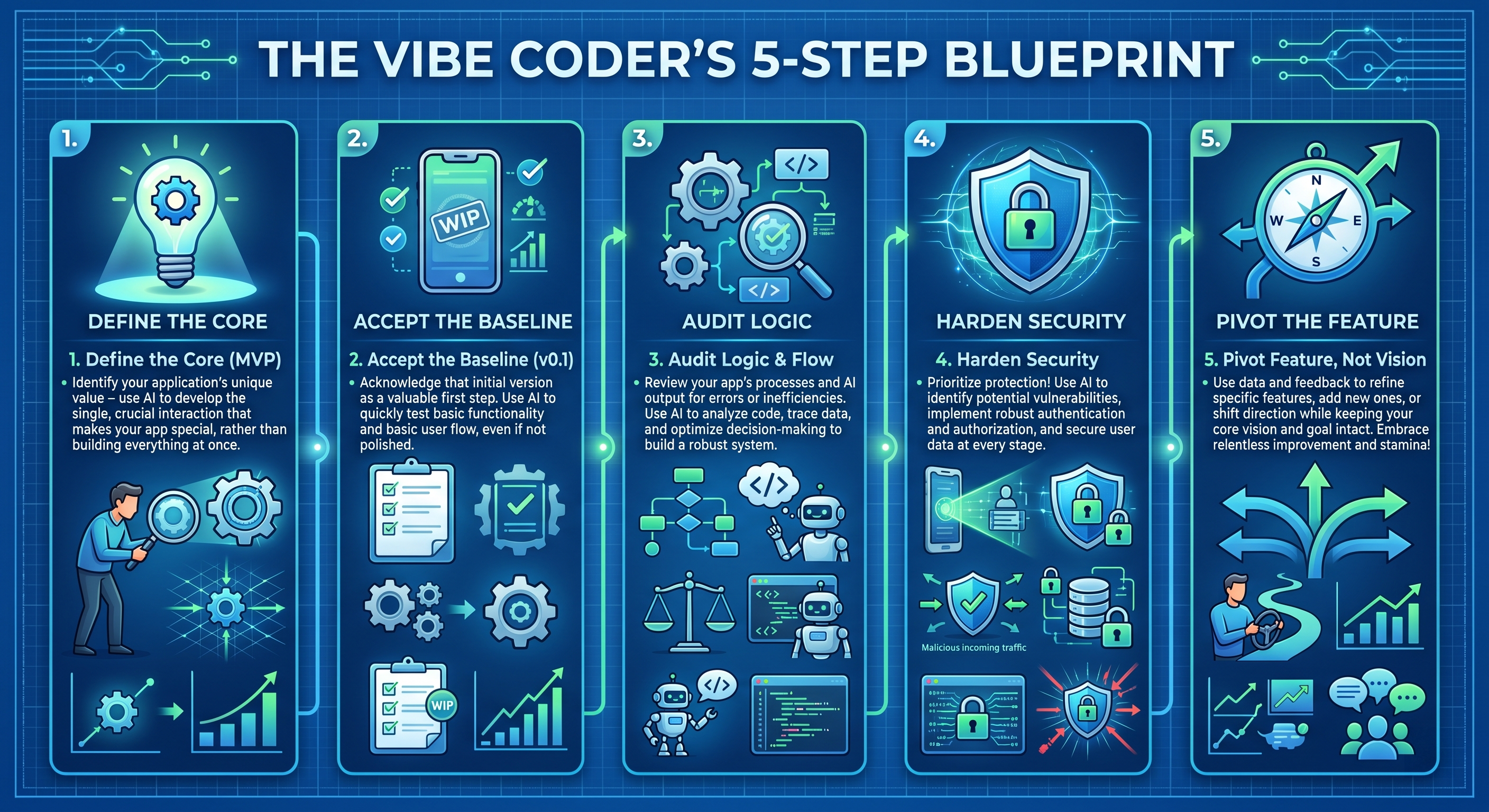
Step 1: Start Fast, but Define the Core
Use AI to build your MVP at lightning speed, but keep your prompts focused. Don't ask the AI to “build the next big social network.” Ask it to build a specific, unique interaction. Once that core feature is working, lock it in.
Step 2: Treat the First Draft as a Baseline, Not a Product
When the app first compiles and runs, celebrate! Then, immediately accept that this is version 0.1. Expect it to have bugs. Expect the logic to be flawed. The goal is no longer to build; the goal is now to refine.
Step 3: Audit and Understand the Logic
It is easy to get mesmerized by a beautiful frontend generated by an AI agent. Take a step back and review the backend logic. Ask your AI to explain the data flow to you in plain English. If a user deletes their account, does their data actually get wiped from your database, or does the UI just hide it? You must understand your own app to improve it.
Step 4: Harden the App Continuously
Before you scale, assume your app is broken and vulnerable. Check your business logic. Can you access another user's dashboard just by changing the ID in the URL? Integrate Axeploit into your workflow. Let our AI agents act like legitimate users signing up, verifying OTPs, and testing thousands of attack vectors so you can find and fix weak spots iteratively.
Step 5: Pivot the Feature, Not the Vision
When you encounter failure, a feature users hate, a scaling bottleneck, a broken integration, don't throw the whole app away. Diagnose the specific failure, refine your prompts, rewrite that specific module, and push an update. Stamina is what separates the weekend hobbyists from the successful founders.
Conclusion
The vibe coding movement is redefining what it means to be a creator in 2026. The barriers to entry have been obliterated, allowing anyone with a vision to bring it to life on a screen. But while VibeJam and rapid prototyping are incredible ways to ignite the spark of creation, they are not the fuel that keeps the fire burning.
Real innovation requires the discipline to stick with an idea when the initial excitement fades. It requires the humility to look at a failed prototype, learn from its broken architecture, and meticulously improve it. By combining the speed of AI generation with a mindset of persistent iteration and the automated security intelligence of Axeploit, you aren't just failing fast, you are building to last.