If you are a Developer, IT Administrator, or Software Engineer building in 2026, you already know that adding “memory” to Artificial Intelligence is the foundation of modern applications. We use Retrieval-Augmented Generation (RAG) to allow large language models (LLMs) to securely search through company documents, chat histories, and proprietary data.
To make this happen, the industry has heavily relied on ChromaDB, a massively popular, open-source vector database designed specifically to store this AI memory. You simply plug it in, and your AI agent instantly becomes smarter.
But while we’ve been racing to build the most helpful AI assistants possible, hackers have been studying the underlying plumbing. Recently, a catastrophic, maximum-severity vulnerability was disclosed in ChromaDB (CVE-2026-45829). This isn't just a minor data leak; it is a critical flaw that allows an entirely unauthenticated attacker to achieve Remote Code Execution (RCE) and completely hijack the server hosting your database.
The Anatomy of the Hijack: CVE-2026-45829 Explained
To understand the exploit, we have to understand what an “embedding function” is. In simple terms, when you feed text into a vector database like ChromaDB, an embedding function translates that human text into a massive array of numbers (vectors) so the AI can process it. ChromaDB often pulls these translation models directly from repositories like HuggingFace.
The vulnerability discovered by security researchers in 2026, revealed that ChromaDB implicitly trusted whatever model name a user supplied.
If an attacker passes a specially crafted, malicious HuggingFace model reference to the database, the server will dutifully download and run it. Because these models can contain executable code, the attacker successfully triggers Remote Code Execution (RCE). This means the hacker can run their own malicious scripts on your machine, granting them full administrative control over your server, your data, and potentially your entire cloud environment.
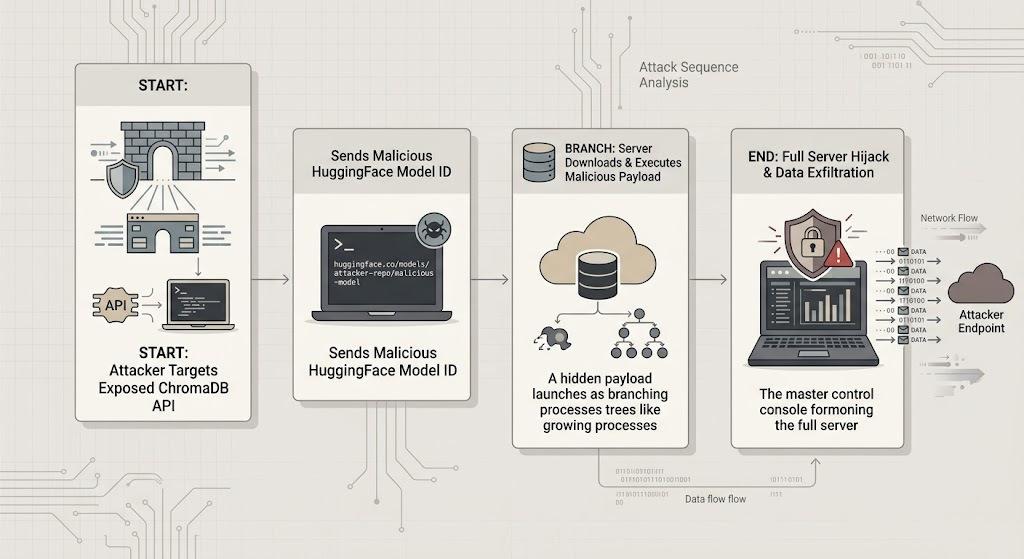
How Hackers Exploit the “Authentication Gap”
You might be wondering: “Wait, doesn't ChromaDB require a password or an API token to create a new database collection?”
Yes, it does. In the official documentation, the specific API endpoint targeted by this exploit (POST /api/v2/tenants/{tenant}/databases/{db}/collections) is clearly labeled as an authenticated route. This means the server should reject any request that doesn't have the right ID badge.
However, the root cause of CVE-2026-45829 is a fatal timing error in how the code was written. The vulnerability stems from two independent failures compounding on one another:
- Unrestricted Trust: The server trusts client-supplied model identifiers via the kwargs (keyword arguments) parameter without sanitizing them.
- The Timing Flaw: The server loads and instantiates the embedding function before it actually executes the authentication check.
Imagine a highly secure corporate building. The security guard is supposed to check your ID before letting you in. But in this scenario, the guard takes a mysterious package from an unverified stranger, opens it, and executes the instructions inside before asking to see the stranger's ID. By the time the guard realizes the stranger isn't authorized, the bomb has already gone off.
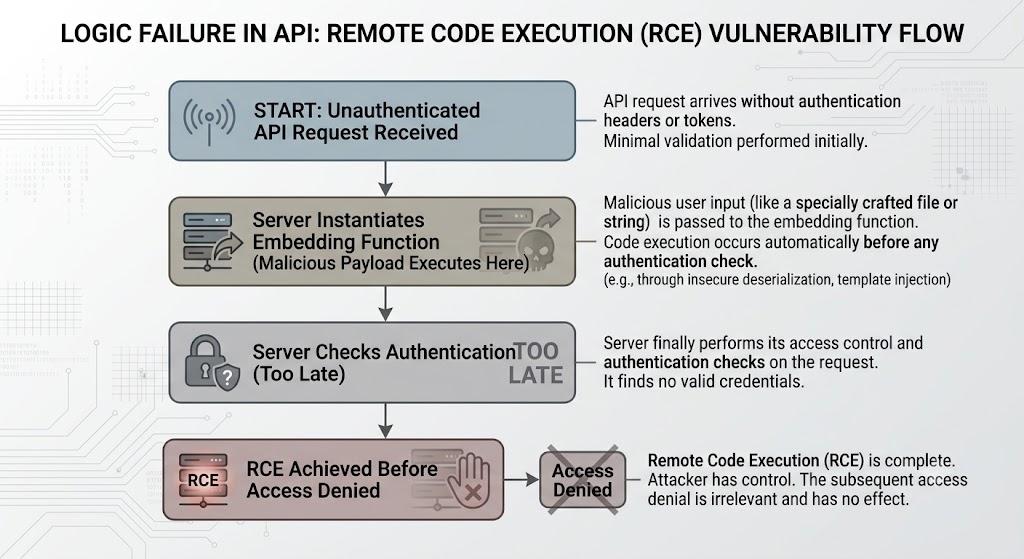
Why the Python FastAPI Server is the Weak Link
It is important for Software Engineers to note that this flaw specifically impacts the Python FastAPI implementation of ChromaDB (affecting versions 1.0.0 through 1.5.8). The newer, Rust-based frontend of ChromaDB is architecturally different and is not affected by this specific instantiation flaw.
Step-by-Step Guide: How to Stay Safe and Lock Down Your Database
Because this vulnerability allows unauthenticated attackers to bypass security perimeters, waiting for an official Python patch to propagate through your dependencies is highly dangerous. You need to take immediate action to secure your pipeline.
Here are the exact steps IT Administrators and Developers must follow to neutralize the threat:
Step 1: Audit Your Deployment Path
Check your current infrastructure to see which version and deployment path of ChromaDB you are actively running. If you are running the Python FastAPI server between versions 1.0.0 and 1.5.8, you are actively vulnerable.
Step 2: Migrate to the Rust-Based Backend (Recommended)
The absolute safest mitigation strategy is to transition away from the Python server.
- Action: Switch your deployment to favor the Rust-based path (using the chroma run command or official Docker Hub images released since version 1.0.0). The Rust frontend safely handles authentication timing and is not vulnerable to this exploit.
Step 3: Restrict Network Access (If Python is Unavoidable)
If legacy dependencies force you to remain on the Python FastAPI server, you must immediately implement strict network compartmentalization.
- Action: Never expose your ChromaDB port directly to the public internet. Use your cloud provider's firewall (like AWS Security Groups) to ensure that only trusted internal clients (such as your own backend application servers) can communicate with the ChromaDB port.
Step 4: Strip Malicious Request Arguments
If you have an API Gateway or a Web Application Firewall (WAF) sitting in front of your internal network, you can block the specific exploit technique.
- Action: Configure your WAF or internal routing logic to inspect requests heading to the create_collection endpoints and aggressively strip any keys named "kwargs" before the request reaches the ChromaDB server.
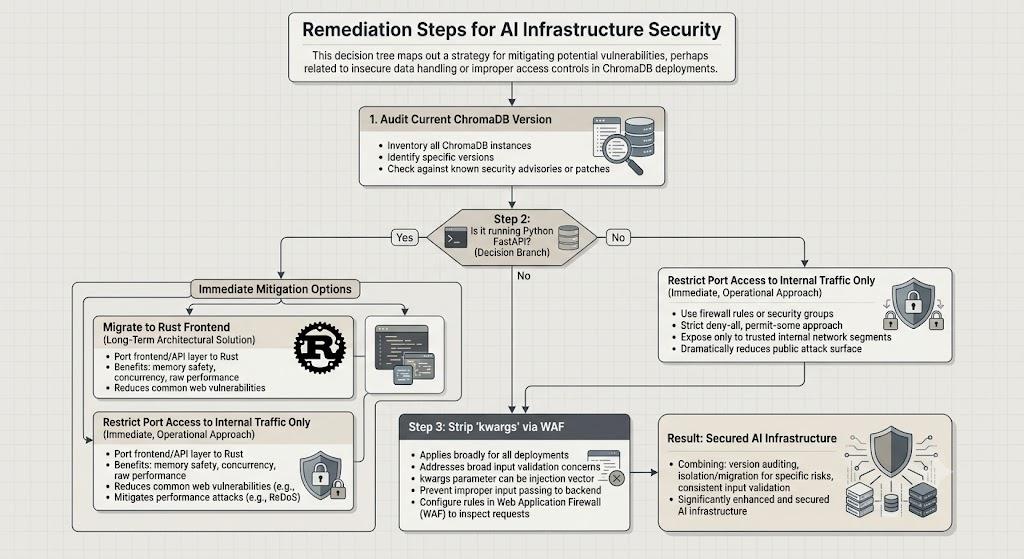
Conclusion: Securing the AI Supply Chain
The rapid integration of AI agents and vector databases has given modern developers unprecedented power, but it has also introduced a terrifying new attack surface. The ChromaDB CVE-2026-45829 vulnerability serves as a massive wake-up call for the industry: we cannot blindly trust our infrastructure just because it handles “AI data.”
When an unauthenticated request can bypass authentication purely due to a timing flaw, passive defense is no longer enough. IT administrators and developers must adopt a DevSecOps mindset, enforcing strict network boundaries, isolating critical database ports, and deeply scrutinizing how third-party models are ingested into production environments. We recommend checking out Axeploit’s blog for more helpful resources.