Living off the Cloud: How Hackers Pivot Inside AWS and Azure Environments
If you are a Security Operations Center (SOC) Analyst, a Cloud Security Engineer, or a Threat Hunter operating in 2026, you already know the painful truth: the era of catching bad actors purely by identifying malicious payloads is over. Today, the most devastating cloud breaches don’t rely on zero-day malware or noisy ransomware droppers. Instead, they rely on perfectly legitimate administrative tools, a tactic that is turning modern cloud security inside out.
Once an attacker breaches a cloud environment, they ditch traditional hacking tools and weaponize your own infrastructure against you. This is known as “Living off the Cloud,” the modern, cloud-native evolution of living off the land (LOTL).
In this guide, we will break down the exact mechanics of how threat actors use native APIs to achieve unseen lateral movement, map out the forensic artifacts they leave behind, and show you how to regain your SOC visibility without slowing down your DevOps team’s automated workflows.
The Evolution of the Breach: Why Malware is Dead in the Cloud
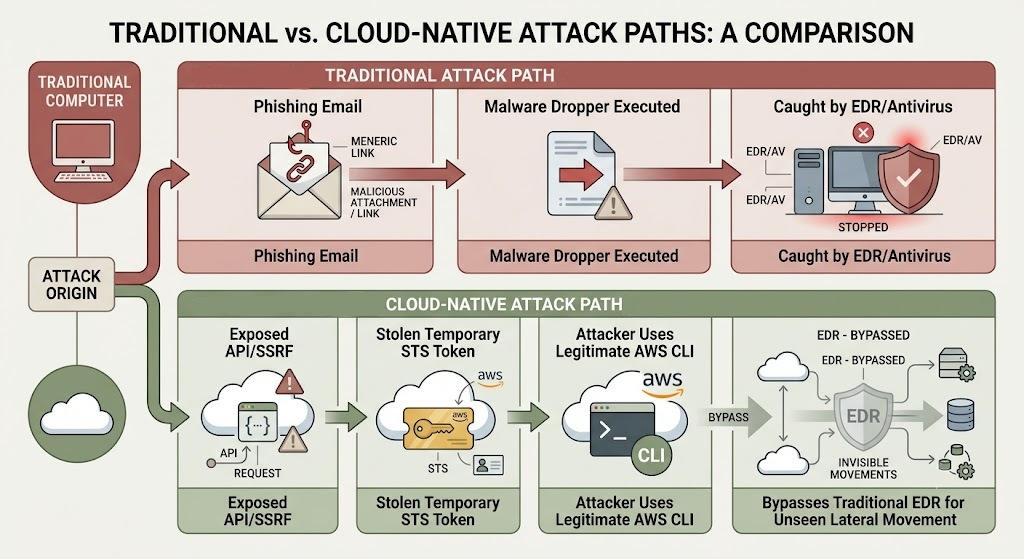
In a traditional on-premise attack, an intruder gains initial access and immediately calls back to a Command and Control (C2) server to download secondary malware, rootkits, or credential dumpers like Mimikatz. That activity is noisy and easily flagged by standard Endpoint Detection and Response (EDR) solutions.
But in the cloud, computing power and identity are intertwined. Why would an attacker risk triggering an alarm by downloading a sketchy executable when they can simply use the AWS Command Line Interface (CLI) or Azure PowerShell modules? By hijacking a developer's dynamic token or exploiting an overly permissive machine identity, attackers seamlessly blend in with the thousands of automated deployment scripts running every minute.
The Mechanics of AWS Exploitation
AWS exploitation rarely looks like a Hollywood hacking montage. It looks like routine IT administration.
The attack sequence usually begins with a minor misconfiguration, perhaps an exposed Server-Side Request Forgery (SSRF) vulnerability on an EC2 instance, or a developer accidentally committing a temporary session token to a public GitHub repository. Once the attacker has that initial foothold, they begin their reconnaissance using built-in, seemingly harmless API calls.
They will start with sts:GetCallerIdentity to see who they are, followed by ec2:DescribeInstances or iam:ListRoles to map out the environment. If the compromised identity has the sts:AssumeRole permission, the real danger begins. The attacker will perform role-chaining, continuously assuming higher-privileged IAM roles until they locate a role with access to secretsmanager:GetSecretValue or s3:GetObject.
Because these API calls look identical to a Terraform script provisioning a new environment, they often sail right past traditional SIEM alerts.
Navigating the Azure AD Labyrinth
The threat landscape in Microsoft’s ecosystem is equally treacherous. In Microsoft Entra ID (the 2026 standard that fully replaced the legacy Azure AD name, though the underlying mechanics remain the same), attackers exploit the complex web of service principals and application permissions.
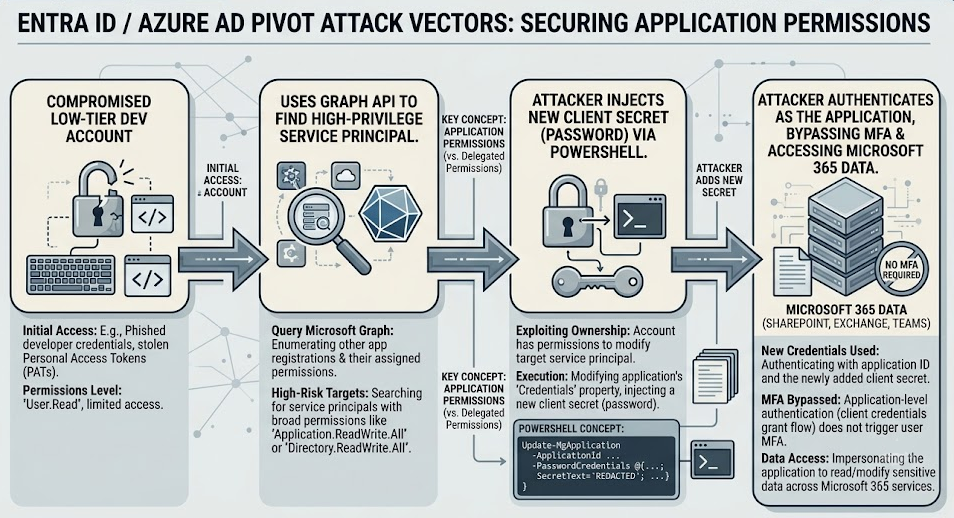
Instead of trying to hack a Global Administrator account, which is typically protected by hardware security keys and strict Conditional Access Policies, attackers target automated Service Principals. If an attacker compromises a developer account with “Application Administrator” rights, they don't need to break into a database directly. They simply use native Graph API calls to add a new client secret (password) to an existing, highly privileged OAuth application.
Once they generate that new secret, they can authenticate as the application itself, entirely bypassing Multi-Factor Authentication (MFA) and conditional access rules.
Restoring SOC Visibility Without Breaking DevOps
The hardest job for a modern SOC Analyst is tuning detection engines to catch Living off the Cloud attacks without generating massive alert fatigue. If you alert on every AssumeRole or every Azure Graph API call, your Threat Hunters will drown in false positives, and your DevOps engineers will revolt.
To achieve true SOC visibility, you must shift from static, rule-based correlation to behavioral and contextual anomaly detection.
Hunting for Forensic Artifacts
Instead of looking at the action, Threat Hunters must analyze the context of the API call. Here are the critical forensic artifacts you should be extracting from AWS CloudTrail and Azure Monitor logs:
- Anomalous User-Agent Strings: Developers typically use specific, updated versions of the AWS CLI or Terraform. If an API call to sts:AssumeRole is made by an IAM user who normally uses Terraform, but the User-Agent suddenly reads Boto3 (Python) or a severely outdated CLI version, flag it immediately.
- Impossible Travel for Machine Identities: A Service Principal or an EC2 instance profile should only execute API calls from within your specific cloud region's IP space. If an AWS STS token assigned to an us-east-1 EC2 instance is suddenly used to make API calls from a residential VPN IP in another country, you are actively being breached.
- Rapid Role-Chaining: Configure your AI threat detection models to alert on velocity. If an identity runs GetCallerIdentity, ListRoles, and AssumeRole within three seconds of each other, especially if that identity has never performed those actions sequentially, it is a strong indicator of an automated attacker script.
Axeploit: Active Defense for the Modern Cloud
Passive logging and SIEM tuning are critical, but in 2026, they are no longer sufficient on their own. By the time an anomaly hits your CloudTrail logs, the attacker is already moving laterally. You need to identify the exposed paths before the attacker does.
This is where traditional static security fails, and where Axeploit becomes an indispensable extension of your security team.
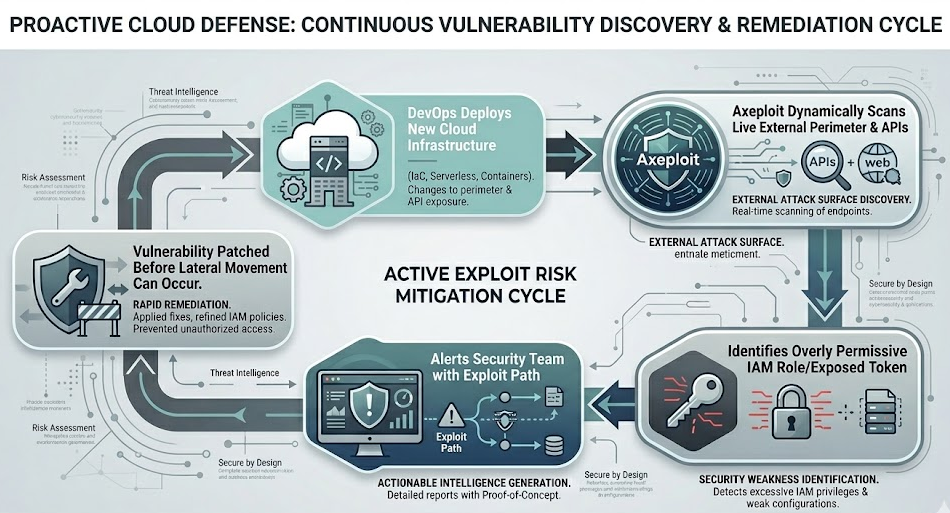
Living off the Cloud relies entirely on exploiting excessive permissions and misconfigured APIs. Axeploit doesn't just read your infrastructure-as-code on paper; our dynamic API checker and automated vulnerability scanner actively probe your live, running cloud environments from the outside. We physically test the reality of your deployed architecture, behaving exactly like an advanced persistent threat.
If a vibe coder accidentally deployed a microservice with an overly permissive IAM role, or left an Azure function exposed without requiring a token, Axeploit’s dynamic engine will catch it instantly. We flag the exact lateral movement path and provide your platform engineers with clear, actionable remediation insights before the infrastructure goes into production.
Conclusion: Shut Down the Native Playground
The reality of 2026 is that attackers are no longer breaking into your cloud; they are simply logging in and using your own administrative tools against you. As long as your environment contains over-permissioned machine identities and unchecked APIs, threat actors will continue living off the land without setting off traditional alarms. Regaining true SOC visibility means abandoning outdated, static rules and embracing contextual, dynamic defense.
Your DevOps teams shouldn't have to choose between speed and security. By proactively hunting for misconfigurations and actively testing your perimeter with automated tools, you strip attackers of their native advantages.