If you are a DevOps engineer, a Security Operations Center (SOC) analyst, or a Cloud Security Architect operating in 2026, you are likely accustomed to a high-velocity development cycle. The modern software ecosystem is built on rapid deployment, automation, and an endless stream of open-source dependencies. We pull from npm, PyPI, and GitHub to build faster and ship continuously. But as we have accelerated our pipelines, advanced threat actors have completely shifted their crosshairs. They are no longer just attacking the software we build; they are attacking the people who build it.
The recent, historic disruption of the notorious “GlassWorm” botnet by CrowdStrike, Google, and the Shadowserver Foundation is a massive wake-up call for the cybersecurity industry. Since early 2025, GlassWorm has systematically infiltrated developer environments, poisoning the very tools we trust to write and deploy code.
Here is a technical breakdown of how hackers used GlassWorm to remotely control infected systems, why their infrastructure was so resilient against takedowns, and a step-by-step guide to locking down your DevOps pipeline before the next supply chain attack hits.
Anatomy of a Breach: How GlassWorm Hijacked Developer Environments
The barrier to poisoning a package or a code editor extension is shockingly low, but the blast radius is enormous. GlassWorm did not rely on complex zero-day vulnerabilities in enterprise firewalls to breach corporate networks. Instead, the attackers deployed trojanized Visual Studio Code (VS Code) extensions through the OpenVSX marketplace and the official VS Code Marketplace, alongside poisoned npm and Python packages.
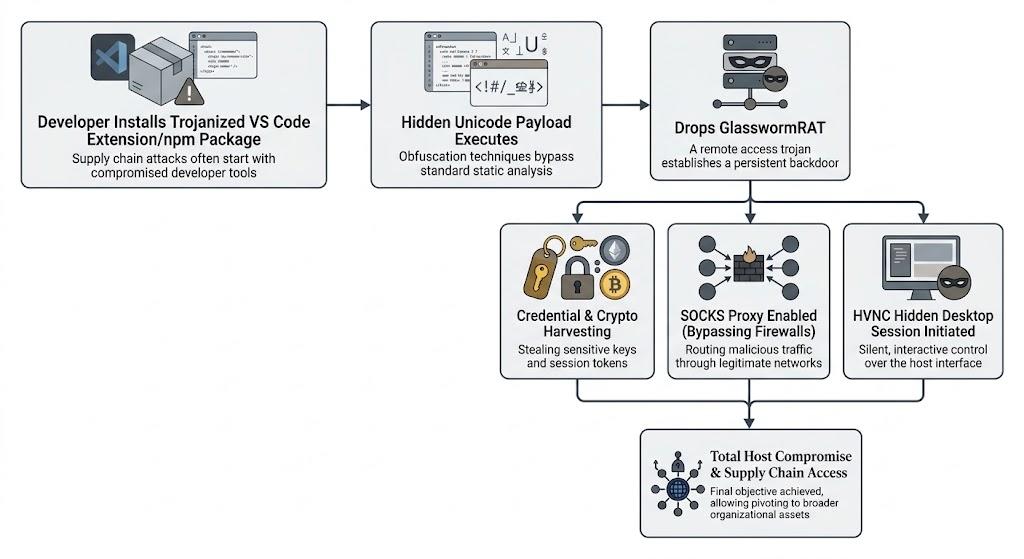
When a developer installed a seemingly benign extension to format code or manage integrations, the payload was silently activated. To evade detection during manual code reviews and security audits, the attackers utilized a brilliant and terrifying technique: they hid their malicious logic using invisible Unicode characters within the code itself. To the human eye, the code looked perfectly clean. To the compiler, it was a ticking time bomb.
Stealth and Remote Control: Explaining the Mechanics
Once the GlassWorm malware executed on a developer's machine, it deployed a highly sophisticated, Node.js-based Remote Access Trojan known as GlasswormRAT. While it infected multiple operating systems, it showed a specific, highly advanced focus on compromising macOS developer environments.
For those less familiar with offensive tradecraft, let's simplify how hackers used this specific malware to completely control infected systems:
- RAT (Remote Access Trojan): Think of a RAT as a digital backdoor. Once installed, it gives the attacker a direct, remote control panel to the victim’s machine, allowing them to steal files, execute commands, and deploy further malware without the user ever knowing.
- Credential and Crypto Harvesting: The malware actively searched the developer's host machine for GitHub tokens, NPM access keys, and cryptocurrency wallets. It even hunted for hardware wallet applications (like Ledger Live), systematically replacing legitimate software with trojanized clones to steal seed phrases. By stealing developer credentials, attackers could force-push malicious code into a company's official repositories, turning a single compromised laptop into a massive supply chain breach.
- SOCKS Proxies: GlassWorm converted the infected developer machine into a covert SOCKS proxy. This essentially turned the laptop into a secure routing node. Hackers could route their own malicious traffic through the developer's IP address, allowing them to bypass corporate firewalls and access internal, restricted networks completely anonymously.
- HVNC (Hidden Virtual Network Computing): Standard screen-sharing (like a Zoom meeting) is visible to the user. HVNC allows the attacker to open a hidden, secondary desktop session on the infected machine. The attacker can interact with applications, open web browsers, and steal data in real time, completely invisible to the developer who is actively using the computer.
The Multi-Headed Hydra: GlassWorm's Resilient C2 Infrastructure
A botnet is only as strong as its Command and Control (C2) network, the centralized servers hackers use to send instructions to infected machines. Usually, when threat intelligence researchers identify a C2 server, they work with hosting providers to simply take it offline.
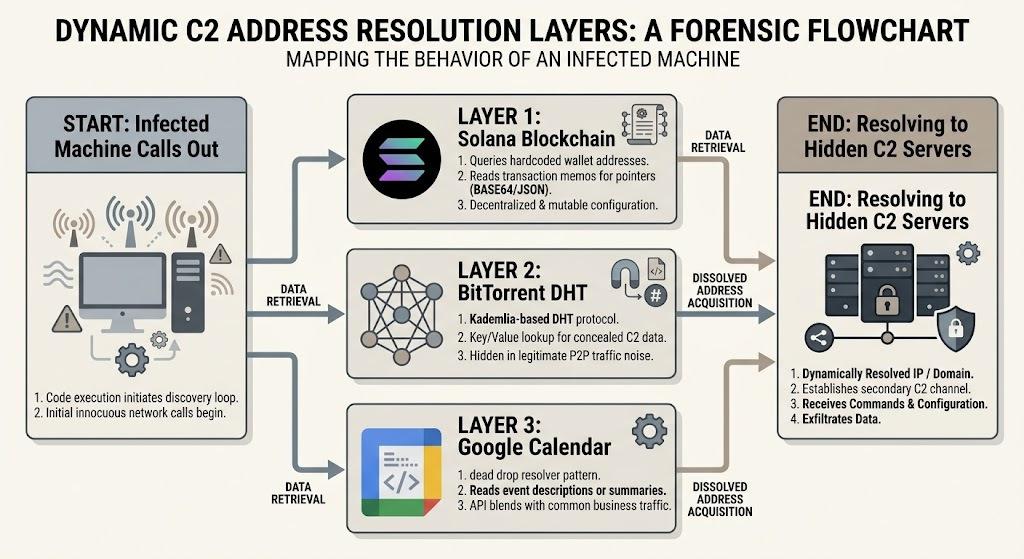
GlassWorm operators anticipated this. They built a dynamic, multi-layered infrastructure designed to resist traditional takedowns:
- Blockchain Dead Drops: The attackers stored their C2 server addresses in the memo fields of transactions on the Solana blockchain. Because blockchain ledgers are immutable (unchangeable) and publicly decentralized, authorities couldn't just “delete” the instructions.
- BitTorrent P2P Networks: GlasswormRAT queried the BitTorrent peer-to-peer network for configuration data stored against hardcoded public keys, ensuring there was no single point of failure in their communication chain.
- Legitimate Web Services: They even used Google Calendar event titles to host Base64-encoded C2 paths, hiding malicious routing instructions in plain sight on a highly trusted, globally allowed platform.
Taking down just one of these channels would have been useless. The botnet would simply pivot to the next. The May 2026 takedown was historic precisely because the coalition of cybersecurity firms managed to sever all four channels simultaneously, effectively decapitating the botnet and cutting the hackers off from their infected hosts.
Step-by-Step Guide: How to Stay Safe from Next-Gen Supply Chain Hackers
While the GlassWorm infrastructure has been disrupted, the playbook they created is already being copied by other cybercriminal syndicates. Securing your software factory is no longer optional.
If you are a SOC analyst, security architect, or DevOps engineer, you must implement these step-by-step actions to secure your supply chain immediately:
Step 1: Rotate All Exposed Developer Credentials
If a developer in your organization downloaded a suspicious VS Code extension or an untrusted open-source package anytime in the last year, you must assume their access tokens are compromised.
- Action: Immediately revoke and rotate all GitHub, NPM, AWS, and OpenVSX access tokens. Implement emergency credential rotation procedures for all developers, paying extra attention to those using macOS environments.
Step 2: Implement Strict Extension Whitelisting
Developers should not be allowed to download arbitrary extensions from public marketplaces on corporate machines. The barrier for attackers to upload trojanized tools is simply too low to rely on blind trust.
- Action: Enforce strict allow-lists for IDE extensions (whether you are using VS Code, Cursor, or Positron). Require mandatory security reviews for any new third-party libraries or development tools before they are introduced into your build environment.
Step 3: Hunt for Known Indicators of Compromise (IoCs)
As part of the coordinated takedown, security researchers “sinkholed” the malware. This means they redirected infected machines to communicate with a safe, benign server rather than the hacker's actual C2.
- Action: Have your SOC analysts immediately review network logs and endpoint telemetry for any outbound connections to the IP address 164.92.88.210. Any machine beaconing to this IP is confirmed to be infected with GlassWorm and requires immediate isolation and remediation.
Step 4: Secure Your DevOps Pipeline with Zero Trust
A compromised developer account should not mean an automatically compromised production environment.
- Action: Enforce Multi-Factor Authentication (MFA) for every code commit and package publish. Apply the principle of least privilege, ensure your CI/CD pipeline tokens only have the minimum permissions necessary to function.
Conclusion
The GlassWorm takedown of 2026 marks a permanent shift in the cybersecurity landscape. Adversaries are no longer satisfied with hacking your product after it is built; they want to poison the factory where it is assembled.
For DevOps teams and security architects, relying on passive firewalls and basic antivirus is a recipe for a catastrophic breach. You must adopt a true DevSecOps mindset, continuously verify your dependencies, and rigorously control your developer environments. This is exactly where dynamic, automated testing becomes critical. While static code reviews often miss obfuscated threats like invisible Unicode characters, advanced dynamic vulnerability scanners actively monitor how your applications and APIs behave in real time.