Traditional Dynamic Application Security Testing (DAST) tools were built for a different era.
An era where applications consisted of static pages, visible forms, and predictable navigation paths.
Modern applications look nothing like that.
Single-page applications, API-first architectures, OAuth flows, multi-step onboarding, tenant isolation, and complex authorization models have fundamentally changed how attackers interact with software. Yet many security tools still operate using methodologies designed decades ago.
Attackers evolved.
Applications evolved.
Security testing must evolve as well.
This is where AI-powered security agents are changing the landscape.
Unlike traditional scanners that simply crawl pages and inject payloads, AI agents can register accounts, authenticate, navigate workflows, understand application context, and reason about attack opportunities much like a human pentester.
The result is a new generation of security testing that focuses on how real attackers operate rather than how scanners operate.
Why Traditional DAST Falls Short
Most DAST tools follow a simple workflow:
- Discover URLs
- Crawl pages
- Inject payloads
- Match responses against known signatures
- Generate findings
While effective for detecting certain technical vulnerabilities, this approach struggles against modern applications.
Today's attack surface often exists behind:
- Authentication barriers
- Multi-step workflows
- Dynamic JavaScript rendering
- API endpoints
- Tenant-specific functionality
- Business logic processes
A scanner cannot effectively test functionality it cannot understand.
As a result, security teams often encounter:
- High false positive rates
- Poor authenticated coverage
- Missed business logic flaws
- Limited API visibility
- Incomplete attack path analysis
The problem is not speed.
The problem is context.
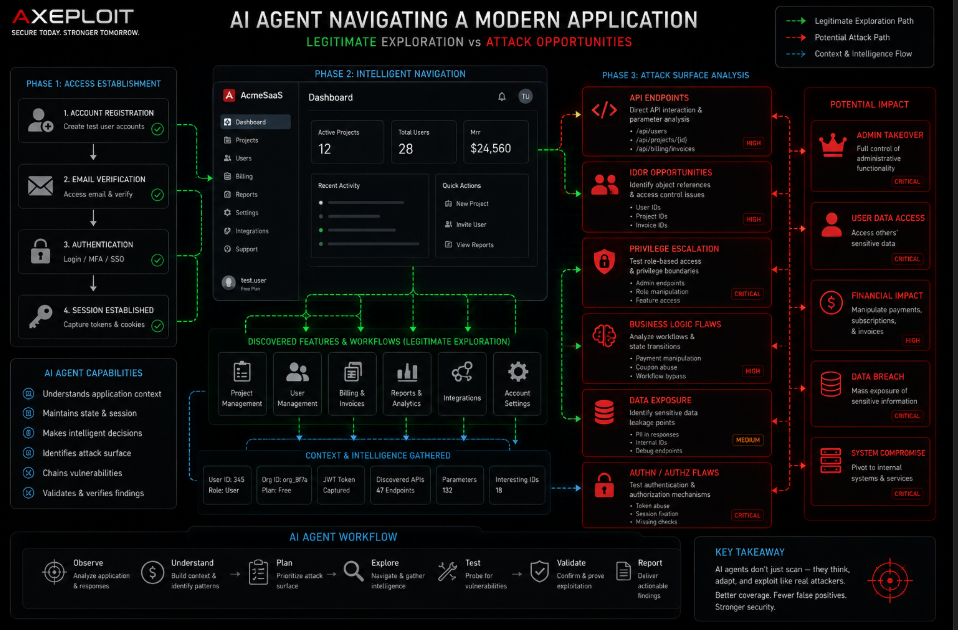
Phase 1: Autonomous Registration and Identity Establishment
Before an attacker searches for vulnerabilities, they first establish access.
AI agents follow the same approach.
Rather than immediately launching payloads against an application, the agent begins by understanding how users enter the system.
This may involve:
- Account registration
- Email verification
- OAuth authentication
- SSO workflows
- Multi-factor authentication
- Tenant onboarding
The agent creates test identities, captures tokens, stores session information, and maps user permissions.
Unlike legacy scanners, it understands that authentication is not merely a page to visit.
It is a state that must persist throughout the assessment.
Every JWT, session cookie, user identifier, and role assignment becomes intelligence for future testing.
Phase 2: Understanding the Application Like a User
Once authenticated, the agent begins exploring the application.
Not by blindly clicking links.
By reasoning.
An AI agent can identify:
- Administrative functionality
- Account management features
- Document storage systems
- Payment workflows
- User management portals
- API integrations
Rather than treating every page equally, the agent prioritizes functionality based on security relevance.
A billing portal receives more attention than a marketing page.
An account settings section receives more attention than a help center.
This mirrors the decision-making process used by experienced security researchers.
Every action generates context.
Every response expands understanding.
Every discovered object becomes a potential attack vector.
Phase 3: Discovering Real Vulnerabilities
The greatest advantage of AI-driven testing is not automation.
It is contextual testing.
IDOR and Access Control Testing
One of the most common vulnerabilities in modern applications remains broken access control.
To discover these issues, the agent creates multiple identities and observes how resources are accessed.
When one user accesses:
/api/documents/4491
The agent immediately tests whether another authenticated user can access the same resource.
This allows it to identify:
- IDOR vulnerabilities
- Authorization flaws
- Tenant isolation failures
- Object ownership issues
The testing process resembles the methodology used by human bug bounty hunters rather than automated scanners.
Authentication and Verification Flaws
Authentication workflows remain one of the most under-tested areas in application security.
AI agents systematically evaluate:
- OTP validation logic
- Password reset workflows
- Email verification systems
- Token generation mechanisms
- Session management
- MFA implementation
Instead of identifying the presence of a security control, the agent evaluates whether the control can be bypassed.
This distinction is critical.
A login system that appears secure may still contain exploitable logic flaws.
API Security Assessment
Modern applications rely heavily on APIs.
AI agents directly interact with backend services to uncover:
- Broken Object Level Authorization (BOLA)
- Excessive data exposure
- Parameter manipulation vulnerabilities
- Business logic flaws
- Privilege escalation opportunities
Because APIs often expose the application's true functionality, they frequently become a primary focus during assessment.
The Power of Vulnerability Chaining
The most impactful security findings rarely originate from a single vulnerability.
Real attackers combine weaknesses.
A seemingly low-risk information disclosure reveals an internal identifier.
That identifier enables access control testing.
The access control issue exposes administrative functionality.
Administrative functionality leads to sensitive data access.
Individually, each finding may appear minor.
Together, they become a critical compromise.
Traditional tools treat vulnerabilities as isolated events.
AI agents build relationships between findings.
They maintain context across the entire assessment, allowing them to identify attack paths that span multiple systems and workflows.
This is where some of the most valuable security discoveries emerge.
Reducing False Positives Through Validation
One of the biggest frustrations in security testing is false positives.
Security teams often spend significant time validating findings that ultimately prove non-exploitable.
AI agents take a different approach.
Before reporting a vulnerability, the agent attempts to validate exploitation.
A finding is supported by:
- Request sequences
- Reproduction steps
- Impact evidence
- Exploitation context
If the vulnerability cannot be demonstrated, it is less likely to be reported.
This produces fewer alerts but significantly higher confidence.
For security teams, actionable findings are far more valuable than large volumes of unverified noise.
What This Means for Security Teams
AI agents are not replacing penetration testers.
They are augmenting them.
The repetitive tasks that consume significant testing time can be automated:
- Account creation
- Workflow exploration
- API enumeration
- Authorization testing
- Authentication validation
- Attack surface mapping
This allows security professionals to focus on:
- Complex attack chains
- Creative exploitation
- Advanced threat modeling
- Strategic security improvements
The combination of human expertise and AI-assisted testing creates significantly stronger security coverage than either approach alone.
Conclusion
Modern attackers do not think like scanners.
They create accounts.
They explore applications.
They test workflows.
They abuse business logic.
They chain vulnerabilities.
They reason.
AI-powered security agents are bringing those same behaviors into modern security testing.
Instead of simply discovering inputs and injecting payloads, they establish identities, navigate applications, analyze context, validate vulnerabilities, and uncover attack paths that traditional tools frequently miss.
As applications become more complex and attack surfaces continue to expand, security testing must move beyond crawling and signature matching.
The future of offensive security is not just automated.
It is autonomous, contextual, and capable of thinking like an attacker.
Organizations that adopt these capabilities early will gain a significant advantage in identifying vulnerabilities before adversaries do.