
If you are a DevOps Engineer, a Cloud Architect, or a DevSecOps professional operating in 2026, you already know that speed and scalability are the lifeblood of modern deployment pipelines. We no longer manually click through cloud consoles or run ad-hoc shell scripts to spin up environments. Instead, we treat our infrastructure exactly like software application code. We define entire global networks, database clusters, and identity management policies using clean, declarative configuration files.
Whether your enterprise relies on the absolute dominance of Terraform HCL or has transitioned to the programmatic power of Pulumi, Infrastructure as Code (IaC) has successfully broken down the traditional walls between development and operations.
But this massive paradigm shift has not gone unnoticed by advanced threat actors. As engineering teams have aggressively shifted security testing left into the repository, hackers have shifted their exploitation focus left as well. Instead of attacking your hardened runtime perimeter, they are targeting the very blueprints used to build your environments. Welcome to the era of IaC poisoning, a silent, devastating breach of the software supply chain where your own automation tools are weaponized to engineer your downfall.
The Leftward Shift: How Attackers Poison the Blueprint
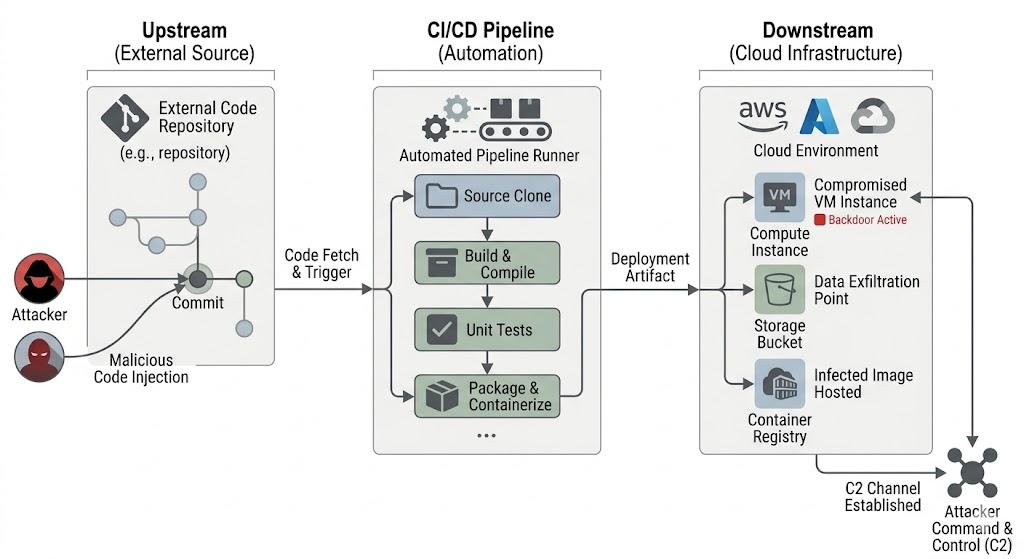
To understand the mechanics of an IaC poisoning campaign, we have to look at how modern deployment pipelines establish trust. In a typical DevSecOps workflow, the Git repository acts as the single source of truth. When a developer updates an infrastructure blueprint, a CI/CD runner picks up the change, validates the syntax, and immediately executes the deployment via cloud provider APIs.
Because these automated pipelines possess massive, highly privileged execution roles to build production infrastructure, they represent a glittering jackpot for attackers.
Infiltrating the Upstream Registry
Instead of risking detection by executing noisy, hands-on-keyboard commands inside a live runtime environment, hackers target the upstream components your configurations rely on. This is achieved through two primary vectors:
- Malicious Public Modules: Attackers publish highly convincing, optimized modules to public registries, leveraging typosquatting or brandjacking to trick developers into importing them.
- Git Repository Infiltration: Through phished developer tokens, compromised third-party OAuth apps, or supply chain slip-ups, attackers gain direct write access to internal repositories and quietly modify existing, verified configurations.
When your pipeline pulls down a poisoned module, it blindly executes the code. The payload doesn't look like an exploit; it looks like a routine infrastructure declaration.
Terraform Vulnerabilities and Pulumi Exploits in the Wild
The terrifying reality of IaC poisoning is its sheer stealth. Traditional vulnerability scanners look for outdated software packages or known malware signatures. They are completely blind to an infrastructure block that is syntactically flawless but architecturally fatal.
The Overly Permissive Security Group Trap
Consider a typical scenario involving Terraform vulnerabilities. An attacker compromises an internal repository and modifies an AWS Security Group module responsible for handling incoming traffic to your core application servers. The attacker subtly alters the ingress block:
Terraform
# Poisoned Ingress Rule Example
ingress {
from_port = 22
to_port = 22
protocol = “tcp”
cidr_blocks = [“0.0.0.0/0”] # Quietly opens SSH access to the entire internet
}
To the untrained eye or a generic code linter, this is a perfectly valid configuration block. But in reality, it punches a hole straight through your network perimeter, exposing administrative access points globally.
Programmatic Complexity in Pulumi
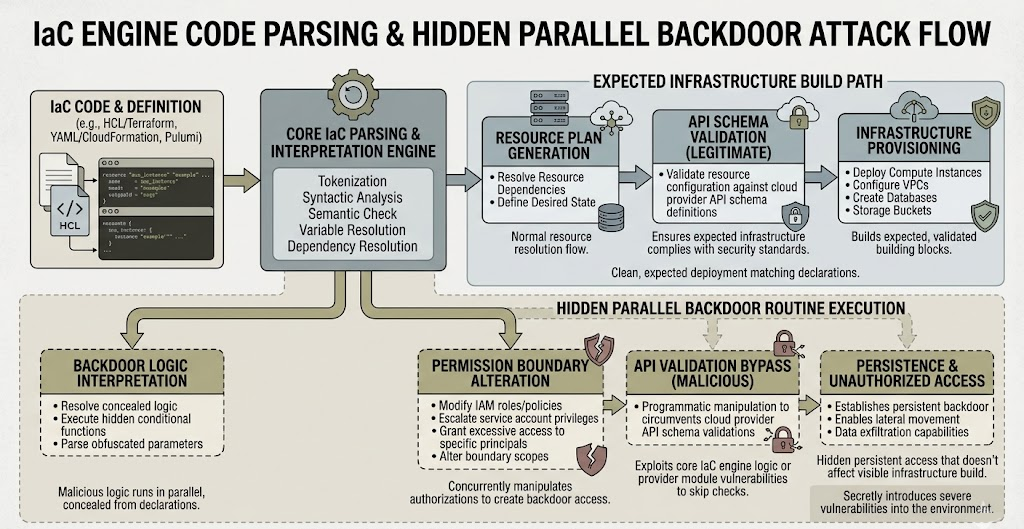
When dealing with Pulumi, the attack surface expands due to its programmatic nature. Because Pulumi allows engineers to write infrastructure using standard programming languages like Python, TypeScript, or Go, attackers can inject full-scale logical scripts. A poisoned Pulumi stack can be engineered to execute custom obfuscated loops that quietly exfiltrate environment variables, compromise API tokens, or dynamically adjust access management roles to create permanent, privileged backdoors.
These deliberate cloud misconfigurations bypass runtime perimeter defenses because the cloud provider's API views the deployment as an intentional, fully authorized action initiated by your trusted CI/CD service account.
Defensive Architecture: Hardening the Pipeline
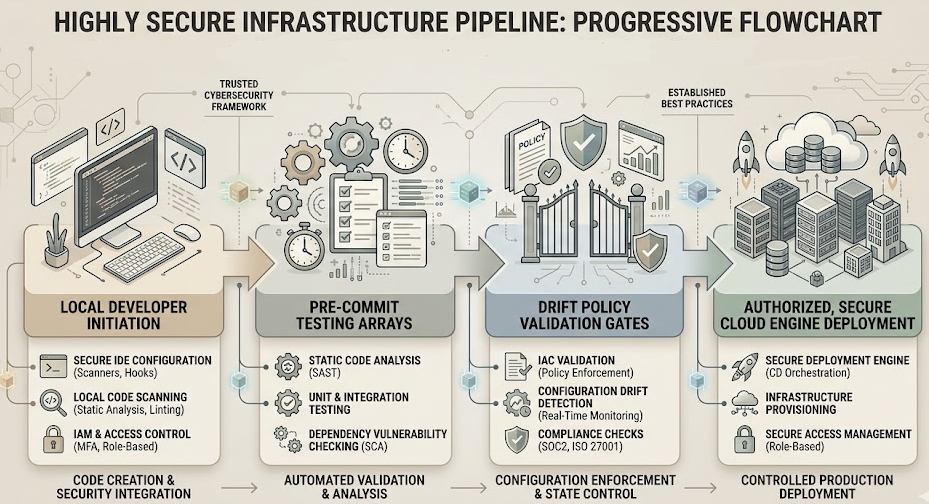
Defeating the threat of a poisoned blueprint requires a profound shift in how we approach IaC security. You cannot rely on passive, post-deployment audits. Your defenses must be natively embedded into the software delivery pipeline itself.
Automated Drift Detection: Catching the Disconnect
One of the most critical mechanisms for maintaining cloud integrity is automated drift detection. “Drift” occurs when the actual state of your live cloud resources diverges from the state defined in your version-controlled code.
Attackers often modify live resources directly after using an IaC vulnerability to gain their initial foothold, or they manipulate state files to mask their trails. Continuous drift detection tools actively poll your cloud environment, mapping the live infrastructure layout against the official repository master branch. The moment an unapproved security group rule or a rogue IAM role is detected, the system immediately flags the anomaly, triggers an alert, and can be configured to automatically overwrite the malicious deviation back to the trusted baseline.
Pre-Commit AI Security Checks
To capture upstream compromises before they ever reach your staging or production environments, DevSecOps teams must implement pre-commit guardrails powered by intelligent context analysis.
- Static Ingestion Checks: Enforce automated scanning hooks that inspect all incoming code changes on the developer's local machine before a commit is finalized.
- Semantic Risk Evaluation: Go beyond basic syntax linting. Use contextual analysis engines to verify if an infrastructure change expands privilege boundaries or creates public-facing endpoints.
- Registry Enforcement: Lock down your package management configurations, forcing your deployment tools to pull exclusively from verified, private registries with pinned cryptographic hashes.
The Axeploit Edge: Active Perimeter Validation
Building a secure IaC pipeline is a vital engineering baseline, but true operational resilience requires assuming that human error, configuration blind spots, or a sophisticated software supply chain breach will eventually allow a cloud misconfiguration to slip through your defenses.
This is exactly where Axeploit steps in.
Axeploit’s automated vulnerability scanner and dynamic API checker serve as your ultimate runtime security net. While static analysis tools try to guess if a block of Terraform or Pulumi code looks dangerous on paper, Axeploit physically tests the reality of your deployed environment from the outside, operating exactly like an advanced cybercriminal targeting your assets.
Instead of just checking your configuration syntax, Axeploit actively and safely probes your live external perimeters, web applications, and endpoints. If an upstream IaC module quietly opened an unauthenticated port, left an internal dashboard exposed to the public internet, or misconfigured an API gateway routing policy, Axeploit’s dynamic engine will immediately discover it. We flag the exposed exploit path and provide your platform engineering team with clear, actionable remediation insights to patch the vulnerability at the source.
Conclusion: Securing the Factory Floor
The transition from manual infrastructure management to automated, code-driven provisioning has unlocked unparalleled engineering velocity. But as our systems grow more unified, the blast radius of a single compromised line of code expands exponentially. Reworking your security posture to prioritize IaC security, deploying continuous drift detection, and leveraging automated validation checks ensures that your automated factory floor only builds trusted, resilient infrastructure.