The 5 Most Lethal API Vulnerabilities We Found in Q2 (And How to Patch Them)
By 2026, the way we architect and build software has fundamentally shifted. Backend developers and API architects are shipping features at breakneck speeds, heavily leveraging autonomous agents, zero-config deployments, and AI-assisted “vibe coding” workflows. But this unprecedented velocity comes at a severe operational cost: the attack surface is expanding far faster than human reviewers or static analysis tools can track.
In Q2 2026 alone, our threat intelligence and dynamic scanning teams analyzed thousands of enterprise breaches and simulated attacks. The consensus is absolute: traditional network perimeters are dead, and Application Programming Interfaces (APIs) are the primary battleground. Advanced threat actors are bypassing edge firewalls and web application firewalls (WAFs) entirely, striking directly at the business logic connecting your microservices.
Based on anonymized, real-world data pulled directly from our continuous threat exposure engagements, we have compiled the five most lethal API vulnerabilities actively being exploited in the wild today.
Here is exactly how sophisticated threat actors are breaking in, the vulnerable code patterns they are targeting, and the precise patches your team needs to secure your infrastructure.
1. Broken Object Level Authorization (BOLA)
Broken Object Level Authorization (BOLA), historically known to penetration testers as IDOR (Insecure Direct Object Reference), remains the undisputed king of API breaches in 2026. Attackers rely on BOLA because it is a fundamental business logic flaw, not a syntax error. A traditional WAF or static code analyzer will completely miss it because the malicious request looks syntactically identical to a legitimate one.
The Anatomy of the Exploit
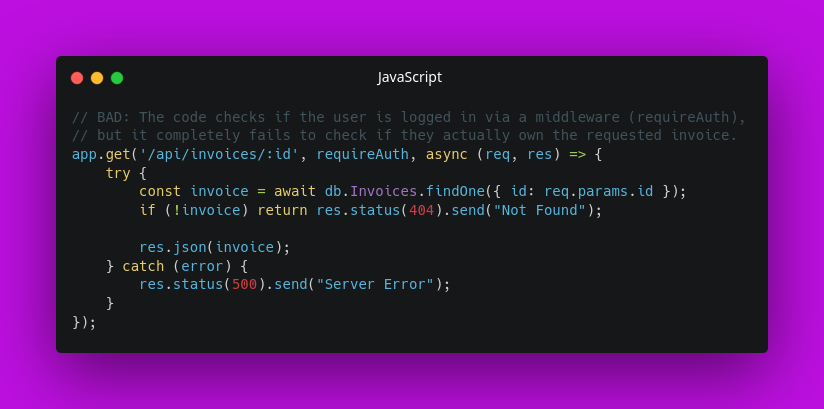
An attacker authenticates to your application as a standard, low-privilege user. They intercept their own legitimate API request, which might look like GET /api/v3/financials/invoices/90210. The attacker simply modifies the identifier in the URL to 90211. If the backend merely checks the session token for validity but fails to mathematically verify if that specific user actually owns invoice 90211, the database happily returns another user's highly sensitive corporate data.
In Q2, we saw this exact vulnerability lead to the mass exfiltration of millions of medical records from a leading telehealth provider.
The Vulnerable Code (Node.js/Express)
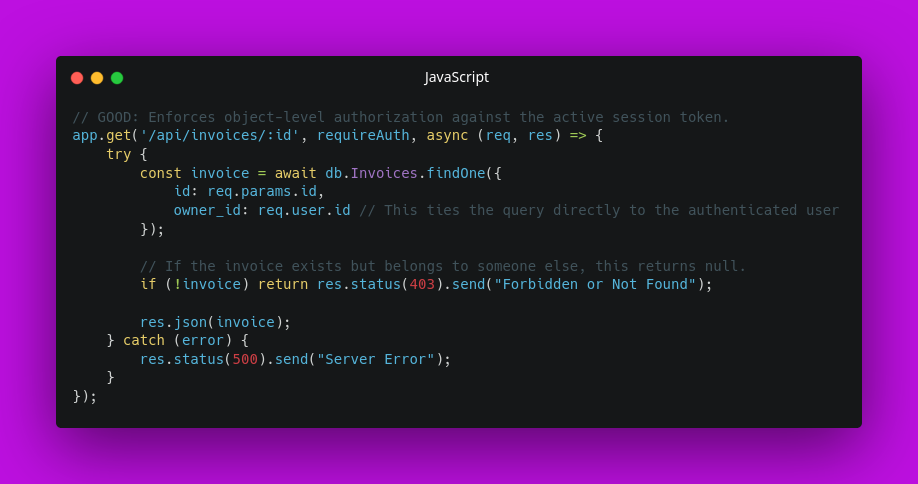
The Patch
Never rely on the client to provide the ID of the object they want to access without enforcing a strict, server-side ownership check cryptographically tied to the active session.
2. Mass Assignment (The Over-Sharer)
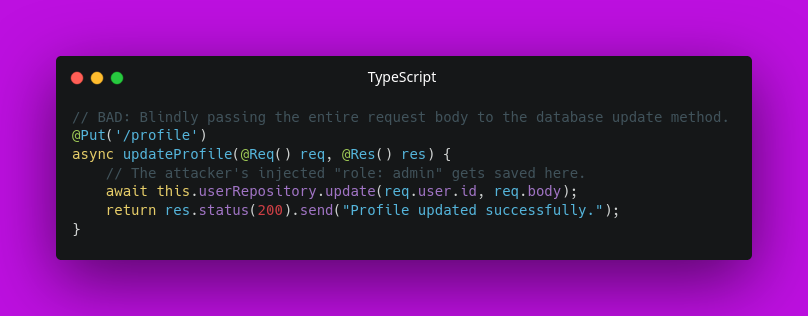
Modern frameworks (like Spring Boot, Ruby on Rails, or NestJS) make it incredibly easy to bind incoming HTTP request payloads directly to backend data models. While this is fantastic for developer velocity and “vibe coding,” it creates massive vulnerabilities when developers forget to strictly filter incoming JSON properties.
How Mass Assignment is Exploited
Imagine a user updating their profile settings via a PUT request containing {"username": "Alice", "email": "alice@corp.com"}. During an active API pentesting engagement, an attacker intercepts this payload and injects an additional, unprompted parameter: {"username": "Alice", "email": "alice@corp.com", "role": "admin", "is_verified": true}.
If the backend explicitly trusts the client and blindly maps the entire payload to the database object, the attacker instantly achieves privilege escalation without ever triggering an alert.
The Vulnerable Code (TypeScript/TypeORM)
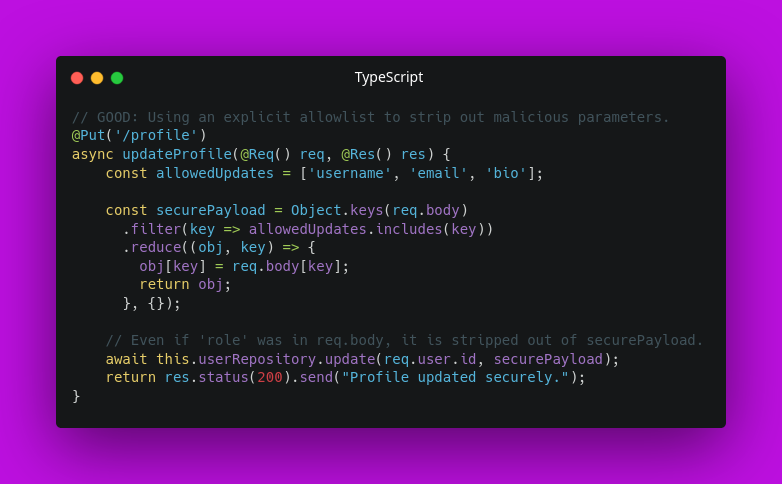
The Patch
Always explicitly define allowable fields using Data Transfer Objects (DTOs) or strict allowlists. Never pass raw JSON payloads directly to your ORM (Object-Relational Mapper).
3. Server-Side Request Forgery (SSRF) in the Cloud
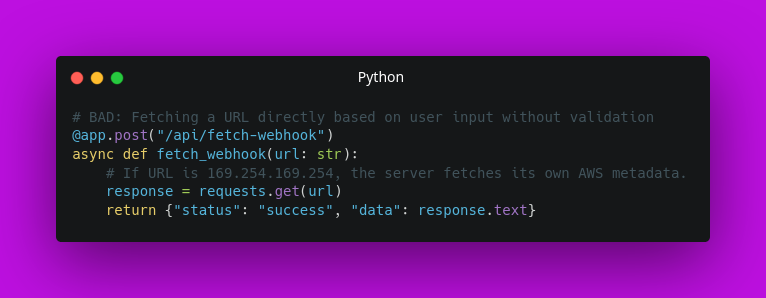
Server-Side Request Forgery (SSRF) has evolved into an existential threat in modern AWS, Azure, and Google Cloud environments. SSRF occurs when an API fetches a remote resource (like an image URL, a webhook, or an external RSS feed) without strictly validating the user-supplied URL.
Exploit Mechanics in Modern Infra
Instead of passing a benign webhook URL to the API, the hacker provides an internal cloud metadata IP address. For example: {"webhook_url": "http://169.254.169.254/latest/meta-data/iam/security-credentials/production-role"}.
Because the backend server is making the HTTP request on behalf of the attacker, it bypasses the external firewall. The server connects to the cloud provider's internal metadata service and returns highly privileged Identity and Access Management (IAM) access keys directly to the attacker in the API response.
The Vulnerable Code (Python/FastAPI)
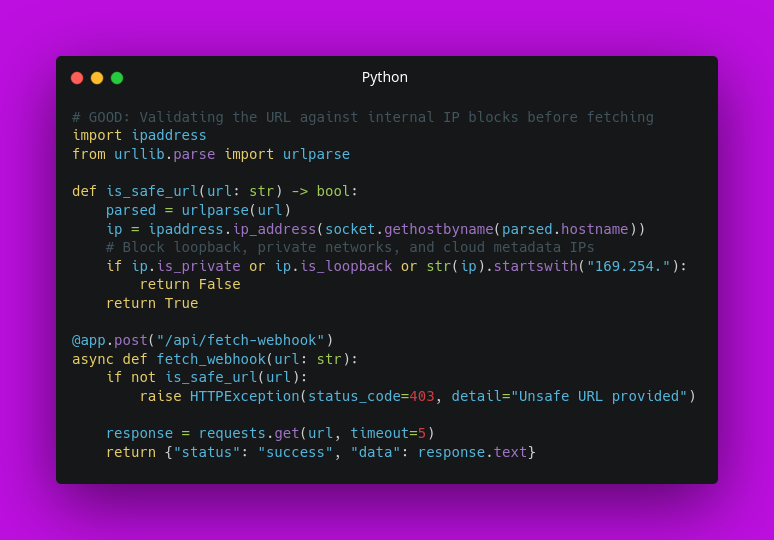
The Patch
Mitigating SSRF requires defense-in-depth. At the infrastructure level, you must disable IMDSv1 in AWS and strictly enforce IMDSv2 (which requires cryptographic session tokens). At the application level, enforce strict network microsegmentation and validate all user-supplied URLs against a hardcoded blocklist of internal IP ranges.
4. Improper Assets Management (Shadow APIs)
In the relentless rush to deploy version 3 of a microservice, version 1 is often deprecated but left running on an undocumented, forgotten subdomain. We call these "Shadow APIs." They are the unseen basement doors to your heavily fortified enterprise.
The Discovery of Forgotten Endpoints
Hackers do not guess; they enumerate. Using automated API discovery tools and fuzzing dictionaries, threat actors continuously map your infrastructure from the outside. In Q2, we observed attackers locating endpoints like api.staging.corp.com/v1/users/export.
Because this is a deprecated Shadow API, it lacks the rate-limiting, strict JWT authentication, and SOC monitoring present on your modern v3 endpoints. The attacker quietly dumps your entire production database without triggering a single SIEM (Security Information and Event Management) alert.
Mitigation and Patching
There is no single "code patch" for Shadow APIs; the fix is architectural.
- Maintain a strict, dynamic API inventory using automated discovery tools.
- Route all traffic through a centralized API Gateway.
- Completely shut down and tear down deprecated endpoints at the infrastructure level (Infrastructure as Code).
- Ensure your staging and dev environments never have network access to production databases.
5. Broken Authentication & JWT Manipulation
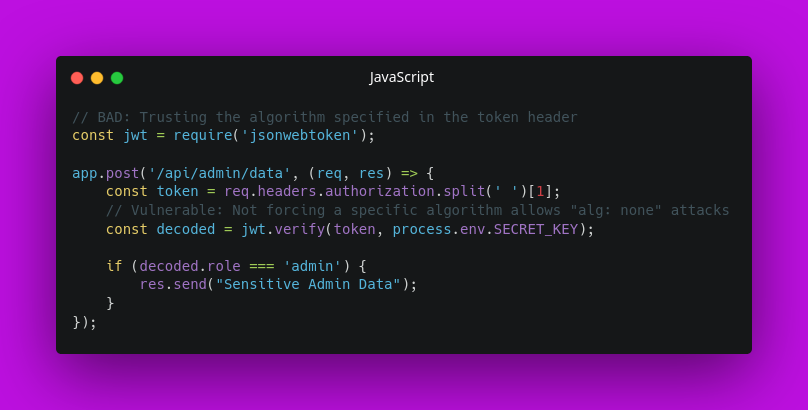
Authentication systems are notoriously complex, and custom implementations almost always introduce fatal flaws. In Q2 2026, our threat intel flagged a massive spike in unauthorized access caused by misconfigured JSON Web Tokens (JWTs).
How Tokens Get Hijacked
An API uses JWTs for stateless session management but relies on the client's token header to dictate the verification process. An attacker takes their valid standard-user token, intercepts it, and modifies the header to "alg": "none". They elevate their role in the JSON payload to "role": "admin", strip the cryptographic signature off the end, and send it back. The poorly configured backend accepts the unsigned token as mathematically legitimate.
The Vulnerable Code (Node.js)
The Patch
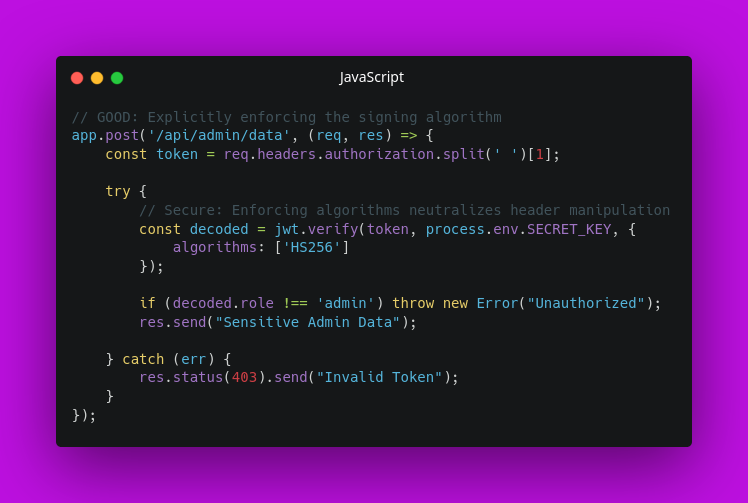
Never trust the algorithm specified by the client in the JWT header. Hardcode your backend to only accept the specific, robust cryptographic algorithm you use (e.g., HS256 or RS256) and immediately reject anything else.
Automating Defense: Axeploit Use Cases
Manual code reviews and static analysis (SAST) tools are no longer sufficient to secure a 2026 tech stack. An AI code assistant can generate syntactically perfect code that still contains a catastrophic BOLA vulnerability because the flaw lies in the complex business logic, not the characters on the screen.
This is where proactive API security becomes non-negotiable, and where the Axeploit API Security Checker serves as your ultimate safety net.
Axeploit bridges the gap between rapid deployment and robust DevSecOps. We do not just read your static configuration files; our automated vulnerability scanner actively attacks your live, running applications from the outside, exactly how a sophisticated threat actor would.
High-Impact Axeploit Use Cases for APIs:
- Dynamic BOLA/IDOR Detection: Axeploit automatically attempts to swap object IDs, manipulate JWT payloads, and escalate privileges in real-time to verify that your authorization logic holds up under active exploitation pressure.
- Shadow API Discovery: We continuously scan your external perimeters and subdomains, hunting down forgotten, undocumented endpoints before attackers can map and exploit them.
- Continuous Threat Exposure Management (CTEM): Integrate Axeploit directly into your CI/CD pipeline. Automatically block deployments if a new endpoint exposes sensitive data, fails SSRF validation, or suffers from mass assignment vulnerabilities.
Conclusion: Stop Guessing, Start Verifying
The reality of 2026 is that APIs are the lifeblood of modern software architecture, but they are also your most exposed attack surface. As we have seen from Q2's breach data, relying on legacy WAFs and passive static code analysis to catch complex business logic flaws like BOLA, Mass Assignment, or hidden Shadow APIs is a failing strategy. Attackers are bypassing the perimeter entirely, and if you are only checking your syntax, you are leaving the front door wide open.
True API security requires a fundamental paradigm shift. You must assume your perimeter is porous and adopt a strict Zero Trust architecture. But more importantly, you must continuously test your live, running environments exactly how an advanced threat actor would. Validating your authorization logic and mapping your active endpoints cannot be an annual compliance check, it must be an automated, non-negotiable part of your daily DevSecOps pipeline.
You do not have to sacrifice engineering velocity for robust security. By integrating proactive, dynamic vulnerability scanning into your workflow, you can ship features with absolute confidence.