By mid-2026, the cybersecurity battlefield had fundamentally changed. If you are a CISO, a Security Researcher, or a Threat Intelligence Analyst, you’ve likely watched the operational dwell time of advanced adversaries shrink from months to mere minutes. The reason is uncomfortable but undeniable: the adversary is no longer a human typing furiously at a keyboard. We have officially entered the era of autonomous threat actors.
Today's attackers are deploying sophisticated AI agents capable of autonomously crawling networks, adapting to environmental defenses on the fly, and chaining complex exploits together in real-time. This shift has rendered traditional, reactive security postures dangerously obsolete. You cannot defend against machine-speed attacks with human-speed triage and static rule sets. This article breaks down why legacy security mechanisms are failing against modern AI cybersecurity threats and why deploying an autonomous, AI-powered vulnerability scanner that mimics the speed and adaptability of modern hackers is your only viable path forward.
The Reality of Mid-2026: The Age of Offensive AI
For years, the cybersecurity industry discussed AI as an enabler, a tool to help human analysts write better phishing emails or generate quick malware scripts. That was the first wave. In 2026, offensive AI has matured into fully autonomous agentic frameworks.
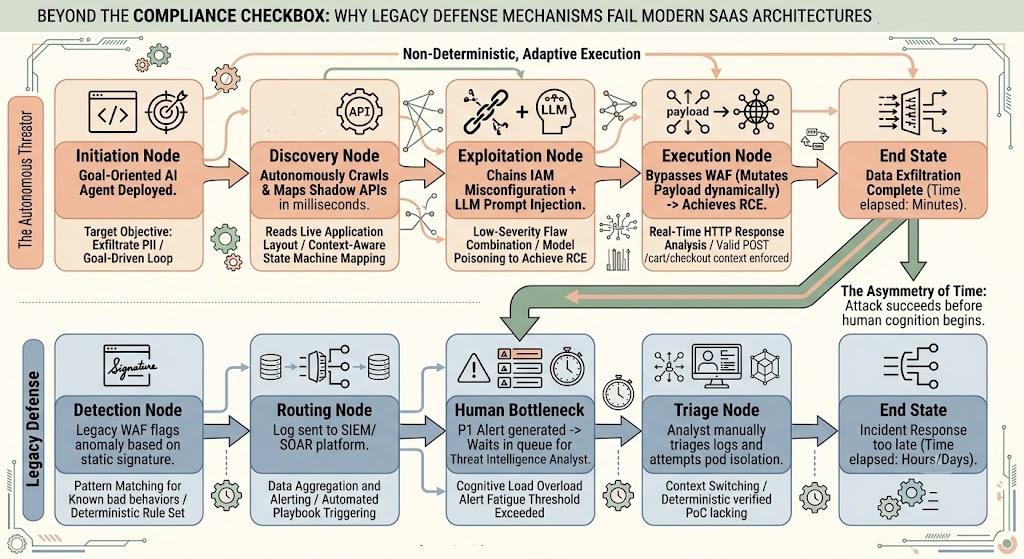
An autonomous threat actor is not just a script; it is a goal-oriented AI agent. Give it a target domain and an objective (e.g., “exfiltrate customer PII”), and the agent takes over. It maps the external attack surface, parses publicly available OpenAPI specifications, identifies shadow APIs, and begins testing inputs.
Automated Exploitation at Machine Speed
What makes these agents terrifying is their contextual adaptability. If a human hacker hits a Web Application Firewall (WAF) block, they must pause, analyze the block page, and manually craft a bypass. An AI agent does this in milliseconds. It mutates its payloads dynamically, learning from the HTTP response codes to map the boundaries of your security controls.
Furthermore, these agents excel at chaining low-severity logical flaws into critical breaches. They might find an exposed internal microservice, combine it with a minor misconfiguration in your cloud IAM roles, and exploit newly published LLM vulnerabilities (such as prompt injection or model poisoning against your internal AI chatbots) to achieve Remote Code Execution (RCE). This is automated exploitation without human fatigue, operating 24/7.
Why Legacy Defense Mechanisms Are Failing
If the attacker is an adapting, learning state machine, why are we still defending our perimeters with static walls? Legacy defense mechanisms, despite being marketed as “Next-Gen,” are fundamentally failing because they rely on assumptions that are no longer true.
1. The Signature Dead Zone
Legacy WAFs, Intrusion Detection Systems (IDS), and traditional endpoint protections rely heavily on signatures. They look for known bad behaviors and syntax. Autonomous threat actors bypass these systems effortlessly because they do not use off-the-shelf payloads. Offensive AI generates bespoke, polymorphic attacks specifically crafted for your environment. When a request is syntactically perfect but semantically malicious (like a Broken Object Level Authorization bypass), signature-based defenses are completely blind.
2. Point-in-Time Testing is Obsolete
The annual or quarterly penetration test is dead. Even automated weekly DAST (Dynamic Application Security Testing) scans are insufficient. When an AI agent can discover an unpatched dependency, craft an exploit, and execute it within three hours of a CVE being published, a weekly scan leaves an unacceptable window of exposure.
3. The Asymmetry of Time (SIEM Fatigue)
Security Information and Event Management (SIEM) platforms and Security Orchestration, Automation, and Response (SOAR) tools were designed to help human analysts respond faster. But human cognition is the bottleneck. By the time a Threat Intelligence Analyst receives a P1 alert, triages the logs, and attempts to isolate the compromised pod, the autonomous agent has already pivoted laterally, escalated privileges, and begun exfiltration.
Fighting Fire with Fire: The Architectural Imperative of Dynamic Defense
The harsh reality of 2026 is this: you cannot out-patch an AI, and you cannot out-triage an autonomous agent. When an adversary utilizes a non-deterministic, learning state machine to attack your infrastructure, defending that infrastructure with deterministic, static rule sets is a mathematical losing battle. Defending against automated, intelligent attacks requires automated, intelligent defense.
This necessitates a fundamental paradigm shift away from passive monitoring toward dynamic defense. Organizations must operationalize security testing agents that possess the exact same offensive capabilities, adaptability, and execution speed as the autonomous threat actors they are trying to stop.
At Axeploit, our philosophy is deeply rooted in offensive resilience. To secure a modern, microservice-driven architecture, your defenses must be continuously probed from the inside out by an AI that thinks like the adversary. This isn't legacy DAST; this is autonomous dynamic application security testing (DAST) engineered for the AI era.
1. Autonomous State Machine & Layout-Aware Mapping
Legacy scanners rely heavily on static OpenAPI/Swagger specifications to understand an API. By mid-2026, we know that documentation is perpetually out of sync with deployed code. Furthermore, autonomous threat actors don't read documentation; they crawl the live application to discover unlisted endpoints and shadow APIs.
Axeploit’s AI agents operate on this exact premise. Utilizing Layout-Aware Intelligence, our agents autonomously explore your web applications and API gateways. They don't just catalogue endpoints; they map the application's underlying state machine. The AI learns the business logic context, understanding, for instance, that a valid POST /cart/checkout request is contextually dependent on a preceding POST /cart/add request. This semantic mapping is critical because it allows the defense AI to interact with the application just as a human researcher or an offensive AI would.
2. Continuous, AI-Powered Penetration Testing & Persona Management
To find the business logic flaws that WAFs ignore, a dynamic defense system must test authorization at scale. Axeploit achieves this by automating the most time-consuming aspects of manual penetration testing: authentication and session management.
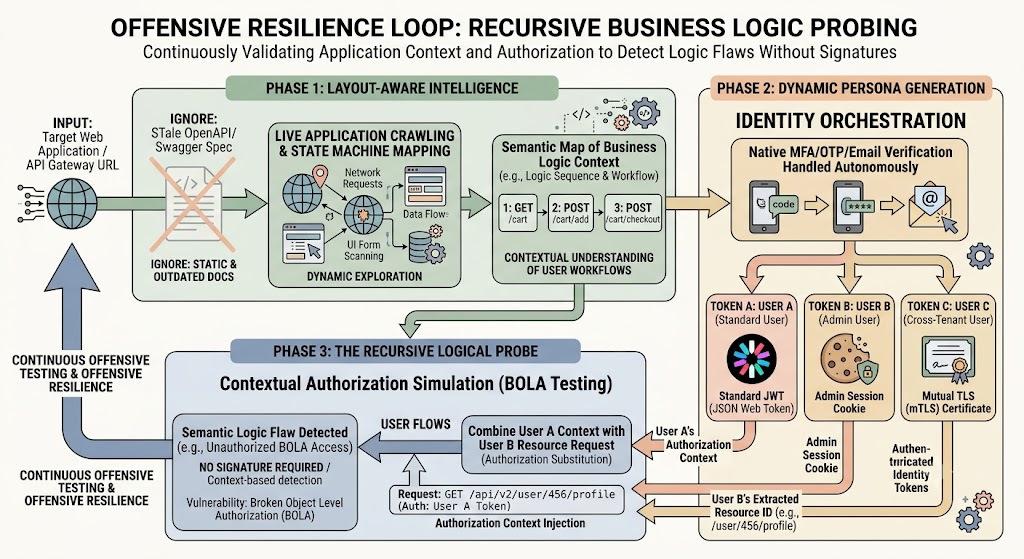
Our agents natively handle complex authentication flows, including mobile OTP, email confirmation links, and Multi-Factor Authentication (MFA). Once authenticated, the AI autonomously generates a matrix of dynamic user personas (e.g., User A: Standard, User B: Admin, User C: Cross-Tenant).
Operating as a continuous, asynchronous webhook in your CI/CD pipeline, the agent executes recursive authorization checks. It systematically attempts to access User B's resources using User A's Authorization context (JWTs, session cookies, or internal mTLS certificates) across every single discovered API endpoint. This is how you catch a Broken Object Level Authorization (BOLA) vulnerability before a threat actor’s AI agent leverages it to dump your database.
3. Behavioral Probing for Zero-Day Discovery
Legacy scanners tell you if you have a known CVE in an open-source library. An autonomous AI security agent actively engages in zero-day discovery within your own proprietary code. Because it isn't looking for static signatures, it asks the same questions the attacker’s AI asks:
- Can I abuse this state transition?
- What happens if I introduce HTTP Parameter Pollution to bypass server-side validation?
- Can I achieve a Broken Function Level Authorization (BFLA) bypass by sending a DELETE method to an endpoint intended only for GET requests?
- If I send maliciously crafted instructions to this internal LLM integration, can I execute a prompt injection attack to leak the system prompt?
The AI actively simulates exploit paths, mutating payloads based on the server's HTTP response codes, constantly probing for the boundaries of your application's intended logic.
4. Deterministic Verified PoCs: Curing SIEM Fatigue
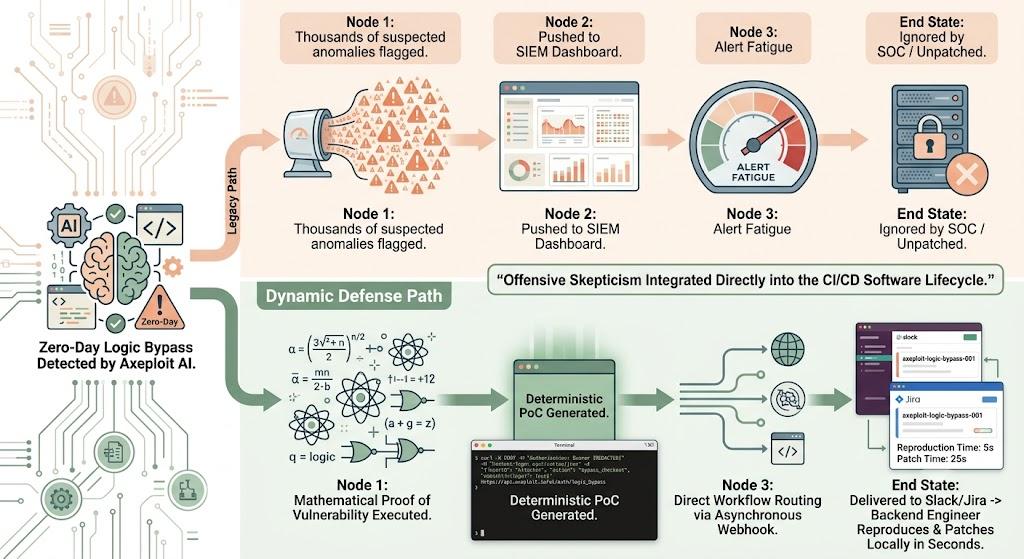
The greatest vulnerability in modern security operations centers (SOCs) is alert fatigue. If an automated defense system flags thousands of suspected anomalies, the Threat Intelligence Analysts will simply start ignoring them. The asymmetry of time favors the attacker.
True dynamic defense must be deterministic. When the Axeploit engine discovers a BOLA exploit, pricing manipulation flaw, or zero-day logic bypass, it does not generate a vague alert. It mathematically proves the vulnerability.
The AI generates a deterministic, locally reproducible Proof of Concept (PoC) using exact cURL commands, complete with the necessary headers, payloads, and execution steps. This verifiable proof is routed directly into developer workflows (Jira, Slack), providing backend engineers with the exact data required to reproduce, understand, and patch the logic flaw immediately.
By integrating this level of offensive skepticism directly into the software lifecycle, you neutralize the attacker's speed advantage. In the era of the autonomous threat actor, your perimeter is only as secure as your ability to hack it yourself.
Conclusion
The transition from human-driven hacking to autonomous AI agents is not a future theoretical scenario; it is the definitive security challenge of 2026. As adversaries leverage offensive AI to scale their attacks, traditional reliance on static perimeters, signature-based blocking, and point-in-time compliance testing is a recipe for a catastrophic breach.
To protect your infrastructure, the asymmetry of time and capability must be neutralized. You must deploy continuous, AI-driven security testing that proactively hunts for logical flaws and API vulnerabilities at machine speed. Security is no longer just about building higher walls; it is about deploying smarter, autonomous agents to continuously test your own perimeter.