You’ve built a formidable perimeter. Your edge API Gateway is bricked up with JWT validation, rate limiting, and the latest WAF rules. Your North-South traffic, the flow from the scary internet to your cluster, is secure. You feel good.
But as a Cloud Architect or DevOps Engineer in 2026, that feeling should make you nervous.
While we’ve been obsessing over front-door security, the architecture behind it has fractured into hundreds of microservices. These services talk constantly, exchanging sensitive data via HTTP or gRPC. This is East-West traffic security, and in most organizations, it relies on implicit trust. If you belong to the internal network, you belong.
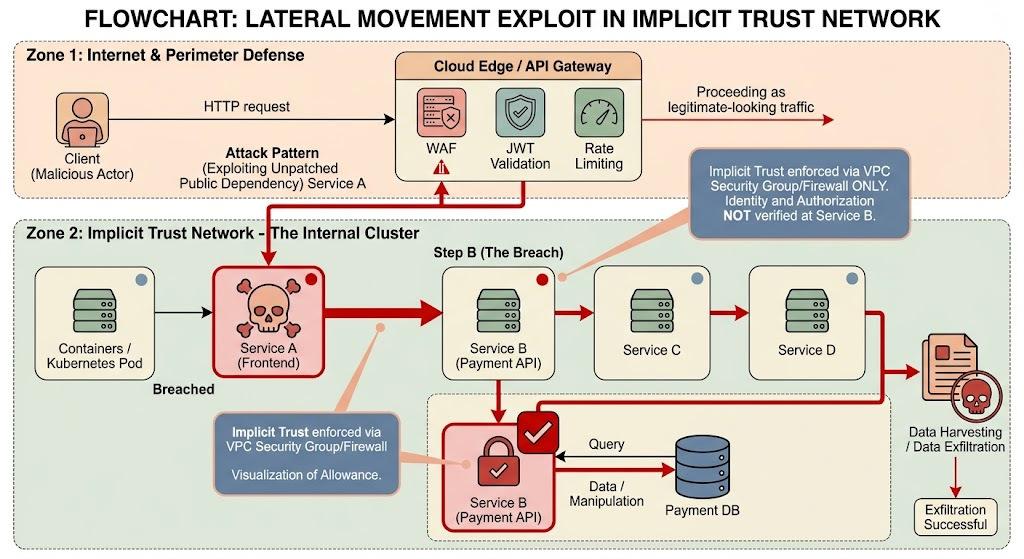
Here is the inconvenient truth: The perimeter is no longer a monolith; it’s a mesh. If an attacker breaches one externally facing service, perhaps through an authentication bypass on an unpatched dependency, they haven’t just gained a foothold; they’ve gained the keys to the kingdom. Within an implicitly trusted network, they can move laterally, harvesting data from internal APIs that were never designed to defend themselves.
At Axeploit, we don't believe in boundaries. We believe in offensive capability. To secure a modern architecture, you must adopt a DevOps blueprint that enforces zero trust architecture at the container level, continuously hunting for the authorization gaps that your edge gateway cannot see.
The Cracks in the Implicit Trust Model
Why are internal APIs so vulnerable? Because they were built for velocity, not security. We hardcode service-to-service credentials, disable TLS to save a few milliseconds of latency, and assume that "internal" means "safe."
The Fallacy of Network-Based Security
For decades, we relied on VPC peering, security groups, and firewall rules to segregate internal traffic. But network segments are coarse-grained. In a dynamic Kubernetes environment, IP addresses are ephemeral. Relying on an IP whitelist to authenticate Service A to Service B is a recipe for disaster in 2026.
If Service A is compromised via Server-Side Request Forgery (SSRF), the attacker isn't just making requests from a rogue IP; they are making requests from an authenticated service identity. Your firewall won't stop that.
Lateral Movement: The Attacker’s Playground
When internal microservices accept traffic implicitly, lateral movement is trivial. An attacker who breaches a non-critical frontend service can begin probing core backend APIs, payment processing, user databases, or internal configuration management. Because these internal endpoints often lack robust authorization checks, the attacker can perform Broken Object Level Authorization (BOLA) attacks at scale, extracting data without triggering a single perimeter alarm.
A DevOps Blueprint for Zero-Trust Microservices API Security
Enforcing zero trust for East-West traffic requires moving security from the network edge directly into the service lifecycle. Implicit trust must be replaced by explicit, continuous verification of identity and authorization.
Here is a four-step blueprint for DevOps teams to enforce microservices API security internally.
1. Shift Responsibility to the Service Mesh (Identity)
You cannot have authorization without a verifiable identity. In a distribution system, "Identity" is not a username/password; it is a cryptographic, ephemeral credential assigned to the service workload.
Do not try to build this yourself at the application level.
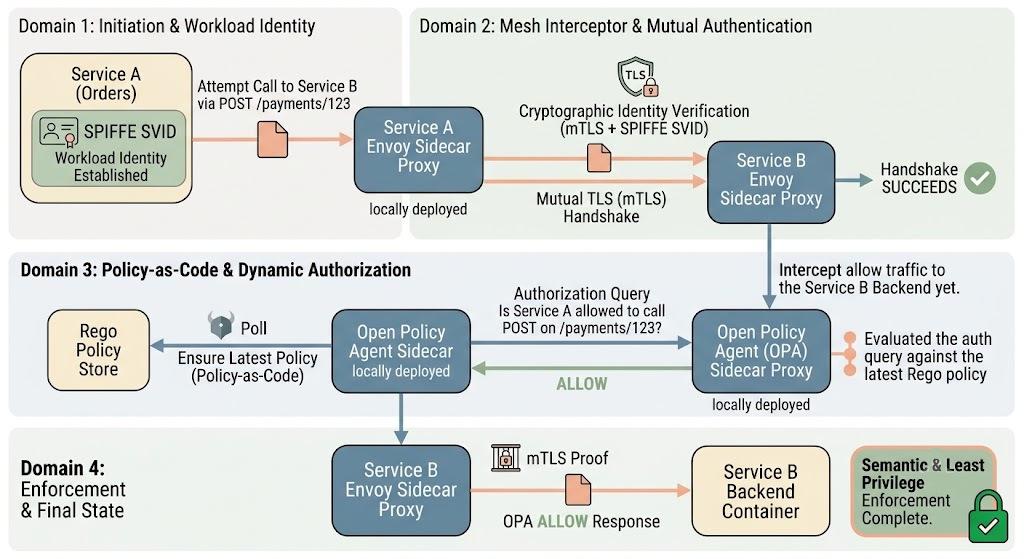
Deploy a service mesh (like Istio or Linkerd) or an advanced Kubernetes CNI to handle workload identity management. These tools automatically issue and rotate identity certificates (SVIDs) for every pod. This forms the foundation of Mutual TLS (mTLS), ensuring that not only is the traffic encrypted, but Service B knows exactly which Service A is calling it. 2026 standard dictates SPIFFE as the runtime identity specification.
2. De-couple Authorization via Policy-as-Code
Once you have established identity (Service A is Service A), you must determine authorization (Can Service A call POST /orders on Service B?).
Legacy WAFs and API Gateways cannot make these decisions for internal traffic because they lack the necessary context of the internal domain model.
The modern standard is de-coupled, de-centralized authorization using Policy-as-Code. Implement a sidecar or a host-level agent running Open Policy Agent (OPA).
Authorization policies (written in Rego) are maintained centrally by the DevOps/Security team but enforced locally at the microservice. When Service B receives a request, the service mesh interceptor queries OPA: "Based on Service A’s identity and the request payload, is this allowed?" OPA makes a lightning-fast decision based on the current policy, keeping authorization logic out of your backend code.
3. Implement Service-Specific Least-Privilege
Service meshes are powerful, but they bring their own set of service mesh vulnerabilities, specifically around misconfiguration. By default, many meshes are configured to allow all-to-all communication (implicit trust, just with encryption).
You must enforce service-level least privilege. This requires explicitly defining which services can talk to which. A simplified AuthorizationPolicy in K8s might look like this:
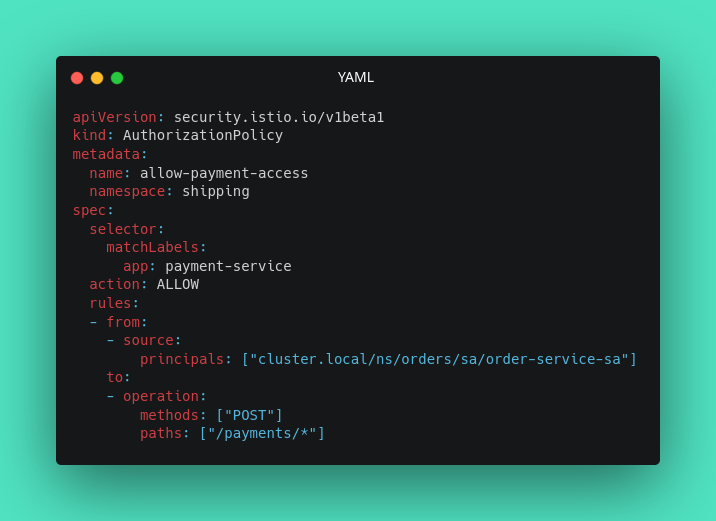
This ensures only the order-service identity can call POST on /payments. Even if the database-backup cronjob pod in the shipping namespace is compromised, it has zero network access to the payment API.
4. Continuous API Traffic Auditing
Policies are static; traffic is dynamic. You need to know that your policies match reality. Continuously aggregate service mesh access logs to audit behavioral anomalies. If Service A usually calls Service B ten times a second, and suddenly it’s making thousands of calls to Service C (a user database), you have a breach. Advanced eBPF-based agents can facilitate this without adding significant latency.
Here is the rewritten, highly technical, and detailed section, incorporating the authoritative tone and offensive security methodologies utilized by Axeploit.
Autonomous Offensive Testing: Continuously Scanning for internal Authorization Gaps
The blueprint described above is necessary, but it is purely defensive. Infrastructure controls,service mesh, mTLS, and de-coupled OPA agents, only ensure that Service A's identity is permitted to talk to Service B's endpoint. They do not validate the application-level logic to ensure Service A is authorized to access specific resource IDs within Service B's datastore.
BOLA (Broken Object Level Authorization) remains the dominant critical vector in distributed architectures in 2026. Passive monitoring and legacy signature-based WAFs are computationally incapable of detecting these logic flaws in East-West traffic.
At Axeploit, we know that to secure a mesh, you must actively attempt to break it. Therefore, internal API testing cannot be a point-in-time exercise; it must be an autonomous, continuous operation integrated directly into the service lifecycle.
The Axeploit Methodology for East-West Offensive Scanning
To effectively find authorization gaps between microservices, your testing regimen must bypass the implicit trust layers. Standard "shift-left" security integration is no longer sufficient; you need offensive dynamic security testing integrated into the build pipeline and against staging/preview environments concurrently, without delaying deployments by a single second.
Here is how Axeploit automates internal API exploitation at machine speed:
1. Autonomous Asset & State Machine Discovery
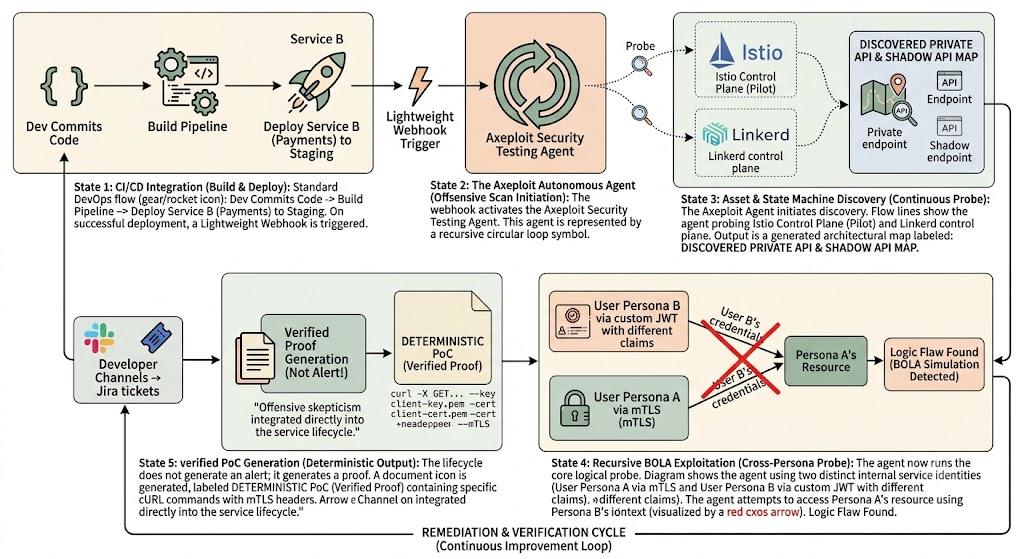
Axeploit’s agents do not rely on static OpenAPI documentation, which is often outdated by the time code is committed. Our agents hook directly into the service mesh control plane (e.g., Istio’s Pilot or Linkerd’s Destination service) to discover private gRPC and REST endpoints, including unlisted shadow APIs. By parsing traffic patterns, the AI builds a model of the application state machine, understanding which sequences of API calls form a valid business process.
2. Cross-Persona Authorization Checks (BOLA Exploitation)
This is the core logical probe. The standard, linear build-blocking security gate is a relic of the past. Modern DevSecOps integration structures security scans as asynchronous, event-driven workflows.
Once deployed to staging, Axeploit fires lightweight webhooks to trigger dynamic scanning. The agent autonomously handles authentication handling, including complex mobile OTP and MFA natively, to generate multiple authenticated personas. Crucially, in a microservices context, it generates multiple valid internal service identities via mTLS or custom internal JWTs with different claims.
The agent then executes recursive BOLA testing: it attempts to access Service A’s resources (e.g., GET /api/v1/users/1001/data) using Service B’s valid identity context. Unlike traditional scanners, Axeploit doesn't rely on regex for input strings; it actively simulates exploit paths.
3. Simulating Lateral Movement via State Manipulation
Do not trust your OPA configurations; prove them. Axeploit probes authorization boundaries and logic flows by manipulating the application state.
Examples of autonomous exploit simulation include:
- Inventory Manipulation: Can an authenticated, low-privilege service call endpoints intended to alter inventory counts or pricing data?
- Parameter Pollution: Does the API accept unlinked web routes or hidden parameters when called internally that it would reject at the edge?
- Function Level Authorization (BFLA) probes: Trying to use Service A's cart checkout with User B's shipping address.
4. Verified PoCs, Not Just Alerts
The standard output of security tools is unverified noise, leading to critical alert fatigue. True security resilience requires deterministic proof. When Axeploit discovers a BOLA or state manipulation flaw, the cycle does not end with a vague warning.
The agent generates a deterministic Proof of Concept (PoC) using exact cURL commands with internal mTLS headers or internal JWTs. This actionable payload, delivered directly to developer channels via Slack notifications, allows backend developers to reproduce and patch the logical flaw locally in seconds before the code ever reaches production.
Conclusion
The days of relying on a strong edge gateway are gone. We live in an era where data manipulation and API exploitation happen internally, bypassing traditional WAFs entirely. Microservices thrive on communication, but that communication must be stripped of implicit trust.
Adopting zero trust architecture for your East-West traffic security is not just an infrastructure change; it is a DevOps cultural shift. It requires validating every identity, enforcing granular Policy-as-Code authorization de-centralized, and, most importantly, treating internal APIs with the same offensive skepticism you apply to your perimeter.
Security is continuous. Implicit trust is a vulnerability. Seal the cracks before someone like us does it for you. Explore the Axeploit Blog for more advanced tutorials on Kubernetes security and API pentesting, or contact us to schedule a comprehensive audit of your microservice mesh.