

If you are a Cloud Architect, DevOps Engineer, or Network Security Admin in 2026, you already know the hard truth: the perimeter is dead. We no longer deploy monolithic applications to single, heavily guarded servers. Instead, we have pushed our routing, our business logic, and our computing power as close to the user as mathematically possible.
This is the era of the edge. It is incredibly fast, infinitely scalable, and absolutely terrifying to secure.
Recent platform-level breaches in 2026, such as the highly publicized incidents involving edge networks like Vercel proved exactly what security researchers have been warning us about. When attackers pivot through compromised third-party OAuth integrations to steal edge environment variables and API keys, they completely bypass the front door. Traditional defenses were not breached; they were simply ignored.
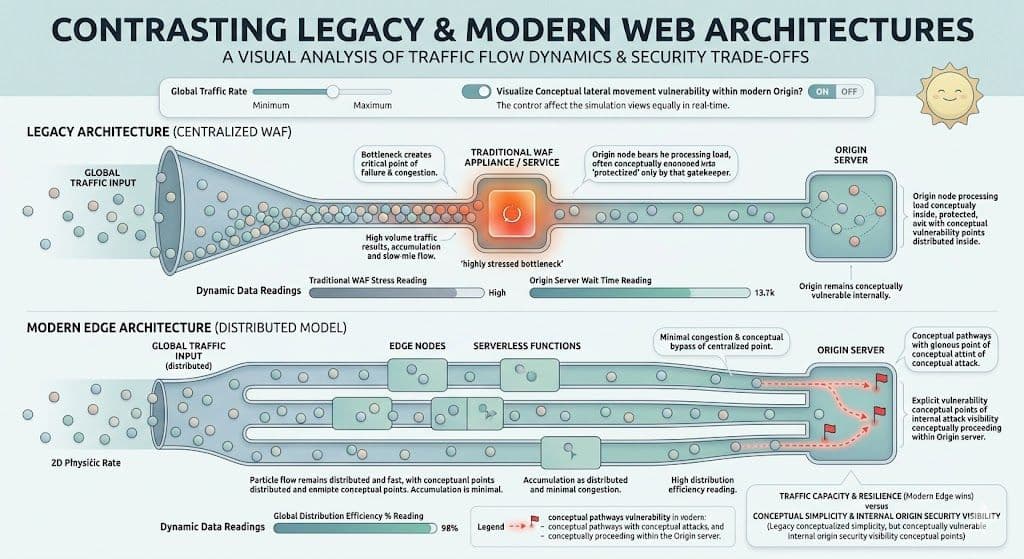
Legacy Web Application Firewalls (WAFs) were designed for a world that no longer exists. Today, relying on a centralized WAF to protect a decentralized edge architecture is like installing a heavy bank vault door on a camping tent. Here is exactly why traditional WAFs are failing, how attackers are weaponizing the cloud against you, and why modern edge computing security requires a fundamental shift in how we defend our infrastructure.
The Monolithic Wall in a Serverless World
To understand the failure, we first have to look at the original design. A traditional WAF acts as a digital bouncer. It sits directly in front of your core application server, inspecting every HTTP request that attempts to pass through. If a request contains a known malicious signature like a classic SQL injection string, the WAF blocks it.
This “castle-and-moat” methodology worked beautifully when all traffic bottlenecked at a single origin server.
But in an edge-native environment, your application is shattered into hundreds of micro-deployments, serverless functions, and content delivery networks distributed globally. When a user interacts with your app, the compute happens at the edge node closest to them, not at a central database in a remote data center.
Because legacy WAFs struggle to inspect traffic moving laterally across these decentralized nodes, they create massive blind spots. Attackers no longer have to attack your origin server; they can directly target the edge functions handling your API routing and business logic.
How Attackers Exploit the Edge (WAF Bypass)
Hackers are acutely aware of the limitations of legacy WAFs. They have developed highly specific methodologies to slip past these defenses by turning the sheer scale of the cloud against itself.
Distributed Edge Functions and Rate Limit Evasion
In the past, to take down an application, an attacker would launch a brute-force or volumetric attack from a compromised botnet. A traditional WAF would identify the massive spike in traffic originating from a cluster of suspicious IPs, trigger its DDoS protection protocols, and block the offenders.
Today, attackers don’t need a botnet. They use cheap, legitimate serverless functions from major cloud providers to execute their attacks. By distributing their malicious requests across thousands of ephemeral, constantly rotating cloud IP addresses, the traffic looks like perfectly normal user activity.
The legacy WAF’s rate-limiting rules are never triggered because no single IP sends enough requests to raise suspicion. This results in a devastating WAF bypass. The attacker successfully drains your backend resources or brute-forces your authentication endpoints, all while your traditional firewall reports that everything is operating normally.
Obfuscating Malicious Payloads
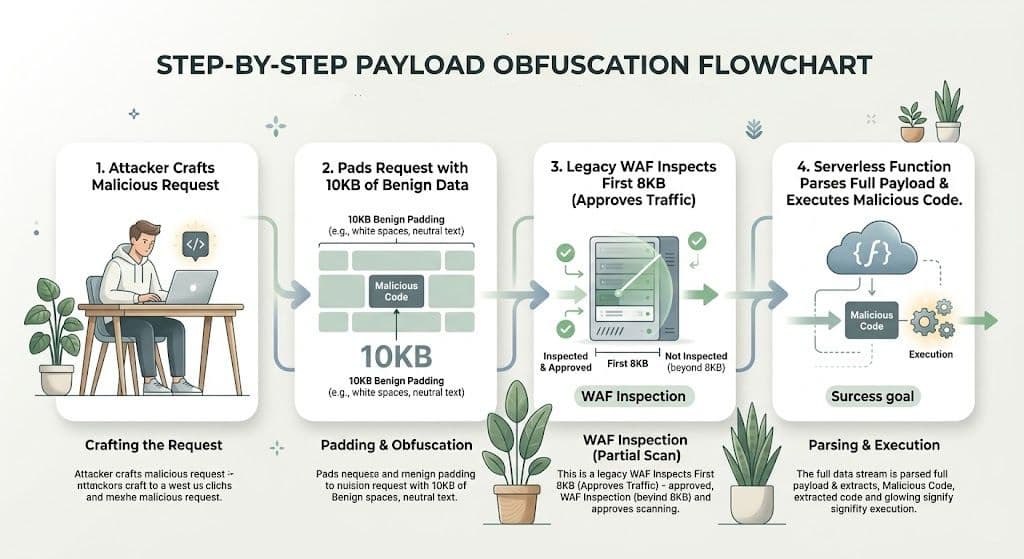
The second major flaw in legacy WAFs is how they inspect data. To preserve low latency and high throughput, many traditional WAFs will only inspect the first 8 KB to 16 KB of an HTTP request body.
Attackers actively exploit these inspection limits using a technique called “payload padding”. They pad the beginning of their request with thousands of bytes of harmless, benign data (such as empty JSON fields, XML comments, or long strings of spaces). The legacy WAF inspects the first 8 KB, sees nothing dangerous, and lets the request pass through.
The actual malicious payload is hidden at the very end of the request. Once the traffic passes the WAF, your backend infrastructure parses the entire object, triggering the malicious code. These Serverless vulnerabilities allow attackers to inject malicious code, manipulate business logic, and exfiltrate environment variables completely undetected.
The Necessity of Edge-Native Threat Detection
You cannot secure a decentralized architecture with a centralized firewall. If you are building on the edge, your security must live on the edge.
To survive in 2026, Cloud Architects and Security Admins must transition to edge-native threat detection. This means moving away from simple signature-based matching and adopting contextual, behavioral analysis that runs alongside your serverless functions.
You must assume that the perimeter will eventually be bypassed. If an attacker manages to compromise a third-party OAuth token and gains internal access to your cloud environment, your decentralized APIs must be able to recognize anomalous behavior, such as a sudden bulk-export of environment variables, and shut it down immediately, regardless of where the request originated.
Axeploit: Your Decentralized API Security Checker
This is where passive defense ends and proactive security begins. You cannot just cross your fingers and hope your legacy WAF configuration holds up against modern, distributed attacks. You need to actively test it.
This is exactly why we built the Axeploit API security checker.
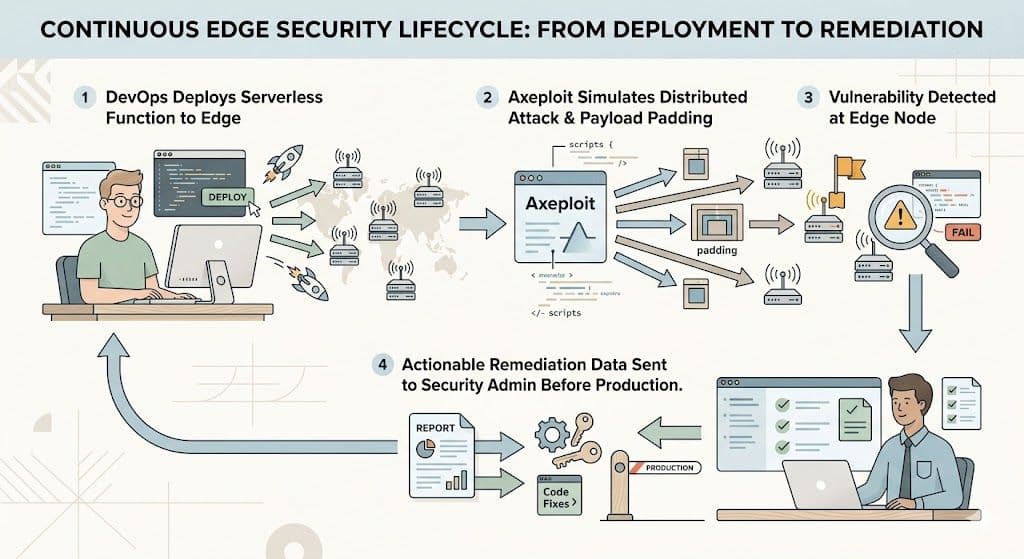
Axeploit bridges the gap between rapid DevOps pipelines and robust edge security. Instead of relying on static rules, our automated vulnerability scanner actively attacks your live, running edge deployments exactly how a modern cybercriminal would.
- Test Your Limits: Axeploit intentionally simulates distributed, serverless-driven traffic to see if your rate limiting and DDoS protections actually hold up under modern attack conditions.
- Exploit the Bypasses: We test your endpoints using payload padding, character obfuscation, and JSON-RPC manipulation to ensure your WAF isn't blindly waving malicious traffic through.
- Secure Your APIs: If an edge function is vulnerable to logic manipulation or unauthorized data exfiltration, our dynamic scanner catches it, flags the exact exploit path, and shows your team precisely how to patch it before it hits production.
Conclusion: Secure the Edge Without Losing Your Edge
The transition to edge computing and serverless architecture has given us unprecedented speed and agility. But building fast without visibility is a recipe for a catastrophic breach.
Legacy WAFs are failing because they are fighting yesterday's war. The attackers of 2026 are using your own cloud infrastructure against you, bypassing outdated perimeters to strike directly at your APIs and environment variables.
To protect your organization, you must adopt edge-native security practices and continuously test your live environments. Do not wait for a breach to find out your firewall is obsolete.


