If you are a Security Operations Center (SOC) Analyst or an IT System Administrator in 2026, the alarms on your dashboard have likely been ringing non-stop. We have decisively moved past the era where threat actors simply brute-forced exposed RDP ports to gain access to a network. Today, advanced adversaries are targeting the very infrastructure designed to protect you, turning trusted vendor appliances into weapons.
The recent “Eclipse Attack” exploiting FortiGate VPN appliances is a masterclass in modern adversary tradecraft. Initially starting as a localized proof-of-concept, this operation rapidly evolved into a real-world intrusion that bypassed leading endpoint defenses and exposed a massive vulnerability in enterprise supply chain security.
Instead of a high-level news recap, we are going to reverse-engineer this breach. Here is a defender’s deep dive into the hacker’s playbook, mapping out the initial access, the persistence mechanisms, and the lateral movement tactics used during the FortiGate Eclipse attack, so you can lock down your network perimeter before your organization becomes the next major headline.
Shattering the Network Perimeter: Initial Access
In traditional network architectures, the VPN is the trusted gateway. It is the heavily armored front door. But what happens when the gateway itself becomes the payload delivery mechanism?
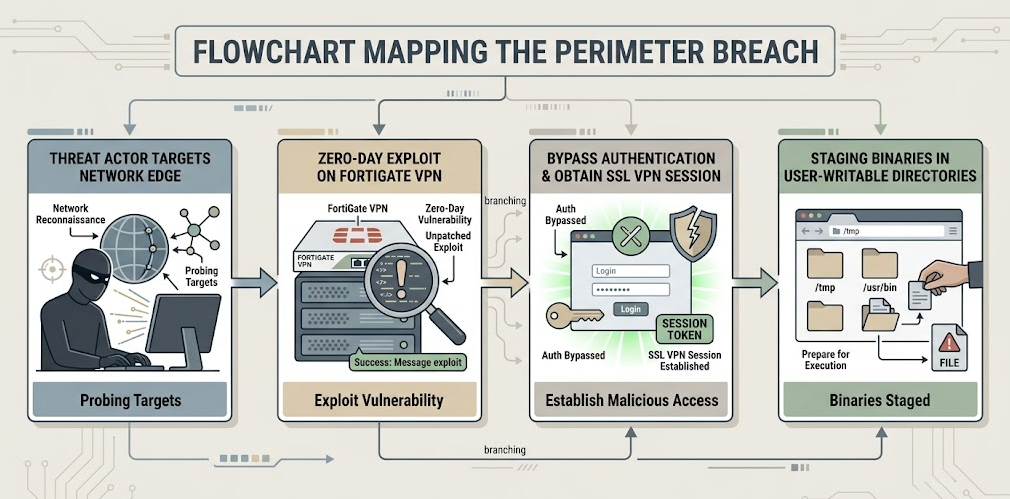
The Eclipse attack began with the compromise of FortiGate VPN SSL sessions. Threat actors originating from offshore IPs leveraged compromised credentials alongside a sophisticated zero-day exploit targeting the edge appliance. Because FortiGate devices often sit at the absolute edge of an enterprise network, obtaining unauthorized administrative access here completely shatters the network perimeter. The trust established by the supply chain (relying on a secure edge device) was weaponized to gain internal routing.
Once the attackers bypassed the VPN authentication, they did not immediately launch noisy malware or trigger massive data downloads. Instead, they utilized their newly acquired legitimate network access to quietly stage custom binaries inside user-writable directories. Specifically, they targeted mundane, often-overlooked locations like the Pictures and Downloads folders on user endpoints to evade strict execution policies and traditional file integrity monitoring.
The Eclipse Attack: Blinding the Defense
Once inside the network, the attackers deployed the core component of the operation: the “Nightmare-Eclipse” toolset. This phase is where the attack earns its name by literally eclipsing the host's antivirus and endpoint detection responses (EDR).
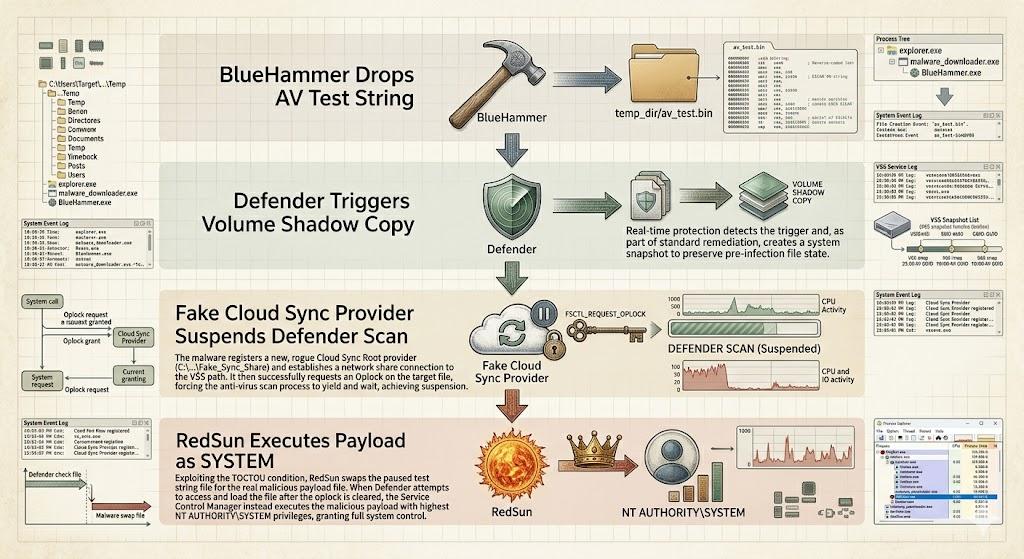
The threat actors utilized a trio of privilege-escalation and defense-evasion tools known as BlueHammer, RedSun, and UnDefend. Rather than trying to outright kill Windows Defender, a highly aggressive action that usually triggers massive alerts to the SOC, they tricked the antivirus into suspending its own operations.
Weaponizing the Volume Shadow Copy
The attackers first used BlueHammer to write a standard, universally recognized antivirus test string to the disk. As expected, Defender immediately flagged it and initiated a remediation process. This automated remediation inherently creates a Volume Shadow Copy to ensure system integrity before the file is quarantined.
Here is where the supply chain trust was abused on the software level. BlueHammer registered a fake cloud sync provider on the compromised endpoint, structurally identical to a legitimate enterprise OneDrive sync client. When Defender attempted to scan the fake directory, BlueHammer intercepted the callback, confirmed the identity of the scanner, and placed a lock on the file.
Defender’s primary scanning thread was silently suspended, waiting indefinitely on a file entirely controlled by the attacker. The antivirus was effectively blinded and neutralized without ever actually crashing or sending an offline alert to the dashboard.
Privilege Escalation via RedSun
With Defender completely frozen, RedSun took over the operation. It abused the Windows file restoration process to overwrite standard system binaries. By redirecting paths into the frozen volume snapshot, the attackers successfully copied their payload into the highly restricted C:\Windows\System32 directory. RedSun then called a local COM object running as SYSTEM, executing the payload with the highest possible privileges on the machine.
Digging In: Persistence and Lateral Movement
With SYSTEM-level access secured and the endpoint antivirus rendered useless, the attackers focused on digging their roots deeper into the environment and expanding their blast radius.
The BeigeBurrow Tunnel
To maintain a highly persistent foothold, the attackers deployed a custom Go-based tunneling agent dubbed “BeigeBurrow” (frequently disguised as agent.exe). This binary established a secure, stealthy reverse shell back to the attacker's command-and-control (C2) infrastructure. By tunneling their traffic, the attackers ensured they could maintain internal access even if the initially compromised FortiGate VPN session was discovered and terminated by the IT team.
Living off the Land (LotL)
Instead of importing noisy, third-party scanning tools that would easily be caught by heuristic network scans, the hackers engaged in “Living off the Land” techniques. They used hands-on-keyboard commands natively built into the Windows operating system:
- whoami /priv to verify their newly elevated token.
- cmdkey /list to enumerate locally stored credentials.
- net group to map out the domain hierarchy and find high-value targets.
Finally, they executed OS credential dumping techniques to extract SAM hashes. Their ultimate goal was lateral movement via Pass-the-Hash, allowing the attackers to jump from the initially compromised host to critical domain controllers without ever needing to crack a plaintext password.
Actionable Incident Response for Defenders
The FortiGate Eclipse attack proves that a strong network perimeter is simply no longer enough to protect a modern enterprise. The moment an edge appliance or trusted vendor integration is compromised, your internal defenses must be prepared to catch anomalous behavior.
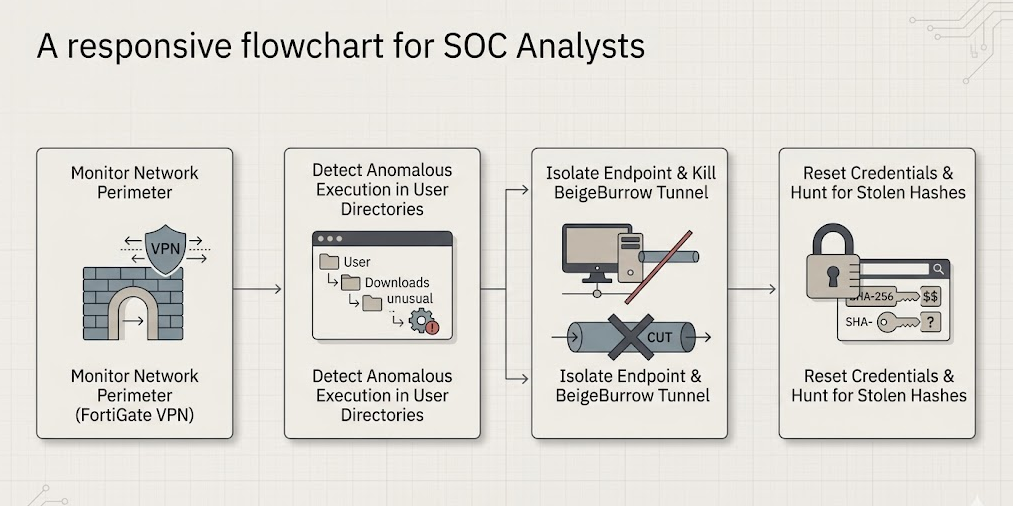
Here is an actionable incident response playbook for SOC analysts and system administrators facing these modern, evasive threats:
- Audit and Patch Edge Devices: Immediately apply the latest vendor patches to your FortiGate VPN appliances. Threat actors actively hunt for unpatched zero-days to gain their initial foothold. Disable any unused SSL VPN interfaces to shrink your attack surface.
- Monitor User-Writable Paths: Create strict SIEM alerts for the execution of .exe or script files originating from unusual user directories like \Pictures or \Downloads.
- Hunt for Eclipse Artifacts: Search your environment for known artifacts related to BlueHammer, RedSun, and UnDefend. Monitor for unexpected Volume Shadow Copy creation events and anomalous cloud sync provider registrations that do not match your approved corporate software list.
- Analyze Network Telemetry: Actively monitor outbound traffic for the tunneling behaviors associated with BeigeBurrow. Look for sustained, long-running connections to unknown offshore IP addresses.
- Enforce Multi-Factor Authentication (MFA): Ensure that every single remote access point, especially VPNs and SSO portals, requires phishing-resistant MFA to mitigate the fallout of compromised credentials.
Securing the Future with Axeploit
Passive logging, manual code reviews, and reactive patching are necessary, but they are ultimately defensive measures. To truly defend against a zero-day exploit and advanced supply chain security threats, you must proactively test your own infrastructure.
This is where the Axeploit API Security Checker and dynamic vulnerability scanner become critical extensions of your SOC team. Axeploit does not just read static configuration files; it actively attacks your live, running perimeter exactly like the threat actors behind the Eclipse attack. By safely simulating these advanced intrusions from the outside, Axeploit identifies exposed VPN endpoints, misconfigured privilege settings, and blind spots in your architecture before a real hacker can exploit them.
Conclusion: Fortifying the Perimeter with Active Defense
The FortiGate Eclipse attack proves that a strong network perimeter is simply no longer enough to protect a modern enterprise. The moment an edge appliance or trusted vendor integration is compromised, your internal defenses must be prepared to catch anomalous behavior. Passive logging, manual code reviews, and reactive patching are necessary, but they are ultimately just defensive measures.
To truly defend against a zero-day exploit and advanced supply chain security threats, you must proactively test your own infrastructure. This is where the Axeploit API Security Checker and dynamic vulnerability scanner become critical extensions of your SOC team. Axeploit does not just read static configuration files; it actively attacks your live, running perimeter exactly like the threat actors behind the Eclipse attack. By safely simulating these advanced intrusions from the outside, Axeploit identifies exposed VPN endpoints, misconfigured privilege settings, and blind spots in your architecture before a real hacker can exploit them.