By 2026, the API security landscape has rapidly evolved, yet the undisputed king of vulnerabilities remains unchallenged. Broken Object Level Authorization (BOLA), historically recognized by many as Insecure Direct Object Reference (IDOR), continues to plague modern web applications, SaaS platforms, and interconnected microservices. For Penetration Testers, Security Researchers, and Backend Developers, finding a critical IDOR exploit is often a routine, highly lucrative payday during bug bounty programs.
But why do these critical flaws persist in production environments that are supposedly guarded by an arsenal of security tools? The reality is that traditional vulnerability scanners are fundamentally flawed when it comes to context. They operate as glorified syntax-checkers; they are entirely blind to application state, user roles, and data relationships. They can catch a poorly sanitized SQL query, but they cannot deduce whether User A is legitimately allowed to view User B's private billing invoice.
This article breaks down why legacy security tools fail at hunting business logic flaws and explores how modern, AI-driven automated API security testing, specifically using agents capable of multi-account state analysis, is the only scalable way to eradicate BOLA vulnerabilities from your CI/CD pipeline.
The Anatomy of BOLA Vulnerabilities and IDOR Exploits
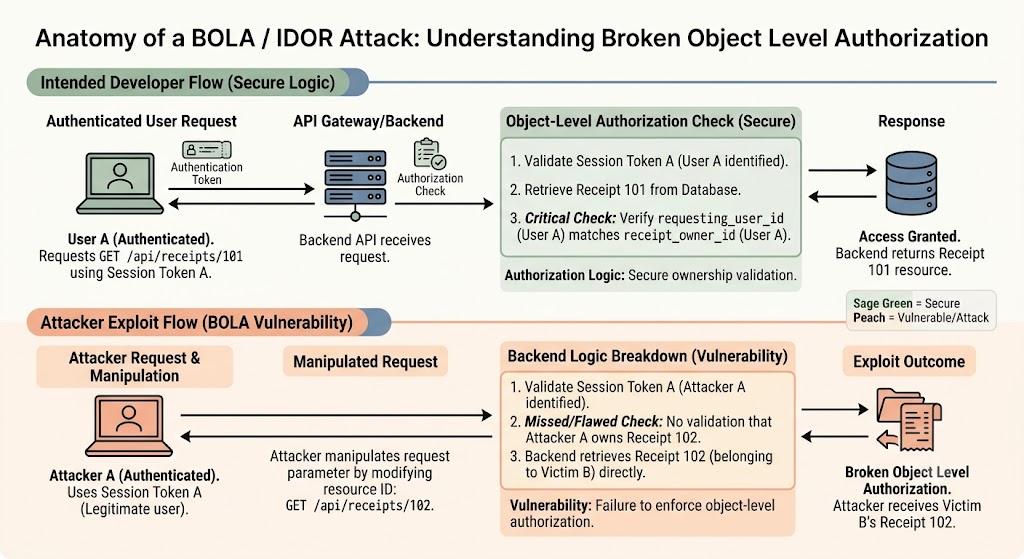
Before we dissect the failures of legacy scanners, we must understand the attacker methodology. Broken Object Level Authorization occurs when an application exposes a reference to an internal implementation object (like a database key or file name) without validating the user's authorization to access that specific object.
The Attacker Methodology: Manipulating Resource IDs
Backend developers frequently build APIs designed to fetch data based on a provided identifier. Consider a standard RESTful API endpoint used by a financial application:
GET /api/v1/users/8842/bank_statements
When User A (whose ID is 8842) logs in, the frontend application calls this endpoint, and the backend happily returns the data. However, the authorization check often stops at authentication. The server verifies that the user possesses a valid session token, but fails to check if the session token actually belongs to User ID 8842.
An attacker simply fires up a proxy like Burp Suite, intercepts the request, and increments the integer:
GET /api/v1/users/8843/bank_statements
If the server returns User B's financial data, the attacker has successfully executed an IDOR exploit.
The UUID Fallacy: Many backend developers attempt to fix this by replacing predictable integers with Universally Unique Identifiers (UUIDs). While a UUID (e.g., GET /api/v1/users/a1b2c3d4...) prevents an attacker from blindly enumerating accounts, it is not a security control. If an attacker manages to obtain another user's UUID (perhaps leaked via a different, seemingly harmless API endpoint like a community forum or friend list), the BOLA vulnerabilities still exist. True security requires robust API authorization testing at the object level, not just obscurity.
The Blind Spot: Why Legacy Scanners Miss Business Logic Flaws
If an IDOR exploit is just a matter of swapping a number in a URL, why don't static (SAST) and dynamic (DAST) scanners catch them during the build phase?
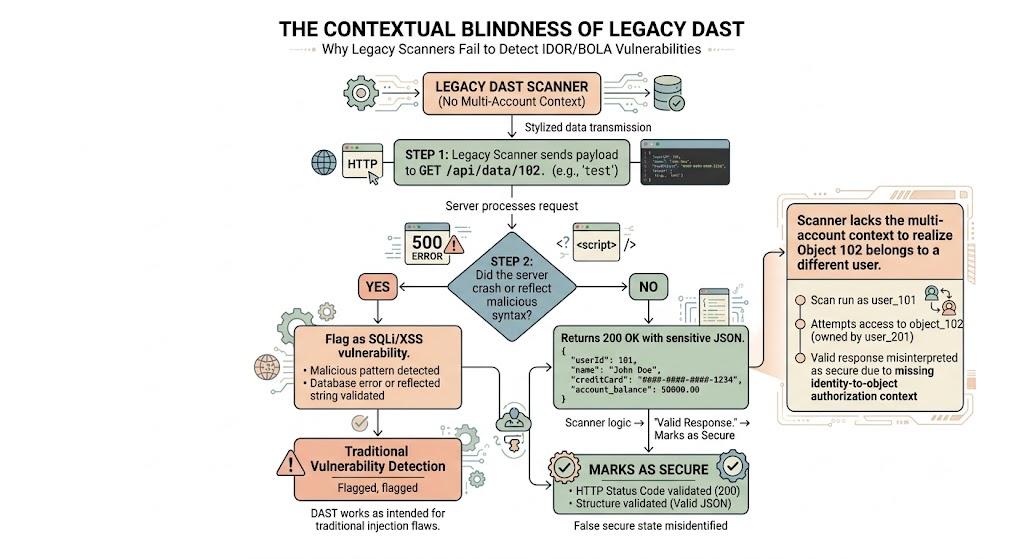
The answer lies in Contextual Blindness.
1. Lack of Application State Awareness
Traditional DAST tools crawl your application looking for standard injection vectors (XSS, SQLi, SSRF). They inject payloads like ' OR 1=1 -- and look for database error messages in the HTTP response. However, business logic flaws do not generate 500 Internal Server Errors or reflective cross-site scripting pop-ups. When an IDOR succeeds, the application behaves exactly as designed, it returns a 200 OK status code and a perfectly formatted JSON payload. A legacy scanner sees a 200 OK and moves on, completely unaware that the data returned belongs to the wrong tenant.
2. The Multi-User Authentication Barrier
To effectively test for Broken Object Level Authorization, a testing tool must understand lateral access. It must log in as User A, create a resource, log in as User B, and attempt to access User A's resource.
Legacy scanners cannot do this. They require a human security engineer to manually record a session (a HAR file) or hardcode a single authentication token. They do not have the capability to autonomously create multiple accounts, manage stateful tokens, and cross-pollinate session IDs. Because they only test from a single user's perspective, lateral API authorization testing is impossible.
Automating the Hunt: The Need for AI in API Authorization Testing
To bridge this massive gap in CI/CD pipeline security, the industry is shifting away from rigid, rule-based scanners and moving toward intelligent, autonomous agents. If legacy tools are the equivalent of a spell-checker, AI-driven platforms like Axeploit act as an automated penetration tester.
Hunting for business logic flaws requires a tool that understands the semantic relationships between users, roles, and data objects. Here is how modern automated API security testing solves the BOLA crisis:
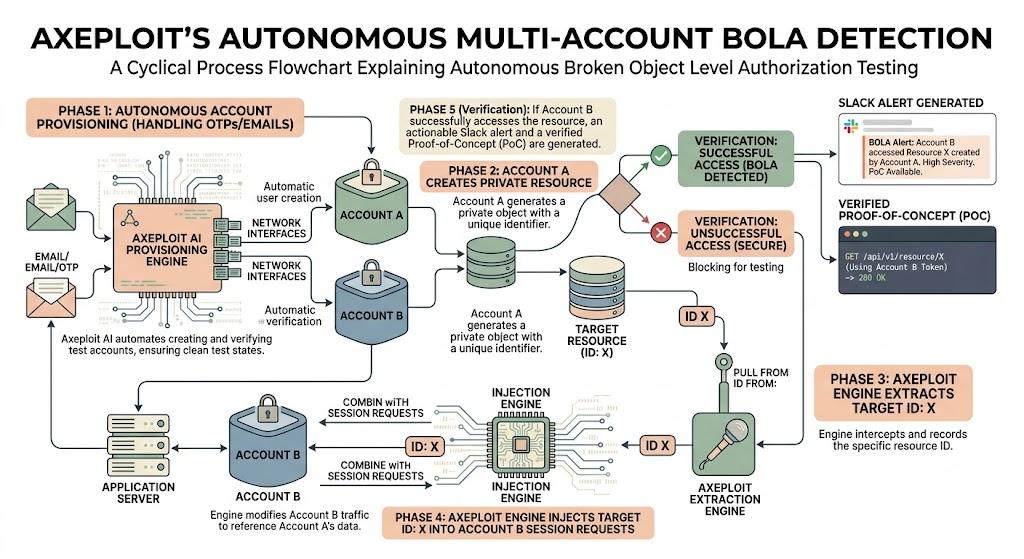
1. Autonomous Multi-Account Creation
Unlike traditional tools that require manual credential feeding, the Axeploit LLM engine operates with zero configuration. It utilizes its own dedicated mobile numbers and email addresses to autonomously register multiple accounts within your staging environment. It can pass email verifications, submit mobile OTPs, and establish distinct, verified user sessions simultaneously.
2. Intelligent Object Discovery and Fuzzing
Once authenticated as User A and User B, the AI agent dynamically maps your APIs. It identifies where User A creates an object (e.g., uploading a private document, creating a shopping cart, or generating an API key). The AI understands that the response contains a unique identifier (integer, UUID, or hash) bound to User A.
3. Executing the IDOR / BOLA Cross-Check
This is where the magic happens. Axeploit automatically takes the resource IDs generated by User A and attempts to access, modify, or delete them using the authenticated session of User B.
- Can User B read User A's data? (BOLA - Read)
- Can User B modify User A's profile? (BOLA - Write)
- Can User B access an admin-only endpoint? (Broken Function Level Authorization)
Because Axeploit operates with real contact details and genuine browser emulation, it tests your application exactly like a sophisticated human threat actor would.
Axeploit in Action: Zero-Config Automated API Security Testing
For backend developers and AppSec engineers, integrating stateful, multi-account security testing into a CI/CD pipeline has historically been an architectural nightmare. Traditional automated testing requires building fragile Selenium scripts, manually seeding databases with test user credentials, and constantly updating HAR files just to get a scanner to authenticate. Axeploit fundamentally changes this paradigm through its Zero-Config LLM Engine.
Instead of manually configuring auth states, teams simply point Axeploit at their application. Driven by a fleet of AI agents, the platform autonomously provisions its own test accounts, handles complex email verifications and mobile OTPs, and executes advanced lateral access checks. By leveraging one of the world's largest password and fuzzing databases alongside continuously updated CVE intelligence, the platform hunts for over 7,500 known vulnerabilities, including zero-days and deep-rooted business logic flaws.
Here is how Axeploit operates under the hood to deliver truly automated API security testing:
- Smart Scan Control for Agile Pipelines: Running a comprehensive infrastructure pentest on every single pull request is unfeasible and creates massive deployment bottlenecks. Axeploit solves this via API access and native webhooks that integrate directly into your CI/CD tools. When a developer commits code, Axeploit’s LLM autonomously configures the scan scope. It targets only the newly introduced features, modified API routes, or high-risk endpoints, allowing for rapid, partial scans without any manual setup required.
- Layout-Aware Intelligence: Modern Single Page Applications (SPAs) and dynamic frontends are notorious for breaking legacy DAST tools the moment a developer shifts a DOM element or renames a CSS class. Axeploit’s Layout-Aware Intelligence adapts to frontend changes in real-time. The AI understands the semantic purpose of the UI, ensuring that the autonomous authentication flows and object discovery processes never break, even during major interface overhauls.
- Deterministic Proof of Concepts (PoCs): Axeploit eliminates the alert fatigue caused by legacy SAST/DAST tools. Because the AI agent actually executes the IDOR exploit safely in your staging environment, it does not just flag a theoretical risk based on a syntax error. If a vulnerability is validated, it instantly pushes a real-time Slack alert to the engineering team complete with a deterministic, undeniable Proof of Concept.
- White-Labeled Compliance Exports: For compliance officers and stakeholder audits, these highly technical findings can be instantly exported via custom, white-labeled PDF reports. This ensures that the time between discovering an authorization bypass and documenting its remediation is reduced to zero.
By replacing rigid, rule-based scanners with an intelligent, autonomous testing engine, Axeploit ensures that your APIs are continuously tested from the perspective of an advanced threat actor, catching the BOLA vulnerabilities that traditional tools inherently miss.
Conclusion
The persistence of BOLA vulnerabilities in 2026 highlights a critical failure in how the industry approaches application security. As long as backend developers rely exclusively on syntax-focused legacy scanners, they will remain blind to the stateful, contextual authorization bypasses that lead to devastating data breaches. Business logic flaws simply cannot be caught by checking boxes; they must be actively hunted by simulating complex, multi-user interactions.
To truly secure modern APIs, engineering teams must evolve their testing methodologies. Automating this process no longer means sacrificing depth for speed. By deploying an AI-powered vulnerability scanner like Axeploit, penetration testers and developers can finally run continuous, automated API security testing that autonomously provisions accounts, tests lateral access, and delivers verified, exploitable truth. Stop settling for theoretical warnings, and start testing your application precisely the way an adversary would.