In 2026, rolling out Multi-Factor Authentication (MFA) is no longer a badge of honor for engineering teams; it is the absolute bare minimum for defending user accounts. Yet, as AppSec engineers and backend developers know all too well, attackers are not blindly battering against the front door anymore. Instead, they are slipping through the side windows by targeting the underlying architecture of trust.
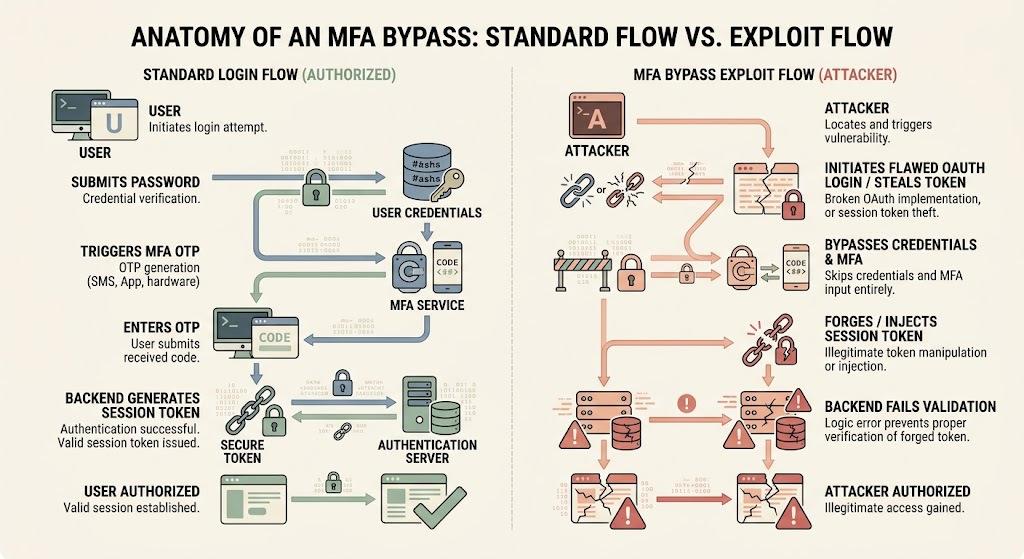
Advanced threat actors are increasingly executing complete MFA bypass attacks, not by cracking the second factor, but by circumventing the authentication flow entirely. When backend implementations fail to properly secure tokens, validate signatures, or manage states, the entire MFA layer becomes a mere illusion of security.
Building on our previous explorations of auth workflows, this deep-dive explores how attackers exploit OAuth vulnerabilities and Single Sign-On (SSO) flaws. We will unpack the technical exploit paths of these attacks and demonstrate how Axeploit’s AI agent navigates real login flows to autonomously test your session integrity and authorization controls.
The Illusion of MFA: Why Strong Credentials Aren't Enough
To a backend developer, authentication and authorization are distinct concepts. Authentication verifies who the user is, while authorization dictates what they can do. MFA excels at the former. However, modern applications rarely rely on isolated, monolithic login forms. They rely on interconnected identity providers (IdPs), SSO protocols, and OAuth 2.0 flows to grant access across microservices.
When an attacker successfully executes a MFA bypass, they are usually exploiting broken authentication at the protocol integration level. If your OAuth flow mismanages state, or your SSO implementation trusts unverified assertions, the attacker never even triggers the MFA prompt. They simply hand the backend a forged or stolen token, and the backend gladly rolls out the red carpet.
Technical Exploit Paths: Deconstructing the Bypass
How exactly do threat actors skip the MFA step? Let’s break down the most critical vulnerabilities haunting modern CI/CD pipelines.
1. OAuth State Parameter Manipulation (CSRF)
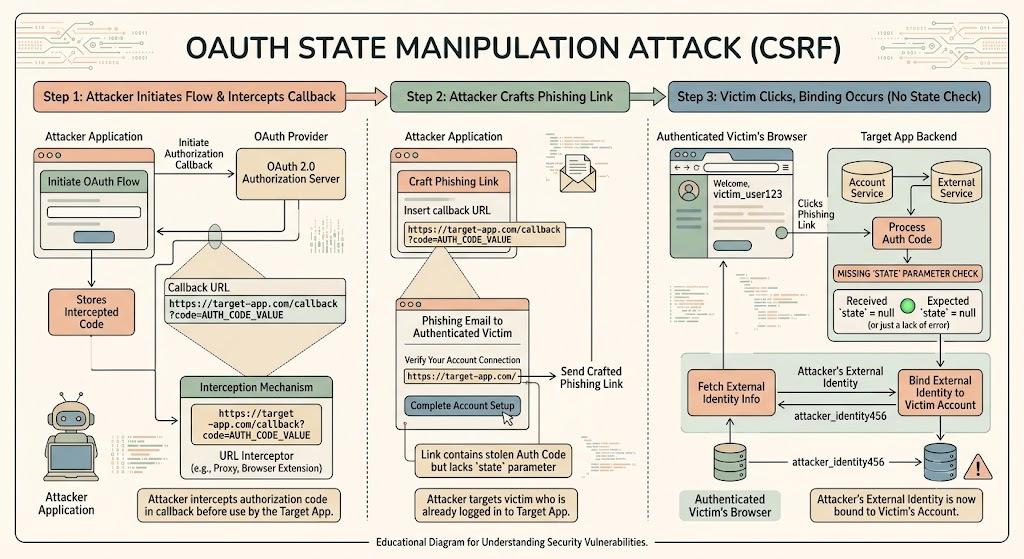
OAuth 2.0 is an authorization protocol, but it is heavily (and sometimes dangerously) used for authentication. A classic exploit occurs when developers misconfigure or entirely omit the state parameter during the authorization code grant flow.
The state parameter is designed to prevent Cross-Site Request Forgery (CSRF). It is a unique, unguessable string tied to the user's session before they are redirected to the Identity Provider (e.g., Google or GitHub).
The Exploit: If your backend does not validate the state parameter upon the user's return, an attacker can initiate an OAuth binding flow, capture the callback URL (containing their own valid authorization code), and trick a logged-in victim into clicking that link. The victim's account is instantly bound to the attacker's third-party OAuth account. From then on, the attacker simply clicks “Log in with Google” and gains full access to the victim's profile, completely bypassing the victim’s configured MFA.
2. Improper Token Validation and JWT Forgery
SSO security relies heavily on JSON Web Tokens (JWTs). While the cryptographic math behind JWTs is sound, the backend logic implementing them often is not.
The Exploit: Attackers frequently manipulate JWT headers. A notorious example is the "None" algorithm attack, where the attacker changes the alg header from RS256 to none, drops the signature, and modifies the payload to claim they are an admin. If the backend library is outdated or misconfigured, it will parse the token and grant access without validating the cryptographic signature.
Furthermore, even if the signature is validated, developers often forget to validate the aud (audience) and iss (issuer) claims. An attacker might generate a valid token from a different application they control (using the same IdP) and pass it to your API. If you only check the signature, the attacker bypasses MFA and logs in.
3. Session Hijacking via Token Theft
Sometimes, the simplest way to bypass MFA is to steal the keys to the kingdom after the door has been unlocked.
The Exploit: Session hijacking occurs when an attacker steals a valid session cookie or OAuth bearer token. This is often achieved through advanced Adversary-in-the-Middle (AiTM) phishing proxies (like Evilginx), Cross-Site Scripting (XSS), or malware on the user's device. Because the session token represents a state where MFA has already been satisfied, injecting this stolen token into a browser allows the attacker to hijack the session entirely. If your application lacks token binding, IP anomaly detection, or aggressive session timeouts, that stolen token offers unmitigated access.
4. A Note on SAML Vulnerabilities
While OAuth and OIDC dominate modern SaaS, many enterprise environments still rely on SAML (Security Assertion Markup Language). SAML vulnerabilities often manifest as XML Signature Wrapping (XSW) attacks. If the XML parser on the Service Provider (SP) side is flawed, an attacker can inject a forged assertion (claiming to be a privileged user) into a validly signed XML document. The backend verifies the signature on the outer shell but processes the malicious payload on the inside, bypassing all MFA requirements mandated by the IdP.
Testing the Untestable: How Axeploit Automates Auth Security
Understanding these OAuth vulnerabilities is only half the battle. The real challenge for AppSec engineers is testing them continuously. Legacy Dynamic Application Security Testing (DAST) tools are notoriously blind to complex authentication. They require manual credential feeding, they cannot handle mobile OTPs, and they break the moment a UI button shifts.
Because auth workflows are stateful and complex, they remain among the least tested areas in traditional CI/CD pipelines, despite causing over 30% of all critical vulnerabilities.
This is where an AI-driven approach fundamentally changes the game. Axeploit’s LLM engine is purpose-built to navigate and exploit flawed authentication logic autonomously.
Autonomous OTP Interception and Session Integrity
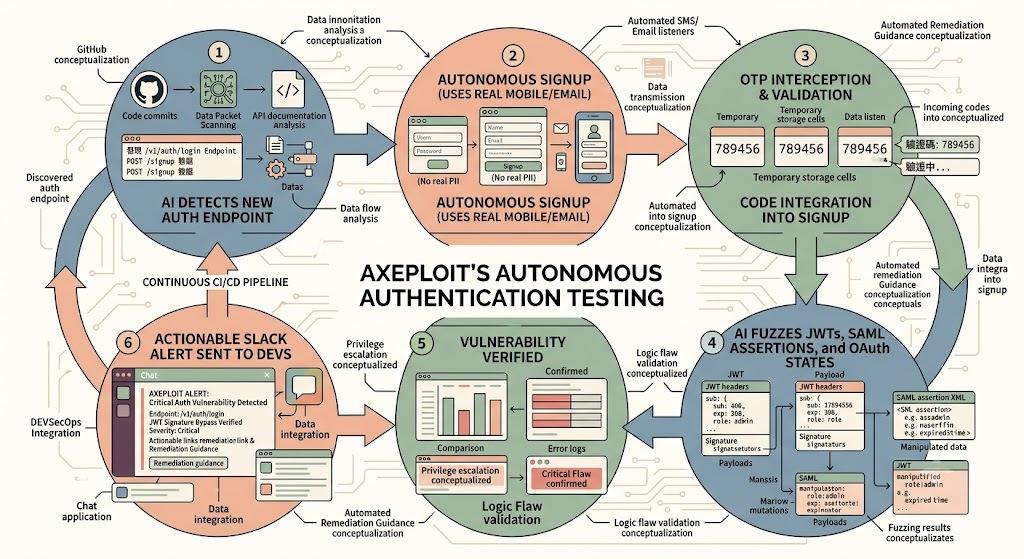
To test for an MFA bypass, a scanner must first understand how to navigate MFA. Axeploit acts as a synthetic, intelligent user. Equipped with its own dedicated mobile numbers and email addresses, Axeploit can autonomously register accounts, intercept SMS/email OTPs, verify emails, and log in.
Once authenticated, Axeploit's AI dynamically tests the session integrity:
- Fuzzing OAuth States: Axeploit automatically drops, manipulates, and replays OAuth state parameters to test if your backend enforces CSRF protections.
- JWT Manipulation: The engine actively intercepts JWTs, attempting algorithm demotion attacks, signature stripping, and audience mismatches to ensure your backend validation is watertight.
- Layout-Aware Intelligence: Even if your frontend team completely redesigns the SSO login page, Axeploit’s AI adapts in real-time, understanding the semantic purpose of the new UI elements without breaking the test flow.
Actionable Takeaways for AppSec and Backend Teams
To ensure your MFA implementation is actually protecting your users, engineering teams must harden the integration points:
- Enforce Strict State Validation: Never implement OAuth 2.0 without a cryptographically secure, session-bound state parameter. Reject any callback that lacks a matching state.
- Rigorously Verify JWTs: Use established, up-to-date libraries for JWT parsing. Always verify the signature, the algorithm (reject none), the expiration (exp), and the issuer (iss).
- Implement Token Binding: Where possible, bind session tokens to device fingerprints or client IP addresses to mitigate the impact of session hijacking.
- Automate Your Offense: You cannot secure what you cannot test. Integrate autonomous, AI-driven auth testing into your deployment pipeline.
Conclusion
Multi-Factor Authentication is an indispensable layer of defense, but it is not a silver bullet. As we navigate the complex threat landscape of 2026, it is clear that attackers are pivoting away from brute-forcing credentials and toward exploiting the very protocols designed to keep them out. When OAuth vulnerabilities, improper token validation, and state manipulation are left unchecked, they render the strongest MFA policies entirely useless.
For modern development teams, the goal must be continuous, contextual security validation. Relying on legacy tools that cannot navigate a simple OTP prompt leaves your most critical endpoints dangerously exposed. By leveraging Axeploit's AI-driven, zero-config vulnerability scanner, AppSec engineers can autonomously test complex SSO flows, intercept OTPs, and validate session integrity at the speed of CI/CD. Secure the front door with MFA, but use intelligent automation to ensure all the side windows are bolted shut.