
The annual penetration test is one of the most durable rituals in enterprise security. A team of skilled professionals spends one to three weeks exercising your application with attacker intent, produces a detailed report of findings prioritized by severity, and hands it to your organization with recommendations. You remediate the findings. You file the report. You schedule the next one for twelve months hence.
This ritual made sense when software shipped quarterly. When a major release represented months of accumulated development and the application that was tested in January was recognizably similar to the application running in December, a point-in-time security assessment provided coverage that corresponded to the application's actual rate of change.
The application is no longer similar to itself twelve months later. In most engineering organizations today, it is not similar to itself three weeks later. Features ship weekly. Infrastructure changes continuously. New dependencies are added with each sprint. APIs are extended, endpoints are added, authorization boundaries are redrawn, and configuration is adjusted in response to operational requirements. The application that the pen testers assessed has been replaced, incrementally but completely, many times over before the next assessment is scheduled.
This is not an argument against penetration testing. Skilled human assessors bring judgment, creativity, and adversarial reasoning that no automated tool replicates. The argument is against treating the annual penetration test as a meaningful security assurance mechanism for an application that changes at modern software development velocity. Assurance requires coverage. Coverage requires correspondence between the testing cadence and the rate of change.
What a Penetration Test Actually Covers
The output of a penetration test is a point-in-time assessment of the application as it existed during the engagement window. The findings describe vulnerabilities that were present, exploitable, and discovered within that window. The report represents the security posture of a specific version of the application at a specific moment.
Understanding what that means for coverage requires understanding what changes between assessments not abstractly, but in the concrete terms of what a real development team ships.
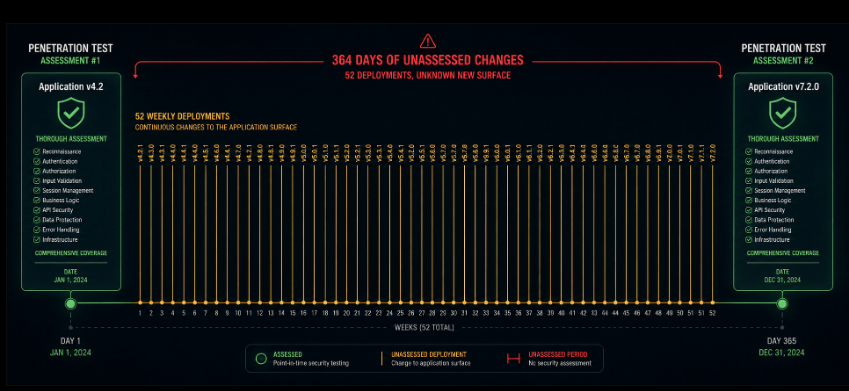
A team deploying weekly over the course of a year ships approximately fifty releases. A team deploying daily ships more than two hundred. Each release potentially adds new endpoints, new authentication paths, new data access patterns, new third-party integrations, and new configuration. Each of these changes is a potential introduction of new attack surface that the previous penetration test did not assess, because it did not exist when the assessment was conducted.
The scope of a penetration test engagement is the application at a moment in time. The scope of the actual attack surface is the application as it exists right now, continuously updated by every release since the last assessment. The gap between those two scopes is every change that has shipped since the engagement closed.
The Coverage Math Nobody Does Out Loud
There is a calculation that organizations should do when they purchase an annual penetration test, and almost none of them do it. It goes like this.
A two-week penetration engagement for a mid-sized SaaS application involves perhaps eighty to one hundred tester-hours of work against the application. The application, over the course of the following year, will be touched by thousands of developer-hours of new code, configuration changes, and infrastructure adjustments. The ratio of security testing effort to development effort in this model is somewhere around one-to-twenty or one-to-thirty, optimistically.
What that ratio means in practice: the security review that was purchased covers a fraction of the changes that will be made to the application in the period between assessments. The coverage is not zero vulnerabilities that were present at assessment time and were not fixed, and classes of vulnerabilities that are present across all versions of the application, will be captured. But the new attack surface introduced after the engagement closes is effectively unreviewed until the next engagement.
This is not a criticism of penetration testing firms or of their work. A skilled assessor in a two-week engagement will find real vulnerabilities and produce real value. The issue is with the organizational expectation that this work provides security coverage for the application over the twelve months following the engagement which it cannot, because the application changes and the assessment does not.
What the Report Says vs. What the Application Does Now
The penetration test report is a historical document on the day it is delivered. The findings it contains describe the application as it was during the engagement. Some of those findings will have been remediated. Some will still be present. Some will have been reintroduced by subsequent changes that were not coordinated with the remediation effort. New findings, introduced by the fifty releases that shipped after the engagement closed, are not in the report because they did not exist when the report was written.
This creates a particular kind of organizational risk: the clean report. An organization that has remediated all findings from the previous assessment and has not received a new report exists in a state where the documentation suggests the application is secure, while the actual application has been continuously modified in ways that may have introduced new vulnerabilities. The documentation is accurate about the past. It says nothing reliable about the present.
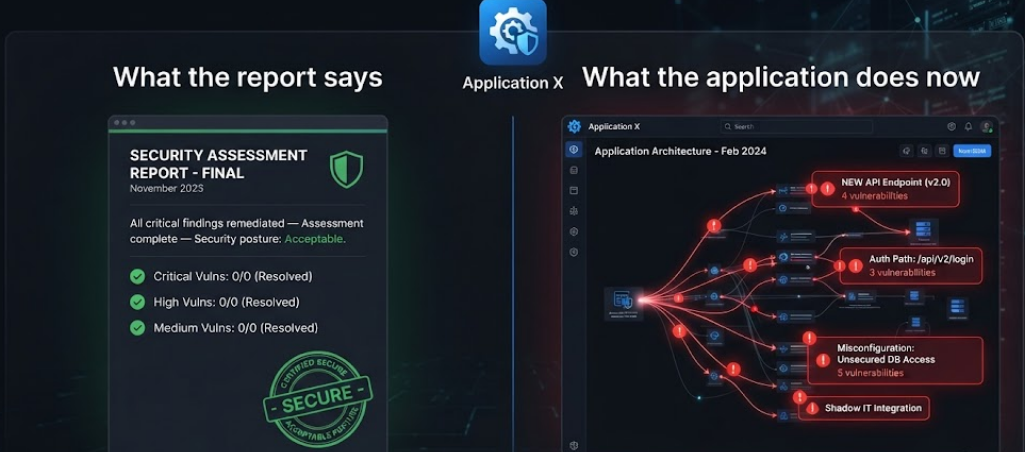
The organizations most exposed to this gap are the ones that use the penetration test report as the primary security assurance mechanism communicating it to boards, to customers, to auditors, as evidence that the application is secure. The report is evidence that the application was assessed and that the findings from that assessment were addressed. It is not evidence that the application is currently free of vulnerabilities, because that claim would require ongoing assessment, not a point-in-time one.
What the Pen Test Was Never Designed to Catch
Even within the assessment window, penetration testing has structural limitations that organizations tend not to fully account for.
Time constraints shape what gets tested. A two-week engagement involves real prioritization decisions. Assessors focus their time on the areas most likely to yield significant findings authentication, authorization, data access patterns, known vulnerability classes in the technology stack. Areas that require deep exploration of application-specific business logic, that require building up context across many application workflows, or that are difficult to reach without extended familiarity with the application receive proportionally less attention. This is not a failure of the assessors; it is an inherent consequence of time-bounded work against a large and complex target.
Business logic vulnerabilities require application familiarity. The most valuable findings from penetration tests are often not the ones produced by running known exploit patterns against known vulnerability classes. They are the ones that emerge from an assessor who has built enough understanding of how the application works to recognize when it can be manipulated in ways its designers did not intend. That understanding accumulates over time. A two-week engagement provides limited time to build it. Some of the most serious business logic vulnerabilities in an application may require more time to surface than the engagement provides.
The assessment environment is not always production. Many organizations provide penetration testers access to a staging environment rather than production, out of legitimate concern for production data integrity and availability. The staging environment may differ from production in ways that are security-relevant: different configuration, different data volumes, missing infrastructure components, different network topology. Findings against staging are a useful proxy for production security posture, but they are not the same as findings against the actual production system that real users access.
The Compliance Trap
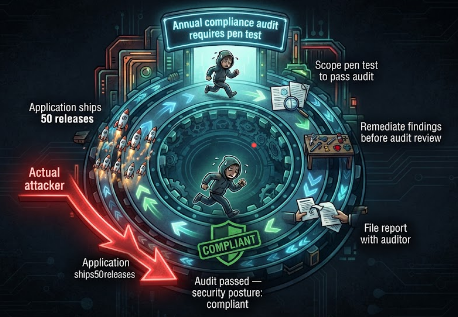
Compliance frameworks that mandate penetration testing SOC 2 Type II, PCI DSS, ISO 27001, FedRAMP have contributed to a procurement pattern where penetration testing is purchased to satisfy an audit requirement rather than to provide security coverage.
This is not the fault of the compliance frameworks, which mandate testing because testing is better than no testing. It is a pattern that emerges when the test is scoped and scheduled around the audit cycle rather than around the application's actual risk profile and rate of change.
An organization that performs a penetration test in October because the SOC 2 audit is in November, uses a staging environment to minimize risk, scopes the engagement narrowly to stay within budget, remediates findings before the audit, and then does not test again until the following October is performing a compliance activity. It is not performing a security activity in any meaningful correspondence with what the application is actually doing.
The compliance requirement and the security requirement are not the same. Satisfying the compliance requirement is necessary. Treating it as sufficient is the trap.
The Testing Model That Matches the Development Model
The alternative to the annual penetration test is not the absence of skilled human assessment. It is a testing model that is structured to provide coverage corresponding to the rate at which the application changes.
This model has three components that complement each other rather than replacing any one of them.
Continuous automated testing against the running application. Automated security testing that runs against the deployed application not the source code, not the dependency manifest, but the actual application responding to HTTP requests provides coverage for the application's current state rather than its state at a past moment. This testing exercises authentication boundaries, authorization controls, input handling, and session management on the version of the application that is live right now. It runs after every deployment, providing immediate feedback on whether a change introduced a new exploitable behavior. It does not replace human judgment, but it provides continuous coverage that point-in-time assessments structurally cannot.
Developer-integrated security testing in the build pipeline. Static analysis, dependency scanning, and security linting integrated into the build process catch classes of vulnerabilities at the earliest possible moment before the code is deployed, when the cost of remediation is lowest. This layer operates on what is about to ship, providing the earliest possible signal on what the continuous testing layer will face when the deployment is live.
Targeted human assessment at meaningful intervals and trigger events. Skilled human assessors continue to provide the judgment, creativity, and depth that automated testing cannot replicate. The change is not eliminating human assessment but scheduling it around security-relevant events rather than calendar dates: a major architectural change, a new payment integration, a significant expansion of data access scope, a shift to a new authentication model. Quarterly targeted assessments of areas of highest change and highest risk provide human-judgment coverage on the surface where new vulnerabilities are most likely to have appeared, without the organizational assumption that an annual review covers the full current surface.
The Argument for Keeping the Annual Assessment
None of the above is an argument for eliminating the annual penetration test. It is an argument for what the annual penetration test is and what it is not.
The case for retaining periodic human-led assessment is real. Skilled assessors find things that automated tools miss not because automated tools are inadequate, but because the specific class of vulnerability that requires extended application familiarity, creative adversarial reasoning, and the ability to chain multiple observations into a non-obvious exploit path is genuinely better surfaced by experienced humans. That value does not disappear because the testing cadence is inadequate for comprehensive coverage.
The case for retaining the annual assessment is also pragmatic. Compliance frameworks require it. Enterprise customers increasingly require evidence of it. Some organizations require it for cyber insurance qualification. These are real requirements that do not go away because the coverage model is imperfect.
What changes is the organizational understanding of what the assessment provides. It provides a thorough human-judgment review of the application at a moment in time, with the limitations that implies. It does not provide assurance about the application's security posture on any day other than the assessment window. That honest framing is the starting point for building the complementary continuous testing capability that covers what the periodic assessment cannot.
Closing: Two Different Questions
The penetration test answers one question: what vulnerabilities exist in this application right now, as assessed by skilled humans with attacker intent?
That is a valuable question. It has a valuable answer. The problem is that organizations have been using that answer to respond to a different question: is this application secure? Those questions are related but not the same, and confusing them produces a security program that provides strong historical documentation and weak current coverage.
The application that your pen testers assessed is not the application running in production today. It is the application that was running when the engagement was scheduled, when the assessors had time, before the thirty-seven features that shipped in the intervening weeks. The report is accurate. It is accurate about something that no longer exists in the form described.
Building a security program around the answer to the first question while pretending it answers the second is how organizations end up with clean pen test reports and production breaches in the months between assessments. The two things are not contradictory the pen test was clean when it was conducted, and the breach happened after it, through a change that was never assessed.
The question that matters for security is always about the present tense: what does the application do right now, and what can someone with attacker intent make it do? That question requires testing the application as it currently exists, at the cadence at which it changes. The annual assessment is a valuable input. It is not, on its own, an answer.
Axeploit was built for the question the annual pen test cannot answer continuously. Its AI agents test the running application after every deployment exercising authentication workflows, probing authorization boundaries, testing input handling across new endpoints, and surfacing the vulnerabilities that appear when software ships faster than point-in-time assessments can track. It provides the continuous coverage layer that makes the periodic human assessment more valuable, not less, by ensuring that assessors arrive at an application that has been continuously tested rather than twelve months unreviewed.