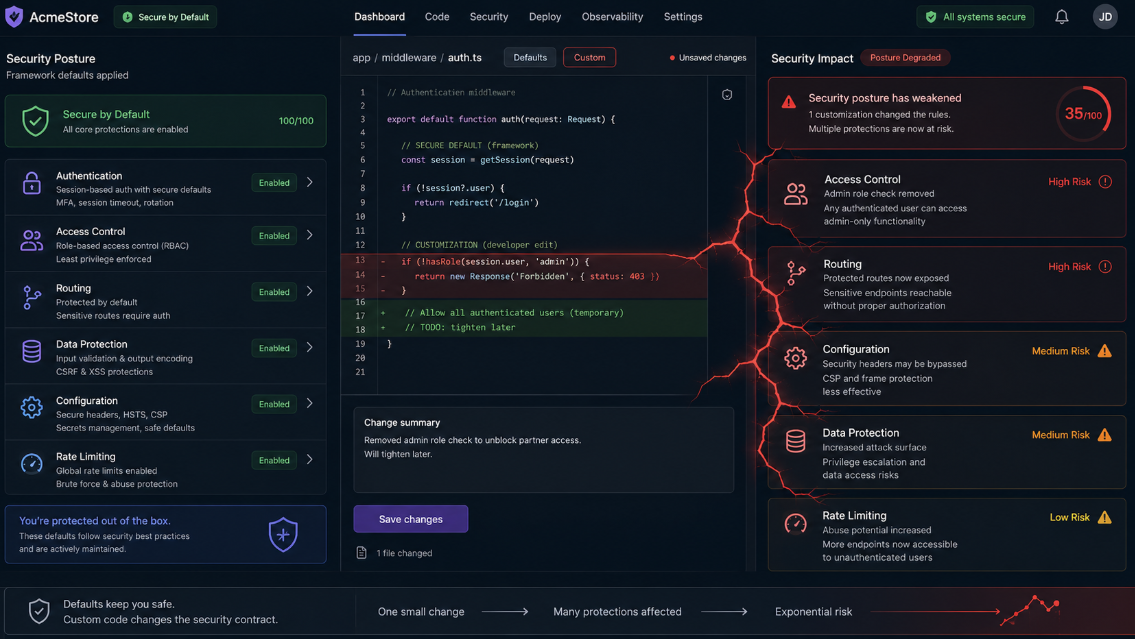
A lot of software starts with a promise that sounds comforting. The framework is secure by default, so the team can move fast without worrying too much. That promise usually holds right up until the first real customization, when a small change in routing, access control, serialization, or configuration quietly opens the door again.
Defaults protect demos, not product reality
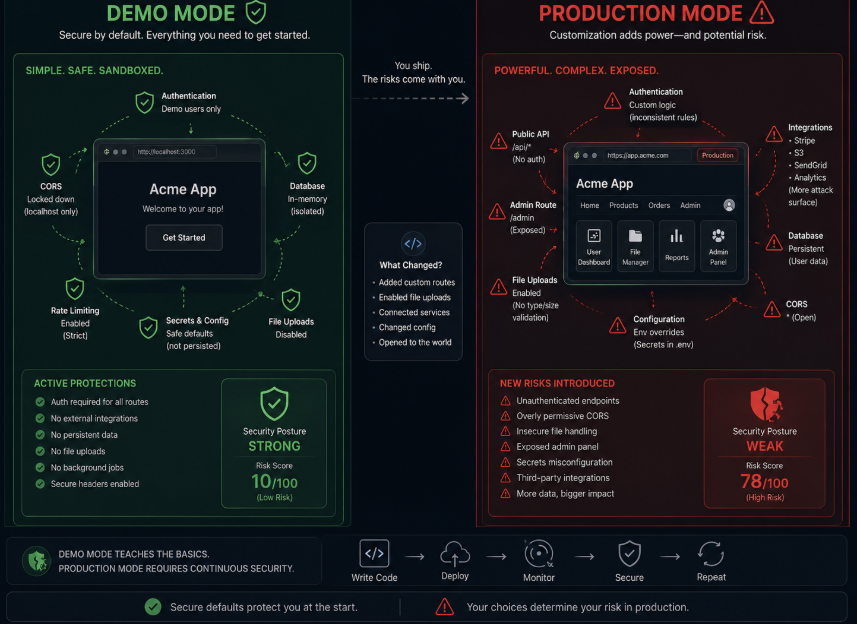
“Secure by default” is one of the most attractive phrases in modern development. It suggests the hard work has already been done and the framework has made the safe choice for you. In demos and tutorials, that is often true. The first login flow works, the first endpoint behaves properly, and the app starts in a reasonably safe state.
The problem begins when the product stops being a demo. Real software gets edited. Teams add custom routes, change middleware, override settings, connect extra services, and expose new API paths. Each change is reasonable on its own. The system as a whole is where the risk appears. A default that was safe in isolation can become unsafe once the application starts handling real users, real data, and real business logic.
That is the systemic issue. Frameworks can reduce the number of dangerous choices, but they cannot protect a product from the decisions developers make after the initial setup. Security often breaks not because the framework was bad, but because a custom requirement removed the guardrail that made it safe in the first place.
Where the break usually happens
The most common break point is authentication and authorization. A framework may ship with solid defaults, but a developer adds a custom endpoint, a convenience route, or an admin override and forgets to enforce the same checks. The app still feels protected because the login screen did not change, but access control has already drifted.
Configuration is another weak point. A secure default can be undone by one environment variable, one permissive CORS rule, one debug flag, or one “temporary” exception used during development. The code still compiles. The app still runs. The exposure is now hidden in plain sight.
Custom serializers, file handlers, background jobs, and integration layers create similar problems. A framework can make the common path safe, but teams often spend more time in uncommon paths once the product grows. That is where the defaults stop protecting the application and the developer takes over, often without realizing they just inherited the burden of security.
Why teams keep assuming the framework will save them
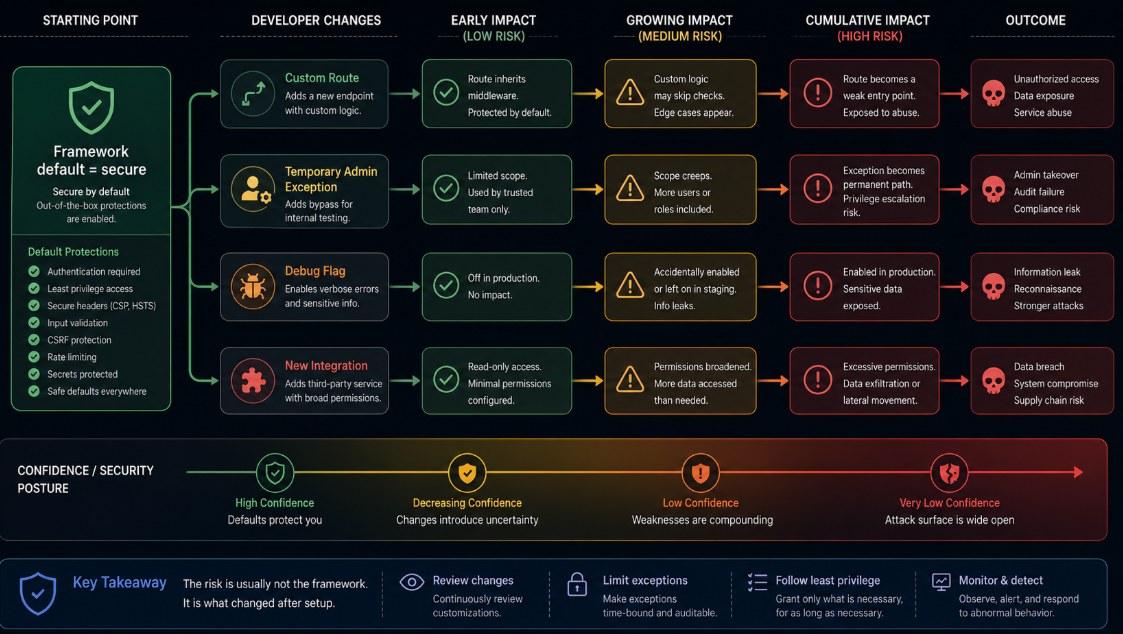
The reason this pattern keeps repeating is psychological as much as technical. When a framework advertises safety, teams relax. They assume the vendor or community has already covered the risky parts. That confidence is useful early on because it lowers friction, but it becomes dangerous when it turns into trust without verification.
Developers also work in a world of pressure and shortcuts. A customer wants a custom login flow. Product wants a faster export. Engineering needs a new integration. The simplest path is often to tweak the default rather than rethink the security model. That is understandable, but it creates a hidden dependency. The team now believes the framework is still protecting them even though they changed the conditions that made the default safe.
This is why secure defaults are not a finish line. They are the starting point. As soon as the application becomes specific to the business, security becomes a living property of the codebase, not a feature of the framework.
What actually helps when defaults stop being enough
The useful mindset is not to distrust frameworks. It is to treat them as a baseline, not a guarantee. Every significant customization should be reviewed as a security change, not only a product change. That includes route additions, permission overrides, admin shortcuts, file upload logic, and anything that changes how the app handles trust.
Teams should also test the application the way attackers would use it, not only the way developers expect it to behave. That means checking object ownership, role boundaries, configuration drift, and flows that bypass the happy path. It also means looking for the kinds of issues that show up after customization, such as IDOR, auth bypass, and business logic flaws. Tools like Axeploit are helpful here because they can uncover the vulnerabilities that appear after framework defaults stop being enough.
The real goal is simple. A framework should make secure development easier, but the team still has to prove the product stayed secure after the first meaningful change.
Something better than blind trust
The strongest teams do not rely on the phrase “secure by default” as a substitute for review. They assume every custom change has the power to erase a safety margin that used to exist. That habit keeps the framework useful without turning it into a false promise. If you want to check how much risk has crept in after those changes, you can run an automated scan with Axeploit.