Trust is necessary for applications: you must let users act. The problem arises when that trust extends further than intended when user-supplied inputs affect control flow, when client-side checks are treated as authoritative, or when admin interfaces accept overly broad privileges. These implicit trust escalations create a “trust hierarchy problem”: lower-trust actors gain influence over higher-trust operations. This article breaks down common failure modes, demonstrates robust alternatives, and provides practical remediation steps you can apply immediately.
What is the trust hierarchy?
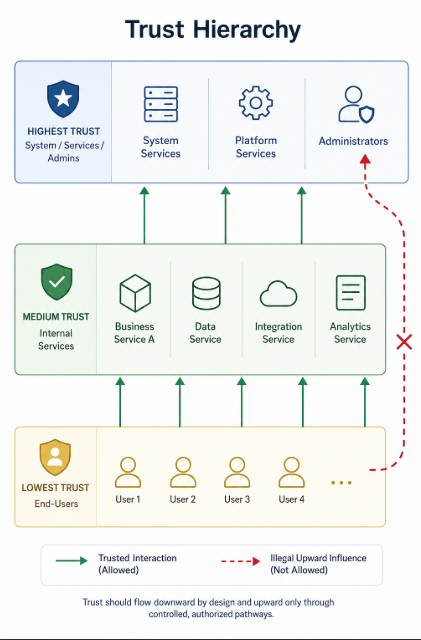
A trust hierarchy orders who (or what) your system trusts: system components and admins at the top, internal services in the middle, and end users at the bottom. Each layer should have clearly bounded capabilities. The trust hierarchy problem occurs when a lower-trust layer typically a user or clientcan influence or override a higher-trust operation, enabling privilege escalation, data exfiltration, and integrity failures.
Common patterns that break trust hierarchies
Client-side enforcement as authority
Failure mode: Relying on client-side checks (UI hiding, JavaScript validation) for critical decisions. Attackers bypass the UI and call backend APIs directly.
Fix: Always enforce validation and authorization on the server side. Treat the client as untrusted.
Example: Bad hiding admin-only buttons in the UI to prevent access. Good API endpoint verifies user role and returns 403 for unauthorized requests.
Header and parameter-based trust
Failure mode: Treating request headers or URL parameters as authoritative (for example, trusting an X-User-Role header or an account_id path param) without cryptographic validation.
Fix: Use server-issued tokens or signed assertions. Authorize based on server-side session or token claims and verify integrity and scopes.
Over-reliance on client-provided resource identifiers
Failure mode: Accepting resource identifiers (IDs, tenant tags) supplied by users and performing actions without verifying ownership or scope.
Fix: Resolve ownership server-side: map authenticated principal to permitted resource IDs and enforce queries/updates using those canonical mappings.
Query parameter authentication bypass
Failure mode: Exposing operations where supplying specific parameters changes semantics (for example, ?as_user=123 to perform action on behalf of another).
Fix: Remove backdoor parameters or gate them with strict server-side checks and auditable approvals.
Implicit trust in sandboxed inputs
Failure mode: Assuming sandbox or iframe boundaries, or "safe" file formats, are inherently non-malicious.
Fix: Sanitize, validate, and treat sandboxed content as potentially malicious. Use CSP, strict MIME checks, and file-type validation.
Authorization anti-patterns and robust alternatives
Role creep and broad RBAC
Anti-pattern: Roles like "admin" or "support" accumulate permissions over time for convenience.
Alternative: Attribute-Based Access Control (ABAC) and least privilege
- Enforce resource- and action-level policies.
- Combine attributes (tenant_id, resource_owner_id, request_origin) to compute effective permissions.
- Use time-limited elevation (just-in-time access) for sensitive operations.
Explicit delegation and service-to-service trust
Anti-pattern: Services implicitly trust other internal services because they run in the same network.
Alternative: Authenticate and authorize every inter-service call using mTLS, mutual JWTs, or workload identity. Tag requests with call-chains (trace context plus signed identity) and verify the caller’s allowed actions.
Data model and API design choices that reduce accidental trust
Canonical references and server-side joins
Problem: APIs require clients to provide linked resource IDs that the server trusts.
Solution: Let the server compute canonical references. For example, accept a user token and an action, and derive the workspace or project ID from the token or server-side mapping rather than trusting a client-submitted project_id.
Idempotent, explicit operations
Problem: Endpoints with ambiguous operations (POST /items with fields that switch behavior) allow clients to trigger unexpected side effects.
Solution: Design clear, purpose-specific endpoints (POST /items to create, POST /items/{id}/archive to archive) with explicit permission checks.
Secure upload flow (pattern)
- Client requests an upload URL with minimal identifying data.
- Server verifies authorization and issues a pre-signed URL tied to server-side metadata and short TTL.
- Client uploads; server verifies checksum and metadata integrity before marking object available.
Admin interfaces and emergency access: controlling the highest trust tier
Problem: Admin tools can be over-broad, lack auditing, and use tokens that are easy to misuse.
Controls:
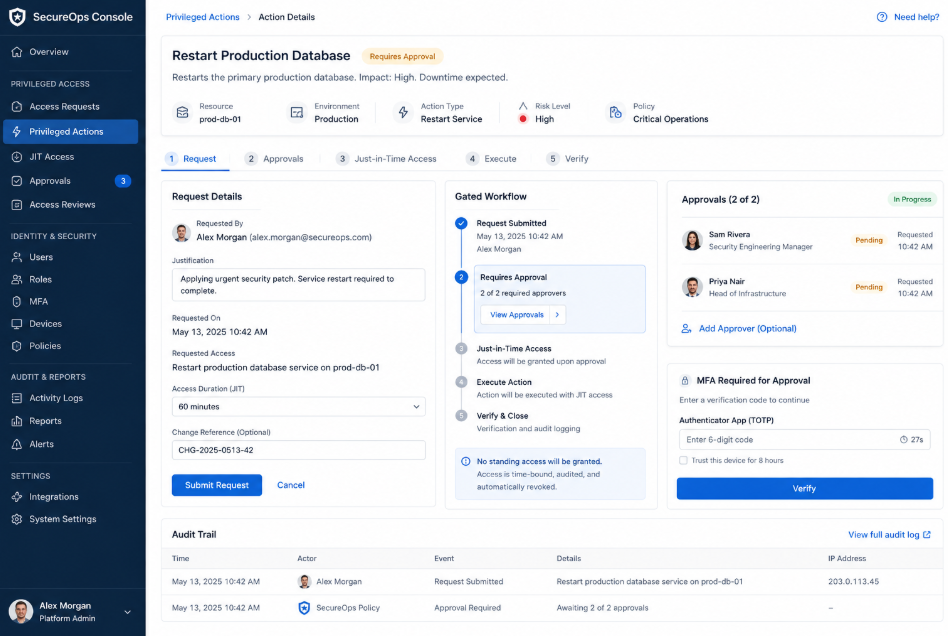
- Require just-in-time approvals and time-boxed elevation for sensitive admin actions.
- Enforce session MFA and device attestation for admin sessions.
- Segregate duties: split read and write admin privileges into distinct roles.
- Log every privileged action with immutable storage and alert on anomalous admin patterns.
Observability and detection: find where trust is abused
Detectable signals
- Unexpected resource access: principal accessing tenant resources not mapped to them.
- Spike in token creation or session revocations.
- High frequency of parameterized queries for different resource IDs.
- Admin actions outside normal windows or from unusual IPs.
Monitoring controls
- Enrich logs with authenticated principal, effective permission set, and request context.
- Implement anomaly detection on permission grants and resource access patterns.
- Use tamper-evident logging (append-only stores, secure logging services).
Practical code and policy examples
Server-side permission check (pseudocode)
- Extract principal from verified token.
- Resolve allowed_resources = mapping(principal).
- If resource_id not in allowed_resources: return 403.
JWT claim validation checklist
- Validate signature, issuer, audience, and expiration.
- Validate scopes/claims correspond to the requested action.
- Reject tokens with unexpected additional claims that could escalate privileges.
Pre-signed upload policy (conceptual)
- Server issues pre-signed URL tied to: principal_id, object_key, TTL, checksum.
- Upon upload completion, server verifies uploader via signed webhook or checksum match before changing object visibility.
Recovery and remediation: what to do when trust was misapplied
Immediate steps
- Revoke compromised tokens and rotate affected keys.
- Freeze impacted admin accounts and require re-authentication with elevated controls (MFA + device check).
- Temporarily tighten delegated privileges and revoke suspicious grants.
Forensic steps
- Collect tamper-evident logs for the incident window.
- Map actions to resource owners and affected principals.
- Perform data integrity checks and roll back changes where feasible.
Long-term fixes
- Tighten and instrument authorization checks.
- Adopt ABAC or more granular RBAC models.
- Implement JIT and just-enough-access principles.
Organizational practices that prevent trust creep
Threat modeling and design reviews
- Include authorization reviews in feature design and architecture documents.
- Ask at design reviews: Which principals can trigger this action? What asserts ownership? How is the call authenticated?
Security champions and code owners
- Assign ownership for sensitive flows (payments, tenant isolation, admin tooling).
- Require security sign-offs for changes affecting trust boundaries.
Testing and CI
- Add automated policy tests to CI that simulate cross-tenant access, parameter tampering, and header spoofing.
- Use fuzzing and API contract tests that include negative cases.
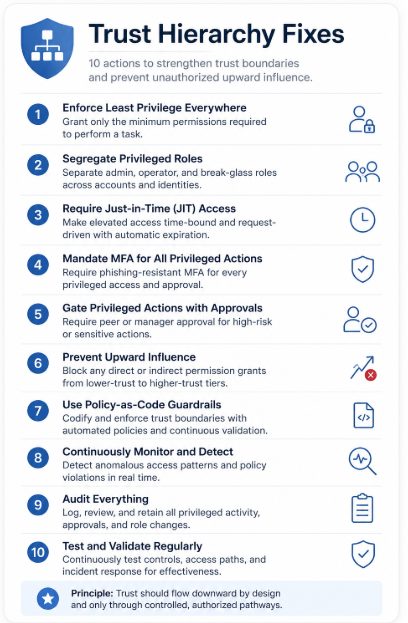
Checklist: Concrete actions to fix trust hierarchy issues
- Enforce server-side authorization for every sensitive endpoint.
- Remove reliance on client-supplied role indicators or ownership flags.
- Validate tokens comprehensively: signature, issuer, audience, scopes, expiry.
- Map principals to resource sets server-side; deny ambiguous or user-supplied resource IDs.
- Introduce ABAC policies or tighten RBAC; document role scopes.
- Require MFA and device attestation for admin sessions; implement JIT escalation.
- Add immutable logging for privileged actions and enrich logs with effective permissions.
- Use pre-signed, server-bound artifacts for uploads and external operations.
- Add CI tests for cross-tenant access, header/parameter tampering, and negative authorization cases.
- Schedule periodic audits for role creep and unused permissions.
Conclusion
Implicit trust is a common, often invisible vulnerability. The trust hierarchy problem appears across UI, APIs, data models, and admin tooling when lower-trust actors influence higher-trust outcomes. Preventing this requires design discipline: canonical server-side mappings, robust token validation, granular authorization, and operational controls such as JIT admin access and tamper-evident logging. Use the checklist and testing approaches above to find and close unintended trust escalations before they become incidents.