Email verification and authentication are two different security operations that solve two different problems. They happen to look similar from the outside both involve a user, an email address, and a token which is exactly why they get conflated in implementation, and exactly why that conflation produces vulnerabilities.
Authentication answers: is this person who they say they are? Email verification answers: does this person have access to the email address they registered with?
These are different questions. A person who verifies an email address has demonstrated control of an inbox. They have not necessarily demonstrated the right to use the account in question, the right to perform actions within it, or the right to access resources associated with it. The verification token is proof of inbox access. It is not proof of identity in any richer sense, and it is not a credential that should be treated as equivalent to an authenticated session in contexts where the distinction matters.
Most signup flows treat these two operations as interchangeable at the worst possible moment: immediately after account creation, when the application is making its first access control decisions about a new account that has not yet been meaningfully verified.
The Standard Signup Flow and Where It Goes Wrong
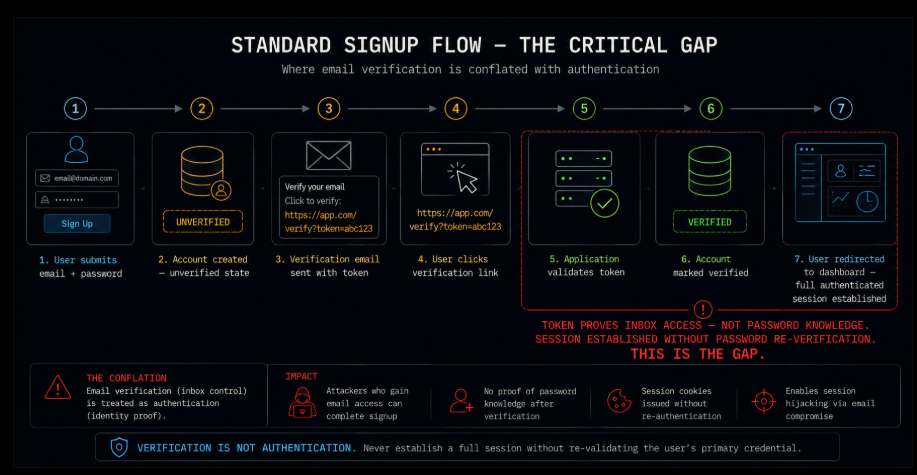
A typical signup flow looks like this: the user submits an email address and password. The application creates an account in an unverified state. The application sends an email containing a verification link with a token. The user clicks the link. The application marks the account as verified and redirects the user to the application dashboard.
That final step redirect to the application dashboard is where most implementations make a critical conflation. The verification link click is treated as proof of identity sufficient to establish a full authenticated session. The token in the URL, which proves only that the user can receive email at the registered address, is used as a session-establishing credential.
This is the gap. The verification token is a single-factor proof of inbox access. It is not a multi-factor authentication credential. It is not equivalent to a username-plus-password authentication. Using it to establish an authenticated session means that anyone who can access the email the legitimate user, anyone who shares the inbox, anyone who has compromised the email account, anyone who can intercept the email in transit, and in some implementations anyone who can guess or enumerate the token can establish an authenticated session without providing the password.
In practice, most verification tokens are not guessable they are cryptographically random strings of sufficient length. The direct brute force of a verification token is not the realistic attack. The realistic attacks are:
Email account compromise. An attacker who compromises the victim's email account can receive verification emails for accounts the victim has not yet verified, or can request new verification emails for existing accounts and use them to establish sessions.
Token interception. Verification emails that travel over unencrypted channels, that land in email providers with weak security, or that are forwarded through insecure mail relay chains can be intercepted.
Application-side enumeration. Many signup flows reveal whether an email address is already registered either through explicit error messages ("An account with this email already exists") or through timing differences in how quickly the registration response returns. This information is useful for targeted attacks.
Token reuse and missing expiration. Verification tokens that do not expire, that can be used multiple times, or that remain valid after the account has been verified represent persistent attack windows.
The Account Enumeration Problem in Registration
The registration form is one of the most reliably informative enumeration surfaces in any application. When a user attempts to register with an email address that already exists in the system, the application has to decide what to tell them.
The response options and their security properties:
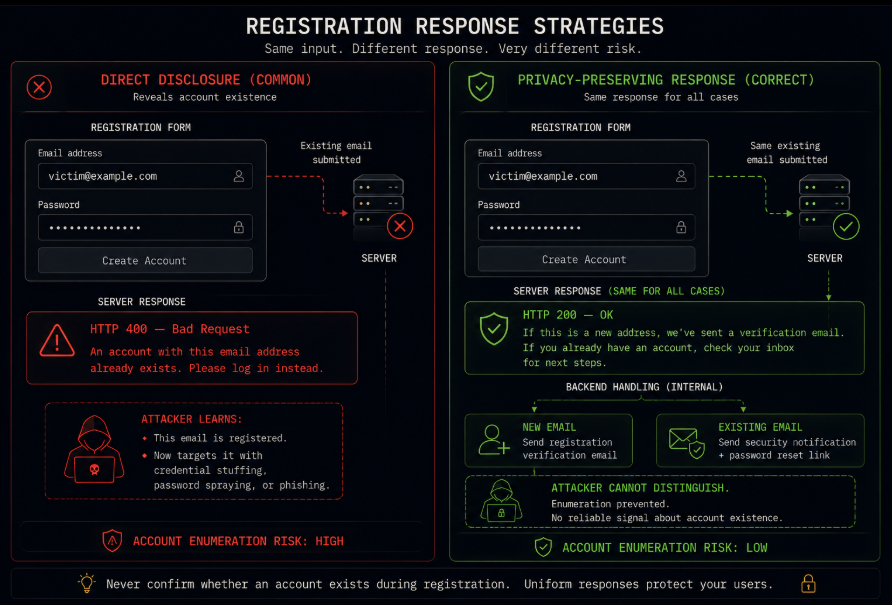
"An account with this email address already exists." This is the direct enumeration disclosure. An attacker who submits email addresses to the registration form can determine with certainty which addresses have accounts. This information enables targeted credential stuffing if the attacker knows a specific email address is registered, they can target it specifically with credentials from breach databases rather than testing addresses that may not have accounts.
"We've sent a verification email to this address." This is the privacy-preserving response the application sends the same message regardless of whether the email is new or already registered, but handles the two cases differently in the backend. For a new email, a verification email is sent with a registration link. For an existing email, a notification is sent informing the account owner that someone attempted to register with their address and providing a link to reset the password if the registration attempt was theirs. The user-facing message is identical in both cases. The enumeration information is not disclosed.
Most applications use the first approach because it is simpler to implement and provides clearer user experience feedback. The security cost is an enumeration surface that attackers regularly exploit.
The Token Lifecycle Vulnerabilities
Even when the verification token itself is cryptographically sound, the lifecycle management of that token produces vulnerabilities that appear consistently in security assessments.
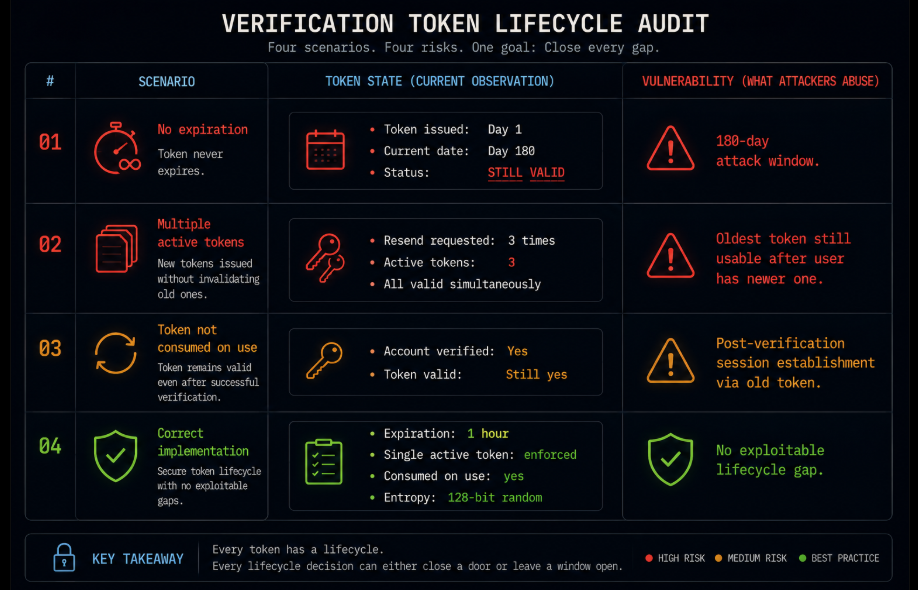
No expiration. A verification token that never expires is a persistent credential. A user who registers and never completes verification leaves an active token in the system indefinitely. An attacker who obtains that token through email account compromise, through a system that logs verification URLs, or through any other means has an indefinite window to use it. Verification tokens should expire within a short, fixed window one hour is a reasonable default for most applications.
Multiple active tokens. When a user requests a resend of the verification email, some implementations issue a new token without invalidating the previous one. The result is multiple valid tokens for the same account active simultaneously. An attacker who obtained an older token can still use it even after the user has received a newer one. Issuing a new verification token should invalidate all previous tokens for the same account and purpose.
Token reuse after verification. A verification token that remains valid after the account has been verified is a persistent credential that can establish sessions after the fact. The token should be invalidated immediately upon successful use not just the account state should change, but the token itself should be marked as consumed in the data store that tracks valid tokens.
Predictable token structure. This is rarer in modern implementations but still appears in legacy codebases: verification tokens that are derived from predictable values rather than generated from a cryptographically secure random source. Tokens based on the user ID, the timestamp, the email address, or any combination of guessable values can be enumerated. Verification tokens should be generated using a cryptographically secure random number generator and should contain at least 128 bits of entropy.
The Pre-Verification Account Abuse Problem
Between account creation and email verification, there exists a state that most applications handle inconsistently: the unverified account. An account has been created. The email address has not been verified. What can this account do?
The range of behaviors across applications is wide:
Full access pre-verification. Some applications grant complete application access immediately on registration, treating verification as an optional step that can be completed later. This allows an attacker to create accounts with real-looking email addresses they do not own, use those accounts to perform actions in the application, and never verify. If the application has any resource limits, reputation systems, or trust mechanisms that accrue to accounts, unverified accounts that are never cleaned up represent a persistent attack surface.
Partial access with upgrade on verification. The most common approach: unverified accounts can access some features but not others, with verification required to unlock full access. The security question is whether the restricted set of features available to unverified accounts is actually restricted to things where the email ownership proof is irrelevant. If an unverified account can interact with other users, send messages, post content, or access any resource where the email address is used as a trust signal, the verification requirement for those actions is not being enforced.
No access pre-verification. Some applications block all access until verification is complete. This is the strictest approach and eliminates pre-verification account abuse but creates a user experience friction point that many product teams are unwilling to accept.
The attack that exploits weak pre-verification access control: register with a target user's email address before they have created an account on the platform. Use the unverified account to claim resources, usernames, or organizational slots that the legitimate user would have claimed. When the legitimate user eventually registers with the same email address, the application informs them the address is already registered and the attacker's unverified account has claimed whatever resources were at stake.
Session Establishment After Verification: The Critical Design Decision
The most security-significant decision in a signup flow is how verification completion translates into session establishment.
There are two fundamentally different approaches:
Verification establishes a session directly. The user clicks the verification link. The application validates the token. The application creates an authenticated session and redirects the user to the application. The user is now logged in.
Verification confirms ownership and redirects to login. The user clicks the verification link. The application validates the token and marks the account as verified. The application redirects the user to the login page with a message: "Your email has been verified. Please log in to continue." The user logs in with their email and password.
The first approach is more common because it provides a smoother user experience one less step between registration and using the product. The security difference between the two is significant.
In the first approach, the verification token is effectively a session credential. Anyone who possesses the verification token can establish a session. The token was sent over email, stored in email servers, possibly logged in email delivery service logs, possibly visible in the browser history if the verification link was bookmarked or if the browser auto-saved the URL. The session is as secure as the confidentiality of all of those channels.
In the second approach, the verification token establishes account ownership. The session requires the password in addition to the verified email. The session credential is the password, which was not transmitted via email and is not visible in URL logs. The verification step and the authentication step are distinct operations that require distinct proofs.
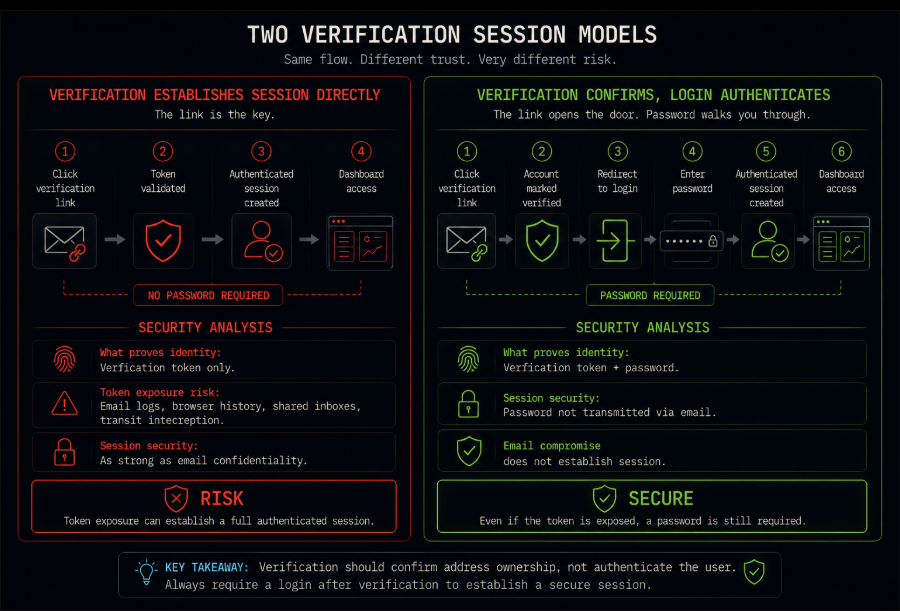
For most applications, the second approach is the correct design. The user experience cost one additional step is small. The security benefit verification and authentication are separate operations requiring separate proofs is substantial.
When the first approach is genuinely required for product reasons, specific mitigations reduce the risk: very short token expiration windows (fifteen to thirty minutes rather than hours), immediate token invalidation on session establishment, rate limiting on verification attempts, and alerts to the account owner when a session is established via verification link rather than via password authentication.
The Forgot Password Flow and Its Relationship to Verification
The password reset flow and the email verification flow share infrastructure both involve sending a token to an email address and using that token to establish or change account state and both require the same security properties: cryptographically random tokens, short expiration windows, single-use enforcement, and careful session establishment logic.
The specific intersection where the two flows create vulnerabilities: applications that allow password reset on unverified accounts.
A user registers with victim@company.com. The verification email is sent but the user has not clicked it yet. The attacker, who knows the account exists (either through enumeration or through other knowledge), requests a password reset for victim@company.com. The password reset email is sent to victim@company.com. The victim receives both the verification email and the password reset email simultaneously.
If the attacker has compromised the victim's email account, they can use the password reset link to set a new password and then log in with it. This is straightforward account takeover via email account compromise the verification flow is not the vulnerability here.
The vulnerability arises in implementations where the password reset flow bypasses verification requirements. In some implementations, successfully using a password reset link is treated as implicitly verifying the email address. This means that an account created by an attacker using a victim's email address and therefore in an unverified state can be converted to a verified, attacker-controlled account if the attacker can trigger and receive a password reset email. This is possible if the email address is one the attacker controls (registering with their own address to claim a username, for instance) or in specific scenarios involving email forwarding rules or inbox compromise.
Testing the Signup Flow: A Security-Focused Methodology
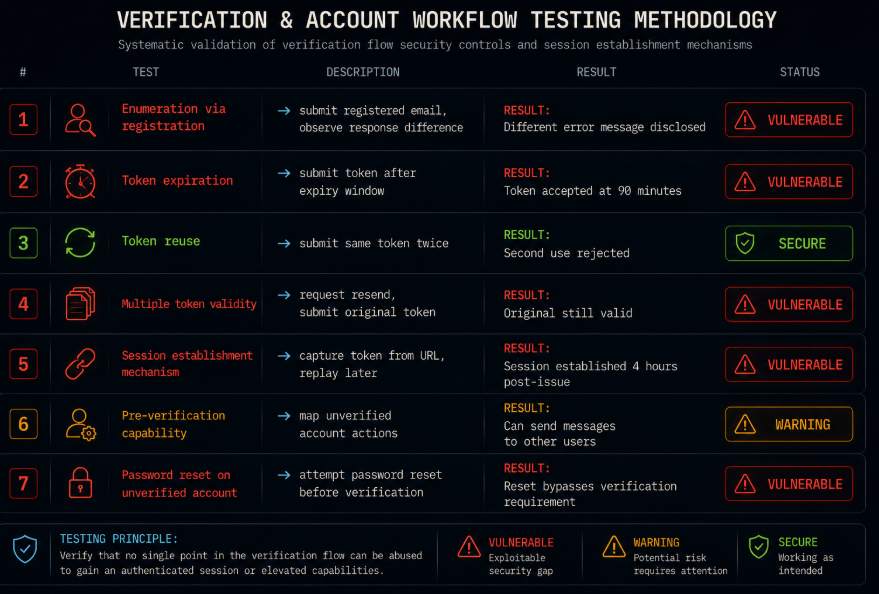
Testing a signup and verification flow for security vulnerabilities requires exercising the flow with attacker intent rather than with normal user intent. The specific tests worth running:
Enumeration via registration: Submit known-registered email addresses to the registration form and observe whether the response differs from the response for unregistered addresses in message, status code, or response time. Any distinguishing difference is an enumeration signal.
Token expiration: Obtain a verification token. Wait beyond the stated or expected expiration window. Submit the token. A correctly implemented flow rejects it. An incorrect implementation accepts it.
Token reuse: Complete verification with a token. Immediately attempt to use the same token again. A correctly implemented flow rejects the second use. An incorrect implementation completes a second session establishment.
Multiple token validity: Request a verification resend. Submit the original token rather than the new one. A correctly implemented flow has invalidated the original. An incorrect implementation accepts it.
Session establishment mechanism: Observe whether clicking the verification link directly establishes a session (verification-as-session pattern) or requires subsequent password entry (verification-then-login pattern). Test whether the verification token, captured from email logs or browser history, can be used to establish a session at a later time.
Pre-verification account capability: Create an account, do not verify it, and map what actions the unverified account can perform. Identify whether any of those actions create resources, relationships, or state that would conflict with the legitimate user's subsequent registration.
Forgot password on unverified accounts: Create an account, do not verify it, and request a password reset. Observe whether the reset succeeds and whether successful reset implicitly verifies the account.
Implementation Patterns That Get It Right
Correct signup and verification implementation has a small set of non-negotiable properties:
Cryptographically random tokens. Generated using the platform's secure random number facility, not derived from any predictable value. Minimum 128 bits of entropy. Stored as a hash in the database not the raw token value.
Short expiration. One hour for account verification tokens. Shorter for password reset tokens where the user experience permits. Time from token issuance, not from account creation.
Single-use enforcement. Mark tokens as consumed in the data store upon use. Reject any token that has been previously consumed, regardless of whether it is still within its expiration window.
Single active token per purpose. Issuing a new verification token for an account should invalidate all previous tokens issued for the same purpose and the same account.
Privacy-preserving registration responses. The registration response should not distinguish between existing and new email addresses. Route the backend behavior differently; present the same user-facing message.
Separate verification and authentication. The verification flow should confirm email ownership. The authentication flow should establish the session. These should be distinct steps requiring distinct proofs, not merged into a single flow that uses the verification token as a session credential.
Consistent unverified account restrictions. Define explicitly what unverified accounts can do and enforce those restrictions consistently. Do not allow unverified accounts to perform actions where email ownership is a meaningful trust signal.
Closing: The Signup Flow Is the First Thing an Attacker Reads
The login form is what security teams think about when they think about authentication security. Rate limiting, credential stuffing defense, MFA integration, session management all of these receive attention because the login form is the obvious authentication surface.
The signup flow is the authentication surface that receives less attention, and it is the one that an attacker reads first when they are looking for a path into the application. Registration reveals the enumeration behavior. The verification flow reveals the token properties. The session establishment logic reveals whether verification and authentication are properly separated. The pre-verification account state reveals what is available before any security check has meaningfully completed.
Every gap in the signup flow is a gap in the authentication story. The attacker who finds that verification tokens do not expire, that registration reveals which emails are registered, or that the verification token can establish a session without the password has found something that the organization's MFA deployment, rate limiting, and session management do not protect because the gap is before all of those controls apply.
Signup and verification are authentication. They should be designed and tested as such.
Axeploit tests the full account lifecycle not just the login flow, but registration, email verification, password reset, and the transitions between unverified and verified account states. Its AI agents create accounts, navigate verification flows, probe token expiration and reuse, test enumeration in registration responses, and verify whether verification completion produces correctly separated authentication rather than direct session establishment. These tests exercise the flows that receive the least security attention and that consistently produce account takeover paths in real-world assessments.