Most session token implementations are designed to solve one problem: how do we know this user logged in?
The answer to that problem is well understood. Generate a cryptographically random token. Store a reference to it server-side. Return it to the client. On every subsequent request, the client sends the token, the server looks it up, and if it finds a match, the request proceeds as that user.
That design works. It works so well, so consistently, for the happy path of user authentication, that it tends to stop there. Nobody sits down and designs what should happen when the user logs out from a different device. Nobody specifies what the token should do during a password reset on an account that has twelve active sessions. Nobody writes a requirement for what happens when the same token is used concurrently from two different continents.
Those are not exotic scenarios. They are normal events in the lifecycle of a real session token serving real users on a real application. And the behavior in each of those scenarios, in most applications, was not designed. It emerged from whatever the implementation happened to do when the scenario first occurred which is usually nothing, because the code was not written with that scenario in mind.
This is where session token vulnerabilities live. Not in the creation step, which most developers implement correctly. In every other step of a lifecycle that most developers never explicitly designed.
The Lifecycle That Should Exist
Before examining where implementations fail, it helps to define what a complete session token lifecycle actually looks like because the gaps become visible when measured against a complete model rather than against a vague sense that authentication is working.
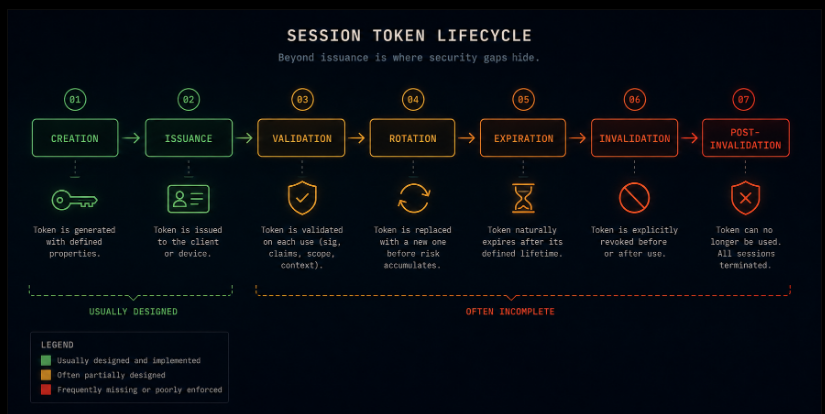
A complete session token lifecycle has seven distinct phases, each of which requires explicit design decisions:
Creation - How is the token generated? What entropy source? What length? How is it stored server-side, and in what format?
Issuance - How does the token reach the client? Over what transport? With what cookie attributes or header conventions? What information is conveyed to the client about the token's scope and expected lifetime?
Validation - On each request, what does the server verify? Does it check token existence, token validity, token ownership, and token scope - or just token existence?
Rotation - When does the token change? What events should trigger the issuance of a new token and invalidation of the previous one?
Expiration - When does the token stop working on its own? What is the absolute expiration? What is the idle timeout? Do these behave differently for sensitive operations?
Invalidation - What events force the token to stop working before its natural expiration? How thoroughly does invalidation propagate?
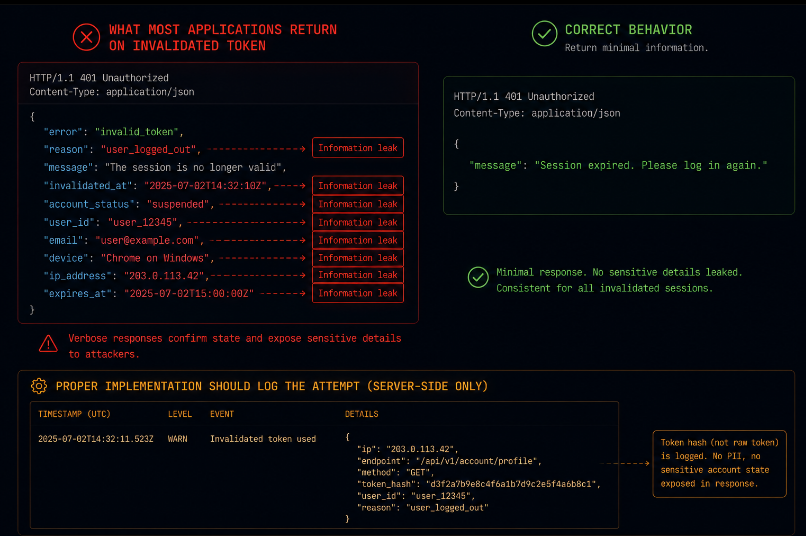
Post-invalidation - What happens if an invalidated token is used? How does the application respond, and what does it log?
Most applications design the first two phases carefully and the last five inconsistently or not at all. The results are predictable.
Creation: Where Most Teams Get It Right
Token creation is the phase with the most established practice and the clearest community consensus. A cryptographically random token of sufficient length, generated using the platform's secure random number facility, is the standard. Most modern frameworks handle this well by default, and the failure mode a predictable or low-entropy token is well documented enough that it tends to get caught.
The creation-phase failures worth auditing are narrower than they used to be, but they still appear:
Using a UUID as a session token is common and usually fine, but depends entirely on the UUID version. Version 4 UUIDs are random and appropriate. Versions 1 and 2 are time-based and partially predictable. A codebase that switched UUID libraries without checking which version is being generated may have quietly changed from secure to predictable token generation with no visible change in behavior.
Storing the token itself in the database rather than a hash of the token means that a database breach yields immediately usable session tokens. The pattern is analogous to storing plaintext passwords: not wrong from a functionality standpoint, but catastrophic when the data reaches an attacker. The server only needs to look up the hash on each request it does not need the raw token value.
Validation: The Gap Between Checking and Verifying
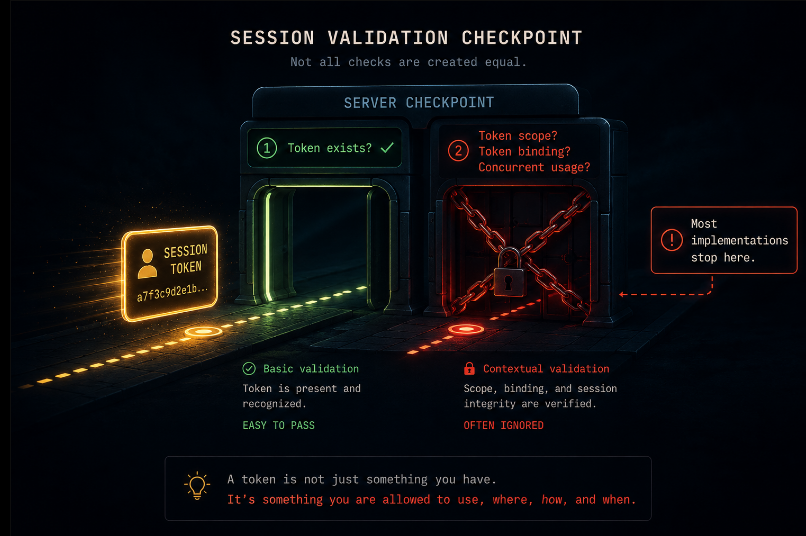
Token validation is where most implementations have their first significant gap. The common pattern is binary: either the token exists in the session store, or it does not. If it exists, the request proceeds as the user associated with that token.
This is necessary but not sufficient. A complete validation step also checks:
Token scope. A token issued for a mobile session should not be valid for an administrative action in a web context. A token issued for a read-only API integration should not be valid for a write operation. Most implementations do not encode scope into the token or validate it at the application layer they treat any valid token as equally valid for any operation the authenticated user is permitted to perform.
Token binding. If the token was issued to a specific IP address, device fingerprint, or client context, subsequent requests from a different context should be flagged or rejected. Token binding is not universally appropriate it breaks legitimate use cases like mobile users moving between networks but for high-value sessions, it is a meaningful layer. Most implementations implement no binding at all.
Concurrent usage patterns. A token used simultaneously from two different geographic locations within a short time window is either an aggressive VPN user or a stolen session being replayed by an attacker. Neither of these is inherently distinguishable from normal use, but the pattern is a signal worth logging and potentially flagging for review. Most implementations log nothing about concurrent usage patterns.
Rotation: The Event Nobody Writes a Requirement For
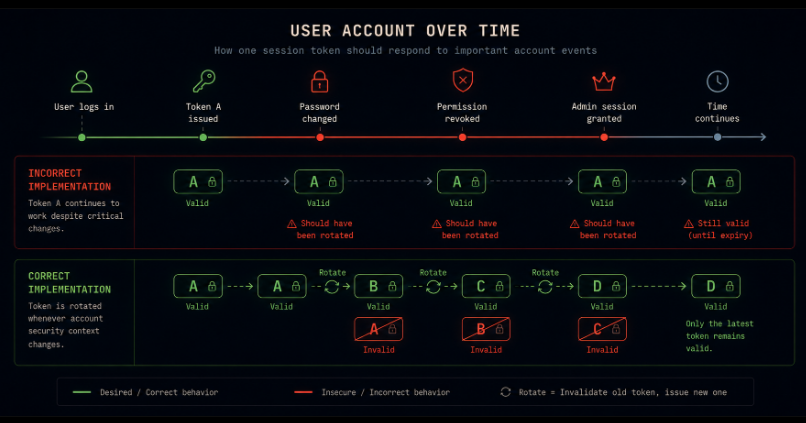
Token rotation is the practice of issuing a new token and invalidating the previous one when specific events occur. It is the correct response to any event that changes the security context of the session.
The canonical example is privilege escalation: when a user completes a second authentication factor, the session that existed before the second factor should be replaced with a new session that encodes the elevated assurance level. A session token issued pre-MFA should not be treated as equivalent to one issued post-MFA simply because the same user is logged in.
Other events that should trigger rotation, and typically do not in most implementations:
Password change. When a user changes their password, the assumption should be that the password may have been compromised. All existing session tokens for that account should be invalidated and replaced. The user completing the password change retains a session. Every other device with an active session is signed out. Most implementations do not do this. The user changes their password, continues the session normally, and every device that had a session before the change continues to have one including any device the attacker was using if the password change was itself prompted by account compromise.
Role or permission change. When an administrative interface grants or revokes a permission for a user, that change typically takes effect on the next login, not in the current session. A user whose permissions were revoked continues to have those permissions until their token expires. Depending on token lifetime, that window can be hours or days. The correct behavior is to force token rotation on permission changes, but this requires the permission management layer to have visibility into and control over the session layer a dependency most implementations do not wire up.
Sensitive action initiation. Accessing a billing page, initiating a funds transfer, changing contact information, or downloading sensitive data are all appropriate triggers for a step-up authentication requirement that produces a new, narrowly scoped token valid only for that action. The step-up requirement forces the user to re-authenticate, producing evidence of continued control of the credential. Most implementations do not have a concept of action-scoped tokens at all.
Expiration: Two Numbers That Usually Get Conflated
Session token expiration is typically implemented as a single number: the token lasts this long. Set it too short and users are constantly re-authenticating. Set it too long and stolen tokens have a long window of usefulness. Teams pick a number that feels reasonable, and that is the end of the design conversation.
A complete expiration design distinguishes between two different concepts that get conflated into that single number:
Absolute expiration is the maximum lifetime of a token regardless of usage. Even if the user has been actively using the application every five minutes for a week, the token expires after the absolute lifetime and the user must re-authenticate. This prevents indefinitely-lived tokens from accumulating, either through legitimate extended use or through a stolen token that is being used quietly by an attacker in parallel.
Idle expiration is the time after last use beyond which the token is treated as abandoned and invalidated. A user who last made a request three hours ago should not have a valid session. The idle timer resets on each authenticated request.
Most implementations implement idle expiration only the token stays valid as long as it is being used and set the idle window to something between thirty minutes and a day depending on the application. Absolute expiration is rarer. The consequence of missing absolute expiration is that a high-engagement user, or an attacker who is actively using a stolen session, can maintain a valid token indefinitely.
There is a third expiration concept worth implementing separately for sensitive contexts: step-up expiration, where an elevated privilege granted by re-authentication expires on a shorter timeline than the overall session. A user who completes MFA to access billing information should not retain billing-level access for the full session lifetime. The step-up access should expire after a short window, requiring re-authentication for subsequent sensitive actions even within the same session.
Invalidation: The List of Events Nobody Wrote Down
Invalidation is the most consistently incomplete phase of the session token lifecycle, because it requires someone to have enumerated the full list of events that should force a token to stop working and that list is rarely written down explicitly.
The events that clearly should trigger invalidation, and in many implementations do not:
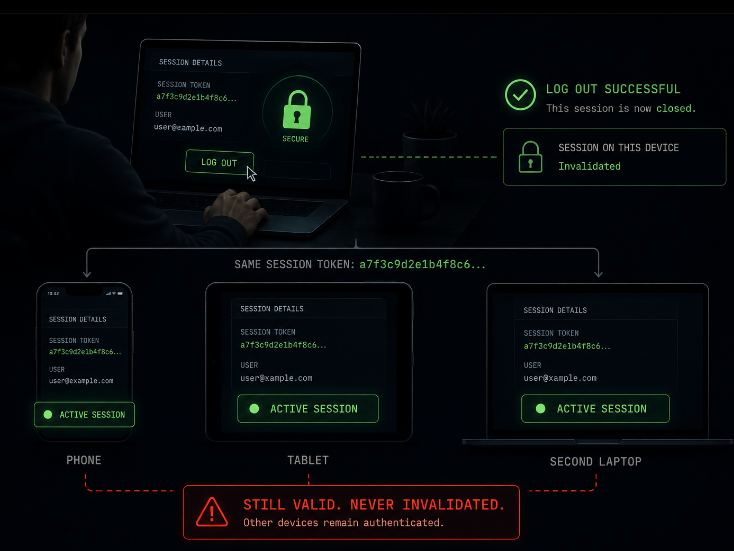
Logout from any device should not leave sessions active on other devices. The modal implementation of logout invalidates the session cookie on the device performing the logout. Sessions on other devices, in other browsers, in mobile apps these continue. "Log out of all devices" is sometimes available as an explicit option, but the implicit expectation that logging out removes access is frequently violated.
Account lockout or suspension should immediately invalidate all sessions. When an administrator locks an account or when automated fraud detection suspends it, any active sessions for that account should stop working immediately. The common implementation invalidates the account at the account record level, but the session layer checks the session store, not the account record, on each request. The session remains valid until it naturally expires. An account suspended for suspicious activity continues to have active sessions for the duration of the token lifetime.
Successful password reset should invalidate all pre-reset sessions. The mechanics here are the same as password change pre-reset sessions should be invalid because the reset event implies the previous credential may have been compromised. The user completing the reset retains a fresh session. All other sessions must be invalidated. Most implementations do not connect the password reset flow to the session layer in this way.
Email or phone number change for accounts that use those values for authentication should trigger invalidation. If a user's email is their username and their recovery channel, a change to that email is a material change to the account's security posture. Existing sessions were issued with the assumption that the previous email was valid. They should be rotated on the change event.
Post-Invalidation: The Response That Reveals the Design
What happens when an invalidated token is used tells you more about the maturity of a session implementation than almost any other signal.
The correct behavior is a 401 response with no meaningful information about why the token was rejected just that the session is no longer valid and the user should re-authenticate. The response should not reveal whether the token was invalidated due to logout, due to account suspension, due to a password change, or due to expiration. Each of these is a potential information leak: an attacker with a token they suspect has been invalidated can probe the error response to learn what happened.
The other behavior that should accompany a post-invalidation event is logging. Every use of an invalidated token should be logged with the token identifier, the timestamp, the source IP, and the endpoint being accessed. An invalidated token being replayed is not always an attacker it is sometimes a cached request, a background refresh, or a client that has not received the invalidation signal. But it is always worth knowing about, and most applications log nothing when an invalid token is used beyond whatever generic authentication failure logging exists.
What a Lifecycle Audit Actually Looks Like
Running an audit against a real application's session token lifecycle is a different activity from standard penetration testing. It is less about sending malicious payloads and more about exercising the lifecycle systematically and observing whether each phase behaves as a complete design would require.
The methodology is straightforward. Obtain a valid session token through normal authentication. Then work through each lifecycle phase deliberately:
For validation: test the token from a different IP, with a different User-Agent, in rapid succession from two different clients simultaneously. Observe whether the server treats these as normal.
For rotation: change the account password, revoke a permission, complete a second factor. Check whether the original token is still valid after each event.
For expiration: allow the token to age without use beyond the idle timeout. Verify it actually stops working. Then test whether absolute expiration exists at all by maintaining continuous activity beyond the idle window.
For invalidation: log out from one device. Verify whether sessions on other devices were affected. Lock the account. Test whether the session is immediately invalid or continues to work until natural expiration.
For post-invalidation: use an invalidated token deliberately. Observe what the response reveals about the reason for invalidation.
Each of these tests exercises a specific design decision that either was made intentionally or is producing behavior by default. The audit reveals which ones were designed and which ones were left to chance.
Closing: The Lifecycle Your Users Assume You Designed
Every user who logs out of your application on a shared computer is implicitly trusting that their session is now inaccessible. Every user who resets a compromised password is implicitly trusting that the attacker's existing session is now invalid. Every user whose account an administrator suspends is implicitly trusting that the suspension takes effect immediately.
These are reasonable things to trust. They are what a thoughtfully designed session token lifecycle would provide. They are also, in many production applications, assumptions that the implementation does not satisfy not because anyone decided they should not, but because nobody ever explicitly designed what happens in those scenarios.
The session token lifecycle that most applications have is the one that emerged from solving the original problem how do we know this user logged in and then never revisiting what comes after. The gaps are not random and they are not subtle. They are predictable consequences of a lifecycle that was started but never finished.
Finishing it is not complicated engineering. It is, mostly, a matter of enumerating the scenarios, writing down what should happen in each one, and then verifying that the implementation matches what was written down. The audit is the starting point. The design conversation that follows is what produces a session lifecycle that works the way your users assume it does.
Axeploit tests the session token lifecycle the way a thorough security assessment does not just whether login works, but whether logout propagates, whether password resets invalidate existing sessions, whether token rotation triggers on privilege changes, and whether invalidated tokens produce appropriately minimal responses. It exercises the phases of the session lifecycle that most tools never reach, because reaching them requires authenticated workflows, real account state, and the ability to simulate the events that a complete lifecycle design has to handle.