Picture this: it’s 2 AM on a Saturday, and your pager goes off. A flagship enterprise client has just submitted a critical support ticket. When they logged into their dashboard, they weren't looking at their own proprietary metrics, they were staring directly at the highly sensitive, unencrypted billing data of their biggest market competitor.
For SaaS Founders, VPs of Engineering, and AppSec Engineers, there is no faster way to destroy enterprise trust and trigger devastating compliance penalties. At the core of this disaster is a catastrophic failure in multi-tenant SaaS security. When your application scales to house data for hundreds of different companies under one shared roof, keeping those logical boundaries airtight becomes an engineering tightrope walk. A single misconfigured API or a rushed code commit is often all it takes to trigger massive cross-tenant data leakage.
In this article, we will break down the architectural trade-offs of modern database structures, explain exactly how these authorization boundaries fail, and show how Axeploit’s autonomous AI agents are empowering engineering teams to continuously hunt down data leaks at scale.
The Architecture Dilemma: Balancing Scale and SaaS Architecture Security
To understand how data bleeds across tenant boundaries, we first have to look at how modern SaaS applications store that data. As your company scales from ten customers to ten thousand, your engineering team is forced to make a critical architectural choice regarding database multi-tenancy.
Shared-Schema vs. Isolated-Infrastructure
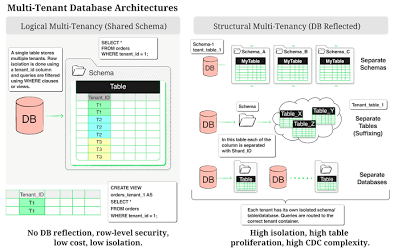
Shared Schema vs. Isolated Databases. Source: Streamkap
There are generally two ends of the spectrum when designing a SaaS database, each carrying vastly different security implications:
- The Silo Model (Isolated-Infrastructure): In this model, every single tenant gets their own dedicated database instance. From a security standpoint, this is highly secure. Tenant isolation is physically or logically guaranteed at the infrastructure level. Even if an attacker finds a flaw in your application code, they cannot query another tenant's database because the connection simply doesn't exist. However, scaling this model is a DevOps nightmare. Provisioning, maintaining, and running migrations across thousands of separate databases becomes impossibly expensive and complex.
- The Pool Model (Shared-Schema): This is the holy grail of SaaS scalability and the architecture most startups and enterprise platforms rely on today. All tenants share the exact same database and the exact same tables. Tenant A’s highly sensitive data sits right next to Tenant B’s data, separated logically by a simple tenant_id column.
While the Pool model makes it incredibly cost-effective and easy to scale, it shifts the entire burden of SaaS architecture security directly onto the application layer. If your application logic fails to validate that tenant_id properly on every single API request, you have a leak. There is no infrastructure safety net to catch you.
The Anatomy of Cross-Tenant Data Leakage
When a SaaS company experiences a cross-tenant data breach, the public often assumes they were targeted by a highly sophisticated, nation-state cyberattack. In reality, the culprit is usually far more mundane, and far more dangerous.
Why Tenant Isolation Fails: The Danger of IDOR
When tenant isolation fails in a shared-schema environment, it is almost always due to Insecure Direct Object References (IDOR), also classified under Broken Object Level Authorization (BOLA).
Let’s say an AppSec Engineer is reviewing a standard API endpoint used to fetch invoices: GET /api/v1/invoices/90210
When a user makes this request, the server performs a few checks. It verifies that the user is logged in (Authentication). But what happens if the server fails to verify that invoice 90210 actually belongs to that specific user’s tenant_id (Authorization)?
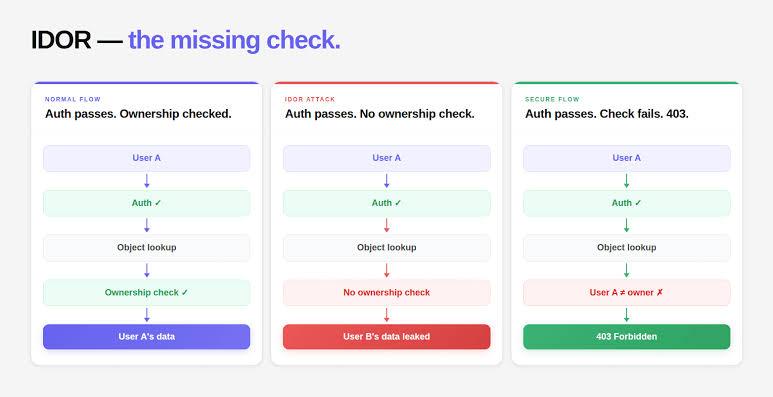
The Mechanics of an IDOR Attack. Source: CodeAnt AI
If an attacker, or even a curious user, simply changes the invoice ID in the URL to 90211, the server will gladly fetch and return Tenant B's invoice to Tenant A.
This is cross-tenant data leakage in its purest form. And because modern SaaS applications have thousands of API endpoints, fetching user profiles, billing details, custom reports, and third-party integrations, the attack surface for IDOR is massive. It only takes one developer forgetting to implement an ownership check on one nested API route to expose your entire customer base.
Why Traditional Security Testing Falls Short
If authorization flaws are so dangerous, why are they so commonly found in production environments? The answer lies in the friction between modern software development and legacy security tools.
The Bottleneck in the CI/CD Pipeline
You cannot catch these complex authorization flaws with traditional automated vulnerability scanners. Legacy tools are excellent at finding generic misconfigurations (like missing security headers) or known CVEs in outdated libraries. However, they possess zero contextual intelligence. A legacy scanner does not understand the business logic of your application, and it certainly does not understand the difference between Tenant A and Tenant B.
Historically, the only reliable way to conduct rigorous IDOR testing and validate tenant boundaries was through manual penetration testing. A security engineer would log in as User A, log in as User B, and manually swap authentication tokens back and forth in a proxy tool like Burp Suite, systematically checking hundreds of endpoints to see if data bled across the boundary.
But manual testing simply does not scale.
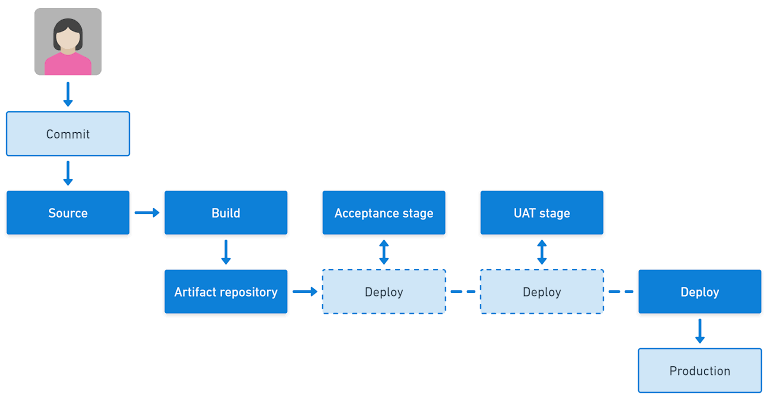
Traditional CI/CD Pipeline Flow. Source: Octopus Deploy
In 2026, your engineering team is likely pushing code to production multiple times a day. If you have to wait for an annual, or even quarterly, manual pentest to validate your tenant isolation, your security posture is lagging months behind your live environment. The traditional pentesting model creates a massive bottleneck, forcing VPs of Engineering to choose between shipping features on time or waiting for security clearance.
You need automated penetration testing that moves at the speed of DevOps, without requiring your team to spend hours manually recording login flows, configuring test environments, and sharing hardcoded credentials with third-party vendors.
Axeploit: Automated Penetration Testing at Scale
This is exactly the scaling problem Axeploit was built to solve. Unlike legacy tools that require complex configurations and constant hand-holding, Axeploit is a zero-config, autonomous vulnerability scanner powered by a fleet of AI agents.
To effectively hunt for cross-tenant data leaks, a security platform must behave exactly like a real human attacker. It must understand context, adapt to frontend changes, and aggressively push the boundaries of your application's logic.
How Axeploit’s Agents Rigorously Test Authorization Boundaries
Here is how Axeploit’s AI agents automate the deeply complex process of cross-tenant authorization testing:
- Autonomous Account Creation: Legacy tools require you to manually generate and share user credentials, meaning they instantly fail if your app uses email verification, mobile OTPs, or dynamic tokens. Axeploit doesn’t ask you to provision anything. Using its own dedicated mobile numbers and email addresses, Axeploit’s agents navigate your platform independently. They sign up, pass OTP verifications, and create multiple authenticated accounts representing different tenants.
- Context-Aware API Discovery: Once inside, the AI agents crawl your application, mapping out the entire structure using advanced heuristics. They discover all accessible endpoints, including hidden directories and nested API routes, understanding the normal business flow of your SaaS just as a legitimate user would.
- Cross-Tenant Authorization Testing: With Tenant A and Tenant B successfully established, Axeploit begins its aggressive automated testing. It systematically captures the authentication tokens from Tenant A and attempts to access the specific objects, files, and resources discovered by Tenant B. If an IDOR vulnerability exists, the agent flags the exact API endpoint where the data leakage occurred.
- Comprehensive Exploit Validation: Axeploit doesn't stop at authorization bypasses. It runs over 130,000 vulnerability checks, testing for 7,500+ known vulnerability types, from advanced business logic flaws to SSRF and SQL injections. Crucially, it validates every finding by generating reproducible proof-of-concept (PoC) code, practically eliminating the false positives that plague traditional scanners.
Because Axeploit operates autonomously and integrates directly into your CI/CD pipeline via webhooks, it can run these deep, contextual tests continuously. Every time your team deploys new code, you get instant Slack alerts if a developer accidentally removes an ownership check, ensuring your tenant isolation remains ironclad.
Conclusion
In the fast-paced world of B2B SaaS, utilizing shared infrastructure is an absolute necessity for scaling effectively. But that scale comes with the heavy responsibility of maintaining flawless application-layer security. A single missing authorization check can result in catastrophic cross-tenant data leakage, permanently damaging your brand's reputation and breaking the trust of your enterprise clients.
Manual testing can no longer keep up with modern CI/CD pipelines, and legacy scanners simply lack the contextual intelligence required to test complex authorization boundaries. You need a security solution that scales seamlessly alongside your engineering team.
With Axeploit, you get the creative, offensive mindset of a seasoned security researcher powered by the relentless speed of AI. By autonomously creating test accounts and rigorously hammering the walls between your tenants, Axeploit ensures your customers' data remains secure by default.