In 2026, the goal of a solo founder isn't to build everything from scratch. It is to assemble a "high-leverage" machine. The bottleneck is no longer server capacity. It is the cognitive load of managing too many moving parts. To move fast, you need a stack where every component is "set and forget."
A pragmatic toolchain focuses on three things: Managed Scale, Identity Control, and Continuous Security.
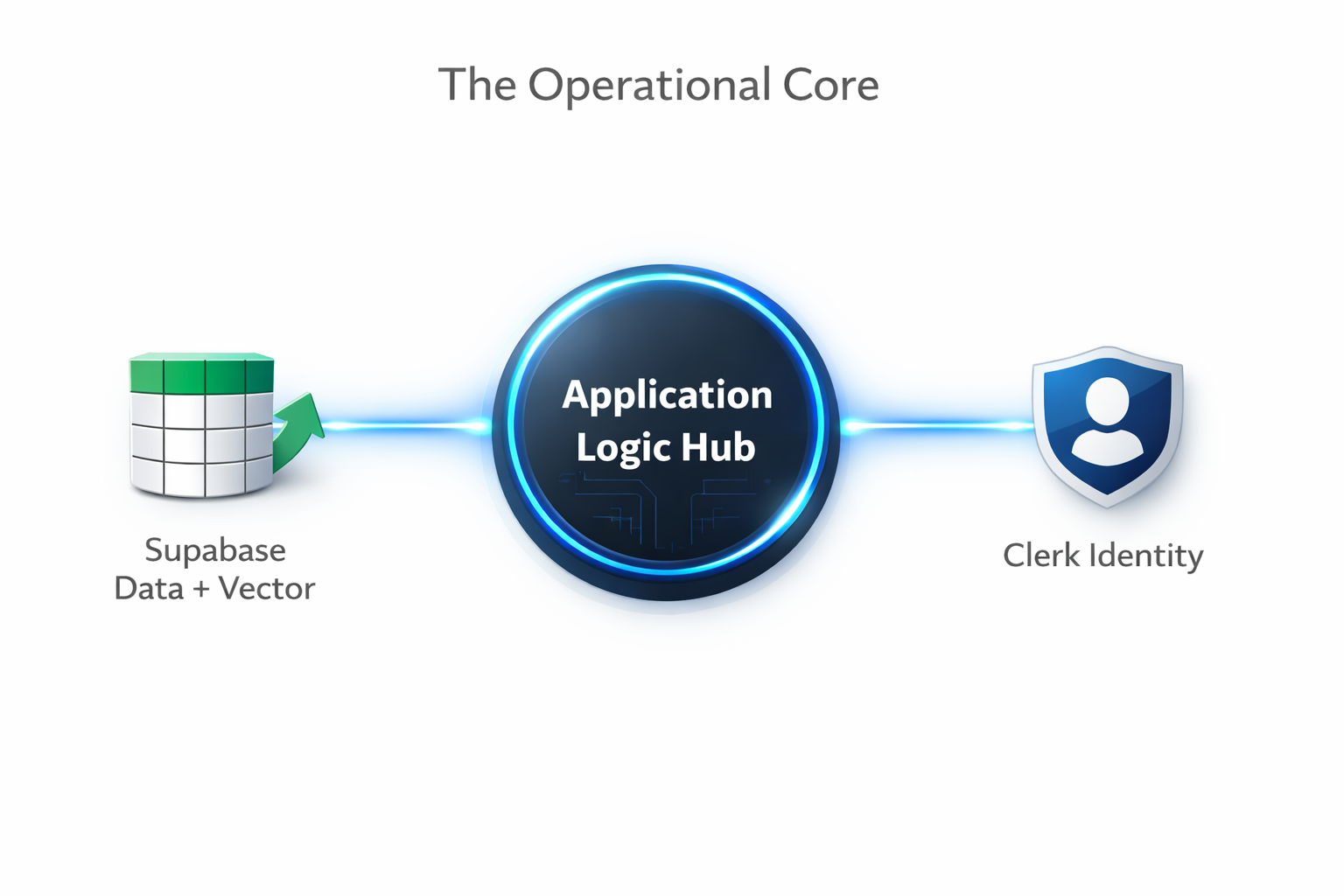
1. The Operational Core: Supabase & Clerk
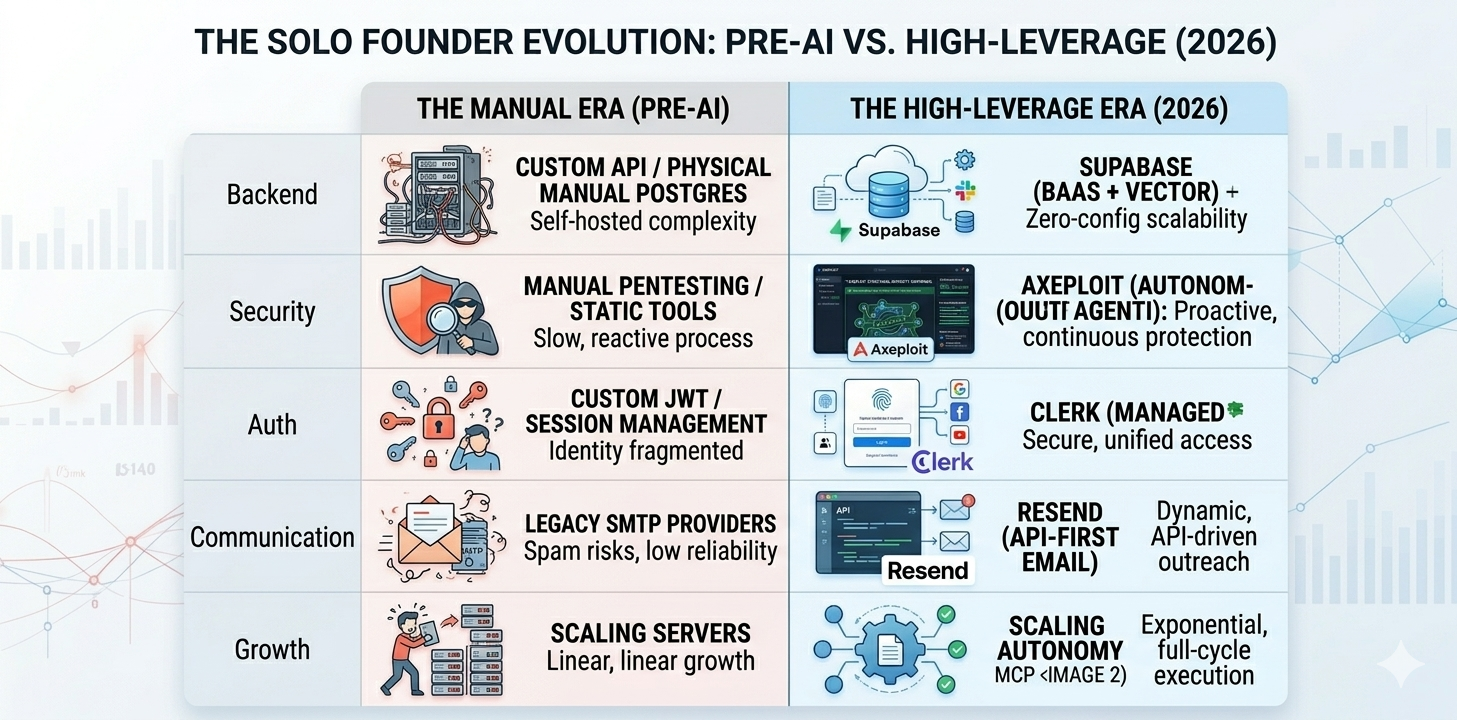
The modern backend is no longer a server you "reboot." It is a suite of managed services that your AI can interact with via simple schemas.
- Supabase: This acts as your unified data layer. By providing Postgres, Row Level Security (RLS), and native Vector storage in one dashboard, it eliminates the need to stitch together separate database and search providers. Your AI agents can query the database directly, ensuring that "memory" and "data" live in the same place.
- Clerk: Identity management is too high-stakes to build yourself. Clerk handles the entire authentication lifecycle, from social logins to multi-factor authentication, allowing you to drop a pre-built component into your frontend and move on to your actual product logic.
2. The Transactional Layer: Stripe & Resend
Revenue and communication are the two points where your application meets the real world. In 2026, these must be entirely API-driven.
- Stripe: Beyond simple payments, Stripe now handles global tax compliance and usage-based billing logic. By using the Stripe SDK, your AI can programmatically manage customer tiers and subscription lifecycles based on real-time activity.
- Resend: Transactional email should be a utility, not a chore. Resend offers a modern, developer-first API that integrates perfectly with React Email. It allows you to build beautiful, dynamic notifications that stay out of the spam folder without managing complex SMTP configurations.
3. The Security Sentinel: Axeploit
When you are moving at high speed with AI-generated code, human-led security reviews become the primary bottleneck. A solo founder cannot be a full-time security researcher, yet the cost of a breach remains catastrophic.
Axeploit bridges this gap by acting as an autonomous security layer. Instead of a static scan that you run once a week, Axeploit’s fleet of agents continuously probes your logic as you deploy.
- Logic Verification: It checks if your Supabase RLS policies actually prevent data leaks.
- Integration Audit: It ensures that your Clerk and Stripe webhooks are securely implemented and haven't introduced "silent" vulnerabilities during an AI-led refactor.
4. Integration via the "Surgical" IDE
The true power of this stack is realized within the IDE. By using Model Context Protocol (MCP) servers, your development environment, like Cursor, gains a direct line of sight into your Supabase schema and your Axeploit security reports.
You aren't just writing code in a vacuum. You are orchestrating a fleet of services. The AI handles the repetitive "plumbing" of these integrations, while you focus on the high-level architectural decisions that define your product's value.
The Bottom Line
Building as a solo founder in 2026 is about reducing the surface area of failure. By outsourcing "solved problems" like Auth, Database, and Security to specialized providers like Clerk, Supabase, and Axeploit, you ensure that your limited time is spent on the features that actually matter to your users.
Master the stack, automate the busywork, and focus on the architecture.