You found a security scanner. It looked affordable. Maybe $50/month, maybe $200. You signed up, opened the dashboard, and then it asked you to configure your API endpoints.
All of them. Manually.
That's the moment most vibe coders either give up or start building something they didn't budget for. The sticker price of a traditional security tool is the smallest part of what it actually costs. The real number is hiding in the integration work nobody mentions on the pricing page.
The Integration Tax Nobody Talks About
Traditional security tools work by testing your APIs. That sounds straightforward until you realize what "testing your APIs" actually requires.
First, you need to tell the tool which APIs exist. Every endpoint, every method, every parameter. A typical web application has around 60 API endpoints by the time it's doing anything useful. Authentication flows, user management, payment processing, data retrieval, file uploads, webhooks. Each one needs to be mapped, documented, and fed into the scanner's configuration.
That initial integration takes real engineering time. Not just clicking buttons in a dashboard. You're writing API specifications, configuring authentication tokens the scanner can use, setting up test environments that won't corrupt production data, and defining what a "valid" response looks like versus a vulnerability.
For a 60-endpoint application, plan on a solid week of a developer's time just to get the scanner running. At standard rates, that's your first hidden cost before you've found a single bug.
But the initial setup is only the beginning.
APIs Change. Your Integration Breaks.
Here's the part that really hurts: your APIs aren't static. You ship new features. You deprecate old endpoints. You change request formats. You add authentication requirements. Every one of those changes means your security scanner's configuration is now out of date.
A scanner testing against yesterday's API spec is worse than no scanner at all. It gives you false confidence. It tells you everything looks clean while missing the new endpoint you added last Tuesday that has a broken access control vulnerability.
Keeping a traditional scanner current means monthly maintenance. Someone has to review which APIs changed, update the configurations, add new endpoints, remove deprecated ones, and re-validate that the scanner's tests still produce meaningful results.
For 60 APIs with regular development activity, budget around $200/month in ongoing maintenance time. That's $2,400 per year, every year, just to keep the tool pointed at the right targets.
Now add the actual subscription. Let's use a mid-range scanner at $199/month. That's $2,388 per year.
The real annual cost: $4,788.
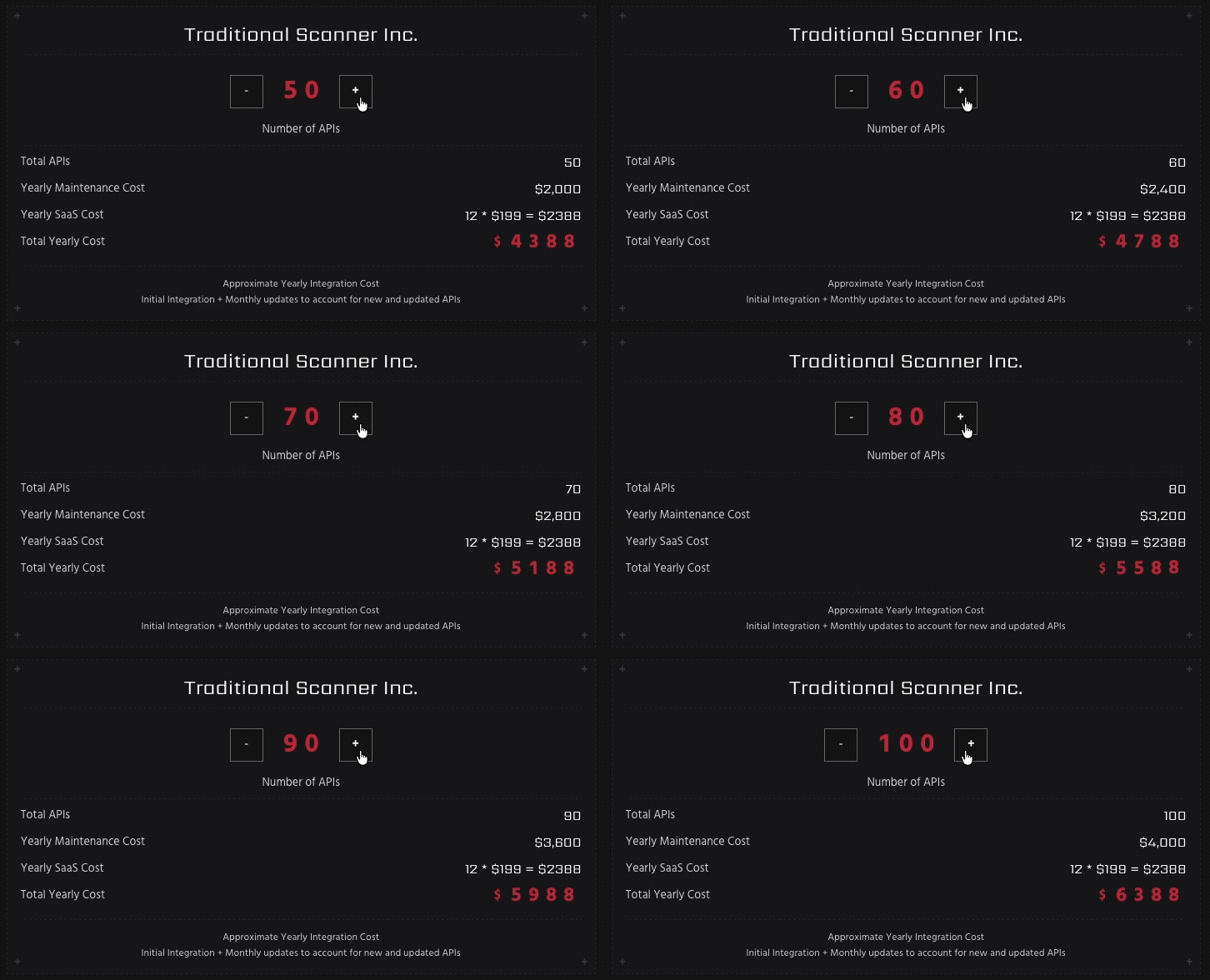
You're paying $2,388 for the tool and $2,400 for the privilege of being allowed to use it. The integration cost is higher than the software itself.
It Gets Worse When You Scale
Those numbers assume 60 APIs. A growing application doesn't stay at 60 for long. Every new feature adds endpoints. Every integration with a third-party service adds more. Microservices architectures can easily hit 200+ endpoints.
The scanner subscription might scale linearly. The integration cost scales worse than linearly because more endpoints means more dependencies between them, more complex authentication flows, and more edge cases in the configuration.
At 120 APIs, you're not looking at double the integration cost. You're looking at something closer to 2.5x because the interactions between endpoints create their own complexity. The testing matrix grows geometrically even though the endpoint count only grew arithmetically.
Traditional tools were designed for security teams with dedicated engineers who maintain scanner configurations as part of their job. That assumption breaks completely for vibe coders who are building and shipping fast, often without a security team at all.
What Zero Configuration Actually Means
Axeploit works differently. You give it a URL. That's it.
There's no API spec to write. No endpoints to map. No authentication configuration to maintain. No monthly update cycle when your APIs change.
The AI agents navigate your application the same way an attacker would. They discover your APIs by using your app. They find endpoints by following links, submitting forms, and observing network requests. They create their own accounts, handle authentication flows, and probe every surface they can reach.
When you add a new feature next week, you don't need to update anything. The next scan discovers it automatically. When you change an API response format, nobody needs to reconfigure a test. The agents adapt to what they find.
Your cost: $199/month. $2,388/year. That's the full number. No integration tax on top.
The difference between $4,788 and $2,388 isn't just about money. It's about what you're spending that money on. With a traditional tool, half your budget goes toward feeding the tool itself. With Axeploit, all of it goes toward actually finding vulnerabilities.
The Math for Your App
If you're evaluating security tools right now, do this exercise:
- Count your API endpoints. If you don't know the exact number, look at your routes file or your API gateway configuration.
- Estimate how many change per month. If you're shipping weekly, it's probably 5-10.
- Calculate the time to configure and maintain each one in a traditional scanner.
- Add that to the subscription price.
Then compare it to submitting a URL and getting a report back.
Security scanning shouldn't cost more in integration than it does in subscription. And it definitely shouldn't require a dedicated engineer to keep running.
Start scanning without the integration tax: https://panel.axeploit.com/signup