

If you are an indie founder, CTO, or compliance officer reading this in 2026, you already know the drill. Frameworks like SOC 2 Type II and ISO 27001 are no longer optional "nice-to-haves" for growing businesses; they are absolute table stakes for closing enterprise deals. Yet, despite shipping code multiple times a day, most startups still rely on a stressful, once-a-year scramble to gather audit evidence. Let’s be candid: treating compliance as an annual fire drill is a broken, exhaustive strategy.
Modern security frameworks now expect verifiable proof of continuous risk management. This guide explores the critical transition from manual, point-in-time pentests to autonomous, AI-driven auditing. We will walk you through how automating your audit evidence with real-time, time-stamped Proof of Concepts (PoCs) not only satisfies auditors with indisputable truth, but ultimately frees your engineering bandwidth to do what they do best: build great products.
The 2026 Compliance Reality: Why Annual Pentests Are Failing CTOs and Founders
For years, the standard approach to SOC 2 penetration testing was an annual consulting engagement. You scheduled a firm weeks in advance, froze code, paid anywhere from $8,000 to $25,000, and waited weeks for a PDF report filled with theoretical vulnerabilities.
By mid-2026, the global threat landscape and compliance expectations have vastly outpaced this outdated model. The updated AICPA guidance emphasizes dynamic, risk-based assessments over static, once-a-year checklists. While SOC 2 does not explicitly mandate pentesting by name in every clause, the Trust Services Criteria (specifically CC4.1) cites it as a leading example of the necessary “separate evaluation” to ensure controls are effective.
Here is why relying on an annual snapshot is actively hurting your business:
- The Velocity Gap: Security needs to move at the same pace as development. If your team deploys new features daily, an annual pentest leaves your infrastructure entirely unassessed for 364 days of the year.
- Audit Fatigue and Bottlenecks: Preparing for an audit manually means your developers and CTO are spending hours copy-pasting screenshots into spreadsheets instead of writing code.
- Reactive Security Posture: Undetected drift creates persistent access paths. Finding out about a critical authorization bypass during an audit window forces a panicked, rapid remediation cycle.
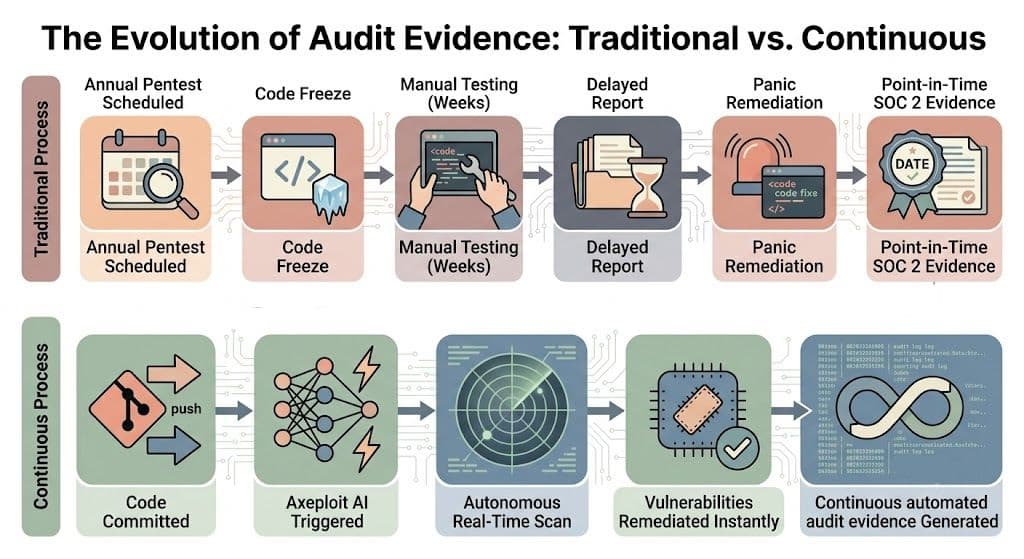
Continuous Compliance: Bridging the Gap Between Engineering and Auditing
The modern mandate is continuous compliance. Whether you are aligning with ISO 27001 pentest requirements or mapping controls for a SOC 2 Type II audit, assessors are no longer satisfied with a single clean report from six months ago. They want to see that your organization identifies risks dynamically and maintains its security posture through every architectural shift and feature release.
Moving from Snapshots to Live Streams
Continuous monitoring replaces the single audit snapshot with a live, ongoing view of your application’s health. When a vulnerability occurs, it is flagged, fixed, and verified immediately.
For CTOs and Indie Founders, the largest benefit of compliance automation is massive time savings. Instead of spending weeks manually gathering evidence, modern platforms automatically track your security events. By adopting an AI-powered vulnerability scanner that natively integrates into your CI/CD pipelines, every code push is automatically vetted.
Why Scanners Were Never Enough (Until Now)
In the past, automated vulnerability scanners were notorious for producing mountains of "theoretical" noise and false positives. Because they could not handle complex, stateful authentication (like email verification or mobile OTPs), they completely missed the business logic and IDOR (Insecure Direct Object Reference) vulnerabilities that account for over 30% of critical flaws. Consequently, auditors frequently rejected scanner-only outputs in favor of human-driven testing.
This is where next-generation AI shifts the paradigm. By leveraging a fleet of AI agents, modern tools can replicate the intelligence and adaptability of human ethical hackers, but at the speed and scale of a machine.
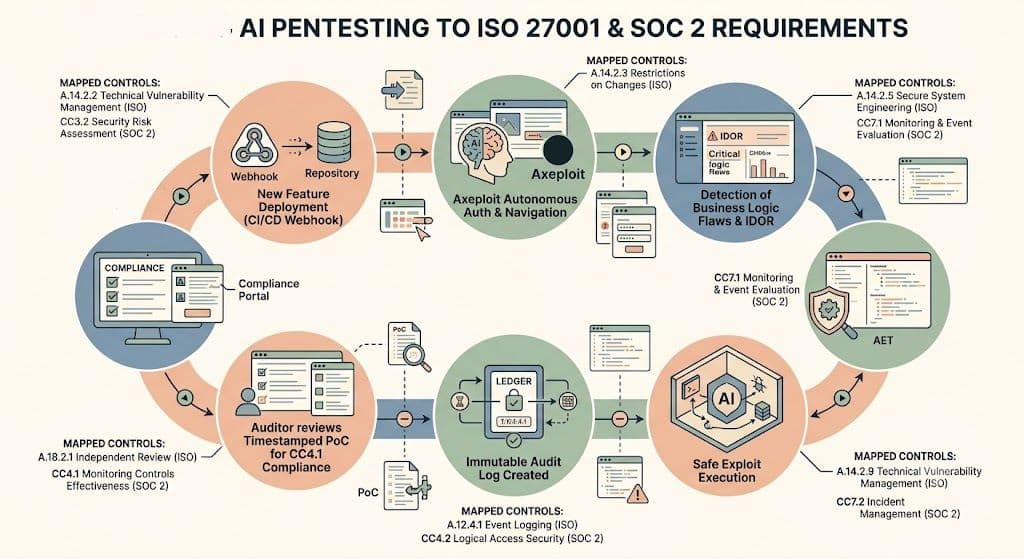
How AI-Driven Continuous Pentesting Automates Audit Evidence
The core of your SOC 2 Type II audit requires demonstrating that your internal controls operate effectively over your observation period (typically 3, 6, or 12 months). Traditional legacy scanners, notorious for bloated reports of theoretical warnings fail this requirement because they lack the contextual awareness to validate actual business logic.
Axeploit operates fundamentally differently. It replaces static, rule-based scanning with a fleet of autonomous AI agents designed to seamlessly integrate into your development pipeline, acting as your continuous, automated security partner.
Here is exactly how the Axeploit architecture automates your audit evidence under the hood:
1. Autonomous Session Management & Multi-Account Authentication
Legacy tools inherently fail at modern authentication; they require you to manually share fragile user credentials and immediately break when frontend DOM elements shift. Auth flaws account for over 30% of all vulnerabilities, making this a critical blind spot for both your security posture and your auditors.
Axeploit solves the authentication barrier natively. The platform's agents are provisioned with their own real mobile numbers and email addresses. This allows them to autonomously locate signup pages, register, receive mobile OTPs, and establish authenticated sessions exactly like a legitimate user. Driven by Layout-Aware Intelligence, the LLM engine adapts in real time to UI/UX changes without breaking the testing flow. By testing stateful logic, such as email verification bypasses, token expiration policies, and OTP rate-limiting, Axeploit proves to your assessors that your post-authentication attack surface is continuously tested and hardened.
2. Deep API Discovery & Logic Fuzzing
Modern microservices expose thousands of endpoints, many of which remain undocumented, hidden, or lingering from legacy deployments. Maintaining API coverage for a pentest usually requires tedious, ongoing manual integration, but Axeploit completely eliminates this overhead.
Upon execution, the AI initiates intelligent web crawling and DNS fuzzing to map out your entire attack surface, discovering hidden APIs and nested routes dynamically. It then leverages one of the world's largest password and fuzzing databases alongside continuously updated CVE intelligence (including zero-days) to test against more than 7,500 known vulnerability types. Instead of relying on surface-level syntax checks, Axeploit executes advanced business logic testing. The agents hunt for complex, deeply embedded API vulnerabilities like Broken Object Level Authorization (BOLA/IDOR), Server-Side Request Forgery (SSRF), Mass Assignment, and JWT token tampering.
3. Safe Exploit Execution & Deterministic Proof-of-Concepts (PoCs)
Auditors demand concrete evidence, and developers despise false positives. Axeploit’s AI-powered analysis reduces false positives by 90% compared to traditional scanners by shifting from theoretical detection to active validation.
If an agent detects a Broken Access Control or an IDOR flaw, it doesn't just flag a "potential" warning. It actively and safely exploits the vulnerability in your staging environment to validate the risk. The platform then generates an actionable report containing reproducible Proof-of-Concept (PoC) code. This gives your compliance officer an immutable, undeniable record of the exact payload used to breach the logic, providing deterministic evidence that your team is identifying and mitigating critical, exploitable risks.
4. Smart Scan Control & Immutable Evidence Generation
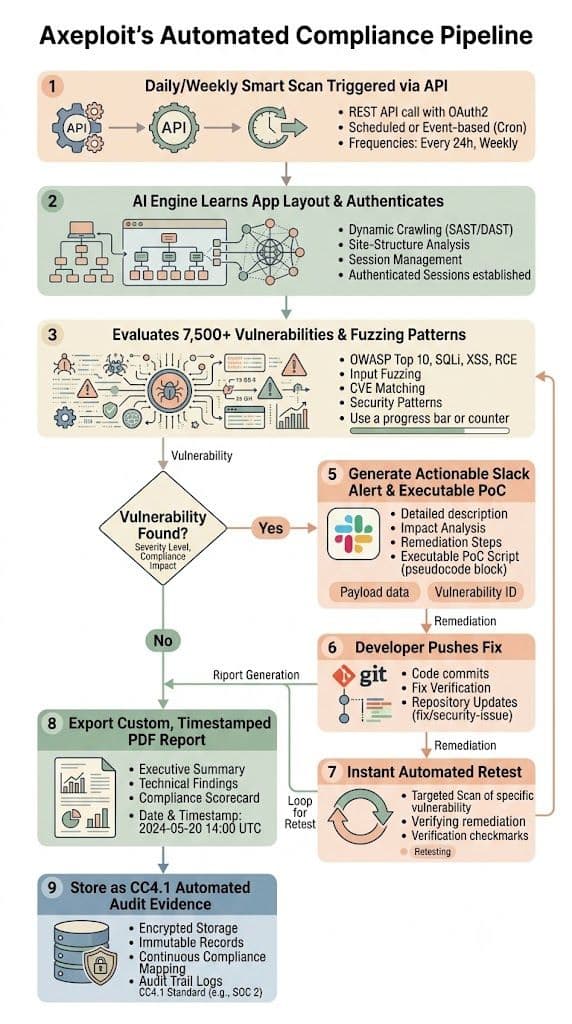
Running a complete, exhaustive infrastructure pentest on every single pull request is an engineering bottleneck. To solve this, Axeploit introduces Smart Scan Control, where an AI-powered LLM configures the scan scope for you automatically. It targets only what matters, focusing purely on newly introduced features, updated APIs, or high-risk endpoints, without requiring manual setup.
Integrated programmatically via API access and webhooks, this granular testing occurs seamlessly in your CI/CD pipeline. When a vulnerability is found or a scan completes, developers receive instant Slack alerts. Once remediated, compliance officers can instantly export custom, timestamped PDF reports using branded white-label templates. These tailored exports map directly to regulatory requirements (SOC 2, ISO 27001, GDPR), transforming fragmented engineering tasks into consolidated, automated audit evidence.
Mapping Vulnerabilities to Trust Services Criteria (TSC)
To successfully pass a SOC 2 audit, your security activities must map directly to the AICPA Trust Services Criteria.
- Security (CC4.1 & CC7.1): Axeploit provides the continuous vulnerability scanning and targeted dynamic testing needed to prove that system vulnerabilities are actively identified and managed.
- Processing Integrity: By testing complex business logic flows (like negative pricing in carts or skipping mandatory checkout steps), AI agents verify that system processing is valid and authorized.
- Confidentiality & Privacy: By autonomously testing cross-tenant isolation in multi-tenant SaaS environments, Axeploit proves that customer data is strictly isolated and protected from unauthorized disclosure.
[Insert Image 3 Here]
Conclusion
Achieving and maintaining continuous compliance in 2026 shouldn’t require an army of external consultants or weeks of lost engineering bandwidth. The outdated model of annual compliance sprints is actively hurting startups, bogging down CTOs, and leaving critical infrastructure exposed between audit windows. Auditors are increasingly looking for mature, ongoing risk management rather than static, point-in-time checklists.
By shifting to continuous security practices, you transition from playing defense during audit season to having a proactive, audit-ready posture year-round. Automating your audit evidence with an AI-driven vulnerability scanner like Axeploit bridges the massive gap between high-velocity engineering and rigorous compliance standards. With zero-configuration setup, autonomous authentication handling, and exploitable PoCs mapped directly to compliance frameworks, your team can instantly generate the undeniable proof that enterprise buyers and assessors demand.
Stop treating your SOC 2 penetration testing as a massive hurdle that disrupts your entire product roadmap. It is time to deploy intelligent, autonomous agents that secure your application at the speed of your CI/CD pipeline. Build trust with your customers, keep your indie founders focused on scaling growth, and hand your compliance officers the automated, verifiable reports they need. Get started with Axeploit and make your next audit entirely effortless.


