Patch Tuesday started in October 2003. Microsoft introduced it to give IT administrators a predictable schedule for testing and deploying patches one day per month, the second Tuesday, when security updates would be released. The predictability was genuine value: administrators could plan testing cycles, schedule maintenance windows, and communicate change management timelines around a fixed date.
That was more than twenty years ago.
In 2003, the median time between public vulnerability disclosure and weaponized exploit development was measured in months. The Patch Tuesday cycle roughly thirty days was not fast enough to beat every attacker, but it was competitive with the exploit development timelines of that era. The monthly rhythm was defensible as a security practice.
The world has changed substantially. Exploit development timelines have compressed dramatically. Proof-of-concept code for high-severity vulnerabilities appears within days of CVE disclosure. Automated exploitation tools incorporate new CVEs within weeks. Active exploitation of critical vulnerabilities in unpatched systems is now regularly observed within two to four weeks of public disclosure often before a monthly patch cycle would have delivered the fix.
The monthly patch cycle was designed for a threat environment that no longer exists. Organizations that continue to run it by convention rather than by deliberate risk assessment are accepting a predictable and quantifiable exposure window that has grown significantly wider since the practice was introduced.
The Exploit Timeline: What the Data Actually Shows
Understanding the urgency of the patch timing problem requires being specific about actual exploit development timelines rather than gesturing at "attackers are getting faster."
Research from Qualys, Rapid7, and the Verizon DBIR consistently shows a narrowing window between vulnerability disclosure and exploitation. Specific benchmarks from recent analysis:
Time to proof-of-concept: For critical and high-severity vulnerabilities in widely-deployed software, a functional proof-of-concept exploit is published within seven days of CVE disclosure in approximately 50% of cases. For vulnerabilities with clear, well-understood exploit primitives memory corruption in a parsing library, authentication bypass in a web framework the timeline is often shorter. Researchers who have been tracking disclosure patterns, or who have access to bug bounty program data, sometimes have working PoCs within hours of public disclosure.
Time to weaponization: A proof-of-concept that requires manual setup and attacker expertise to execute is not the same as a weaponized exploit integrated into automated scanning or exploitation tools. The weaponization step making the PoC reliable, automating target selection, packaging it for distribution adds time, but not much. Metasploit modules for high-profile CVEs regularly appear within two to three weeks of disclosure. Commercial exploit frameworks move faster.
Time to active campaigns: The point at which automated exploitation of a vulnerability is observed at scale in the wild appearing in honeypot logs, being flagged in threat intelligence feeds, showing up in incident reports has historically fallen between two and eight weeks after disclosure for critical vulnerabilities in commonly deployed software. For vulnerabilities with published PoC code and clear attacker incentive (remote code execution, authentication bypass, credential theft), the lower end of that range is more common.

Against this timeline, a monthly patch cycle means organizations are routinely unpatched for the first two to four weeks after a critical CVE disclosure the period when proof-of-concept code is published, when automated exploitation tools are built, and when active campaigns begin. The patch arrives on day thirty. The campaign began on day twenty-one.
This is not a theoretical risk. The compromise pattern appears in incident post-mortems with enough regularity that it has its own informal name: "patch day plus thirty" breaches, where the compromise timestamp is within a month of the patch availability date and the organization had not yet applied the patch.
What Continuous CVE Monitoring Actually Means
Monthly patching and continuous CVE monitoring are distinct practices that are often conflated.
Monthly patching is a deployment schedule: patches are applied to production systems once per month, on a schedule. It says nothing about when patches are identified, evaluated, or prioritized. An organization that patches monthly might identify a critical CVE on day two and spend twenty-eight days in testing and change management before deploying. Or it might not identify the CVE at all until the monthly review cycle surfaces it.
Continuous CVE monitoring is an intelligence practice: vulnerabilities in components you deploy are tracked from the moment they are disclosed, their severity and applicability are evaluated immediately, and the information surfaces to the people who need to make patching decisions without waiting for a calendar event.
The distinction matters because patch deployment speed is only one variable. Identification latency the time between a CVE being disclosed and your organization becoming aware that the vulnerability exists in your environment is a separate and often larger contributor to exposure duration.
An organization that checks the NVD database once per month on a fixed schedule has an average identification latency of fifteen days for any given CVE. A vulnerability disclosed on day two of the month will not be reviewed until day thirty-two approximately fourteen days of exposure during which the organization does not know the vulnerability exists in their environment, has not assessed its impact, and has made no deployment decision.
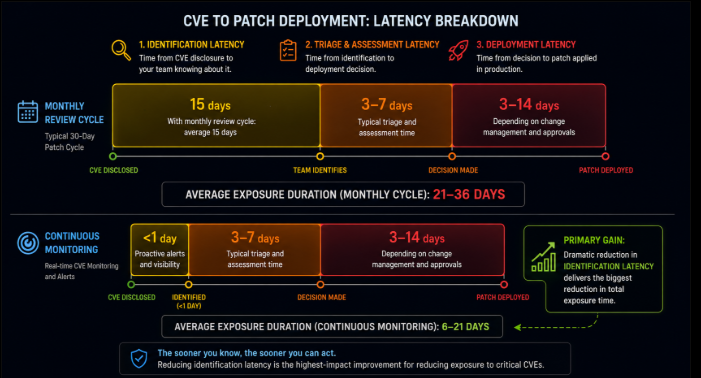
Continuous CVE monitoring eliminates or dramatically reduces the identification latency segment. When a critical CVE affecting your stack is disclosed, your team knows within hours rather than weeks. The subsequent triage and deployment steps still take time, but they begin immediately rather than after an arbitrary delay imposed by the monitoring cadence.
The Applicability Problem: Why Blanket Patch Schedules Miss Context
A fundamental issue with calendar-based patch cycles is that they treat all vulnerabilities as equivalent from a timing perspective. Everything gets patched on Patch Tuesday, or on the first Saturday of the month, or during the quarterly maintenance window. The schedule does not adjust for the actual risk profile of individual vulnerabilities.
This creates two simultaneous failure modes:
Over-patching low-risk vulnerabilities urgently. A CVSS 4.0 medium severity vulnerability in a component that is not externally reachable in your specific deployment does not require the same urgency as a CVSS 9.8 critical in a component that is publicly exposed. Calendar-based patching applies the same schedule regardless, sometimes causing unnecessary disruption to stable production systems to patch things that represent minimal actual risk.
Under-patching high-risk vulnerabilities appropriately. A CVSS 9.8 critical in a component that is directly exposed to the internet, with a published proof-of-concept exploit, with evidence of active exploitation in the wild, requires faster response than the next calendar event. Calendar-based patching applies the same schedule regardless, leaving the critical vulnerability unaddressed for days or weeks after the risk profile has made its urgency clear.
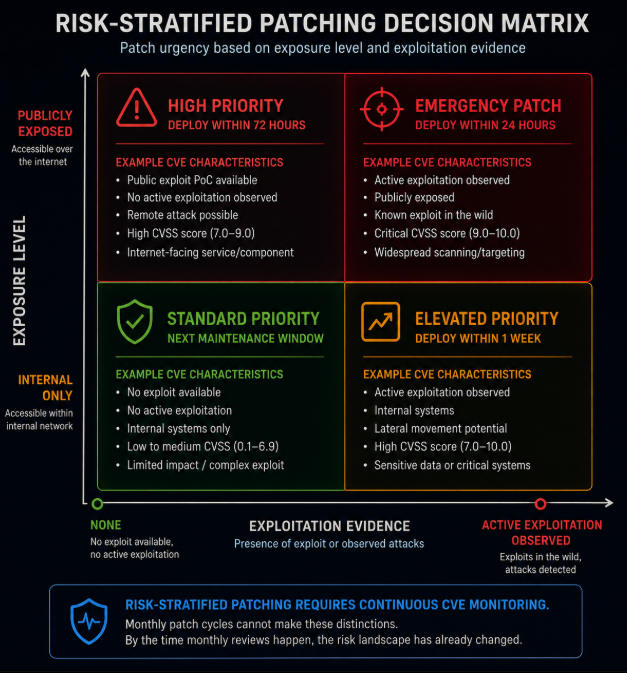
Continuous CVE monitoring enables risk-stratified patching: the monitoring system surfaces vulnerability information with enough context to make rational timing decisions. A vulnerability with active exploitation evidence gets an emergency patch response. A vulnerability in an internally-accessible component with no known exploit gets scheduled for the next maintenance window. A vulnerability in a component that is not present in the production environment gets closed as not applicable.
This tiered approach produces better security outcomes than a uniform schedule because it concentrates deployment urgency where the risk is highest and avoids unnecessary urgency where the risk is low.
Building a Continuous CVE Monitoring Program
The components of a continuous CVE monitoring program that actually reduces exposure duration rather than just generating more alerts:
Software Bill of Materials (SBOM). You cannot monitor for vulnerabilities in components you do not know you are running. An SBOM a machine-readable inventory of every software component in your production environment, with versions is the prerequisite for any meaningful vulnerability monitoring. Without an SBOM, vulnerability monitoring is reactive: you hear about a CVE and then investigate whether you are affected. With an SBOM, monitoring is proactive: the moment a CVE is published for a component you are running, you receive an alert automatically.
SBOM generation is now sufficiently mature that automated SBOM production can be integrated into CI/CD pipelines for most technology stacks. Tools like Syft, Trivy, and Grype generate SBOMs from container images, compiled binaries, and application dependency manifests. The SBOM becomes an artifact of each build, maintained current with each deployment.
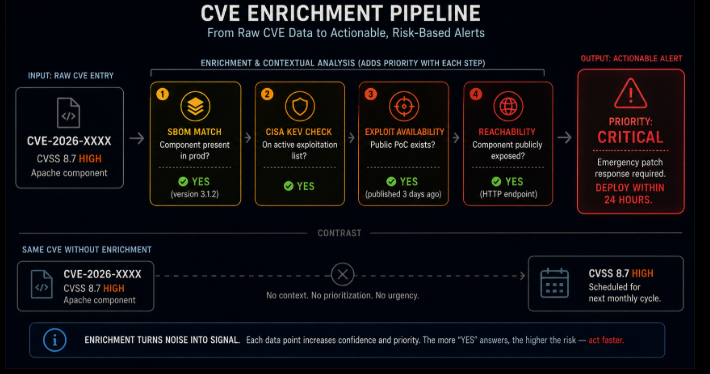
Authoritative CVE feeds with contextual enrichment. The National Vulnerability Database is the primary authoritative source for CVE data. But NVD data alone a CVE identifier, a description, a CVSS score is insufficient for timely risk assessment. Contextual enrichment that matters for prioritization:
- CISA's Known Exploited Vulnerabilities catalog: binary signal is this CVE actively being exploited against real targets? If yes, the patching urgency is dramatically elevated regardless of CVSS score.
- Exploit availability: is a proof-of-concept or weaponized exploit publicly available? This information significantly changes the probability that an unpatched system will be exploited.
- Vendor-specific applicability: is your specific version of the component affected? A CVE affecting versions 2.0.0 through 2.3.4 is not applicable if you are running 2.3.5.
- Environmental reachability: is the affected component exposed externally, accessible only internally, or not reachable from untrusted networks? This determines the realistic attack surface.
Alert routing to the right people. A CVE alert that arrives in a general security mailbox where it waits for a weekly review is not providing the value of continuous monitoring. The alert needs to reach the team responsible for the affected component, with enough information for that team to assess applicability and make a deployment decision, within hours of CVE disclosure.
This requires integration between the CVE monitoring system and the organization's internal component ownership model: who owns the service running this library? What is the on-call contact for the team responsible for this component? The monitoring system that can answer these questions routes critical CVE alerts directly to the decision-maker rather than into a queue.
Tracking against SLA not against calendar. The output of continuous CVE monitoring should drive patching decisions that have explicit SLAs: critical vulnerabilities with active exploitation evidence are patched within 24 hours. Critical vulnerabilities without active exploitation evidence are patched within 72 hours. High-severity vulnerabilities are patched within 7 days. Medium-severity vulnerabilities are patched within 30 days. These SLAs are measured from the moment the CVE is confirmed as applicable, not from a calendar date.
The SLA model produces accountability that a calendar model cannot: if a critical CVE was disclosed on March 3rd, confirmed as applicable on March 3rd, and the affected system was not patched until March 15th, the SLA was breached and the breach is visible in the monitoring system's records. A calendar-based model has no equivalent accountability mechanism patching on Patch Tuesday is inherently compliant regardless of when the critical CVE was disclosed.
The Tools That Make It Practical
Continuous CVE monitoring at scale requires tooling that automates the components described above, particularly SBOM maintenance and CVE-to-SBOM matching.
Software composition analysis (SCA) tools continuously scan your dependency manifests package.json, requirements.txt, pom.xml, Gemfile.lock against vulnerability databases and alert when new vulnerabilities are published affecting components you use. Tools like Snyk, Dependabot (GitHub's integrated version), Mend (formerly WhiteSource), and Grype do this with varying levels of automation and alert quality.
The critical configuration decision is where in the pipeline SCA runs and what the alert routing looks like. SCA that runs only as a PR check produces findings only when code changes. SCA that runs continuously against deployed artifacts produces findings when CVEs are published for already-deployed components which is the majority of real-world CVE exposure.
Container and infrastructure scanning extends SCA coverage to the operating system layer and to infrastructure components. A container image that uses a base OS with a vulnerable version of a system library is as exposed as an application with a vulnerable dependency but application-level SCA will not find OS-layer vulnerabilities. Trivy, Clair, and similar container scanners cover both application dependencies and OS packages.
CISA KEV integration. The Known Exploited Vulnerabilities catalog is the highest-signal source for urgent patching decisions. A CVE that appears on the KEV list has been confirmed exploited against real organizations in the wild. CISA updates the catalog continuously new entries appear within days of observed exploitation. Integrating KEV status into CVE triage means that the moment a vulnerability affecting your components appears on the KEV list, your monitoring system escalates it regardless of its CVSS score.
What Monthly Cycles Can Still Do
Making the case for continuous CVE monitoring does not require arguing that calendar-based patching has no value. It has specific, ongoing value in two contexts.
Non-critical patches and low-severity vulnerabilities. Not everything needs emergency deployment. Medium and low-severity vulnerabilities in components with limited exposure represent lower risk that can be managed through scheduled cycles without meaningful exposure increase. Continuous monitoring identifies these but they do not require the same urgency.
Testing and change management for complex systems. Some patches particularly for database engines, operating systems, and middleware that require coordinated maintenance windows require more preparation than a 24-hour emergency cycle allows. For these components, the appropriate model is continuous monitoring that identifies the vulnerability and triggers immediate testing while scheduling the deployment for the nearest available window rather than the next calendar date.
The correct framing is not "replace monthly patching with continuous patching" but "use continuous CVE monitoring to determine which patches require immediate response and which can be managed in scheduled cycles." The monitoring program provides the intelligence that makes the distinction possible. The patching program executes the decisions the intelligence produces.
The Compliance Question
Many organizations run monthly patch cycles because compliance frameworks require demonstrating "a patch management process." Monthly cycles are easy to demonstrate they produce audit trails, change management records, and maintenance window logs that auditors can review.
Continuous monitoring-driven patching is harder to demonstrate at audit time, because it is inherently irregular patches are deployed when the risk assessment indicates they should be, not on a fixed schedule. The audit trail exists but it looks different: a risk assessment for each CVE, an SLA calculation, a deployment record within the SLA window.
Most compliance frameworks including PCI DSS, SOC 2, NIST 800-53, and CIS Controls do not specifically mandate monthly patch cycles. They mandate "timely" patching, typically with specific requirements for critical vulnerabilities (often 30 days for critical, 90 days for high). These requirements are more permissive than necessary for the current threat environment but they do not prohibit more aggressive patching cadences and they do not mandate calendar-based approaches.
An organization that patches critical vulnerabilities within 24 hours of CISA KEV listing and high-severity vulnerabilities within 7 days satisfies every major compliance framework's patch management requirements while significantly outperforming the security outcomes that monthly patching produces. The documentation burden is higher. The security outcome is better.

Closing: Patch Tuesday Was an Answer to a Different Problem
Patch Tuesday was an answer to the problem of unpredictable, uncoordinated patch releases that created unmanageable workload for IT administrators. It solved that problem. It was never designed to answer the question of how quickly organizations should respond to critical vulnerabilities in a threat environment where exploit timelines are measured in days rather than months.
The threat environment changed. The practice persisted. The gap between the two is the patch timing exposure the predictable, quantifiable window during which organizations running monthly patch cycles are unpatched for vulnerabilities that have active exploits in circulation.
Continuous CVE monitoring does not make patching faster in isolation. It makes the decision to patch faster by eliminating identification latency and enabling risk-stratified urgency decisions. The patch itself still requires testing and deployment. What changes is that the decision to begin that process is made on day one of vulnerability disclosure rather than on the next calendar event.
For critical vulnerabilities with active exploitation evidence, that difference can be the difference between patching before the campaign begins and discovering the breach after it ends.
Axeploit continuously tests the running application which means it detects exploitable vulnerability behavior in deployed systems independently of whether the CVE has been disclosed. For vulnerabilities that reach your application through dependency chains but manifest as exploitable endpoint behavior, Axeploit finds them whether or not the CVE is published, whether or not your SCA tool has flagged the dependency version, and whether or not the patch cycle has reached the affected component. It is not a substitute for CVE monitoring it is the verification layer that confirms whether the controls you believe are in place are actually preventing the exploitation that matters.