GraphQL vs. REST: The Security Blindspots Leaving Your Data Exposed
In the race to optimize frontend performance and accelerate developer velocity, engineering teams are rapidly abandoning traditional REST architectures in favor of GraphQL. The appeal is undeniable: clients can fetch exactly the data they need, exactly when they need it, completely avoiding the classic over-fetching problems of REST. However, this architectural leap often comes with a massive, undocumented cost. By condensing hundreds of endpoints into a single, highly dynamic query engine, organizations are inadvertently introducing critical GraphQL security vulnerabilities.
For Backend Developers, API Architects, and Penetration Testers, this transition is a double-edged sword. While GraphQL solves data routing efficiency, it fundamentally breaks the traditional security tooling built specifically for REST API security. Network firewalls that rely on URI paths become completely blind. Rate limiters that count HTTP requests become essentially useless. In this article, we’ll dissect the most dangerous GraphQL-specific attack vectors, from nested query DoS attacks to schema leaks, and demonstrate how to adapt your defensive posture and testing protocols to secure these highly dynamic endpoints before they hit production.
The Architecture Shift: Why GraphQL Breaks Traditional Defenses
REST APIs are inherently structural. If you want a user’s profile, you send a GET request to /users/123. If you want their recent posts, you hit /users/123/posts. Security controls are typically mapped directly to these routes. A Web Application Firewall (WAF) can easily block excessive requests to the /posts endpoint, and authorization middleware can verify user permissions on a strict, route-by-route basis.
GraphQL fundamentally alters this paradigm. Instead of distributing logic across multiple URIs, a GraphQL API exposes a single endpoint, usually POST /graphql. The client dictates what data it wants by sending a complex JSON payload containing the query string.
This means the application logic, not the infrastructure routing, is entirely responsible for parsing, validating, and authorizing the request. Because traditional WAFs and API gateways only see a standard 200 OK status on the single POST /graphql route, they are completely blind to the malicious logic executing deep inside the query. This architectural inversion creates a fertile playground for attackers.
Introspection Query Exploits: Handing Attackers Your API Blueprint
One of the most powerful features of GraphQL is its self-documenting nature, made possible by a feature called introspection. Introspection allows developers to query the API itself to return the exact schema of the graph, detailing all available queries, mutations, objects, fields, and arguments.
While invaluable in a local development environment, leaving introspection enabled in production is catastrophic. It is the equivalent of handing a bank robber the architectural blueprints to the vault. Introspection query exploits occur when attackers use the __schema meta-field to dump the entire API structure. With a single request, a penetration tester can map out hidden administrative mutations, deprecated fields, and undocumented data types that were never meant to be exposed to the public frontend. Even if you disable introspection, attackers can often use automated field suggestion features (like Apollo’s "Did you mean X?" error messages) to brute-force and fully reconstruct the schema.
The Depth Problem: Deeply Nested Query Denial-of-Service (DoS)
Because GraphQL allows clients to define the shape and scope of the response, it inherently supports relational data queries. If your schema contains circular relationships, such as a User having Posts, and Posts having an Author, a malicious actor can exploit this connection to launch a devastating application-layer Denial-of-Service (DoS) attack.
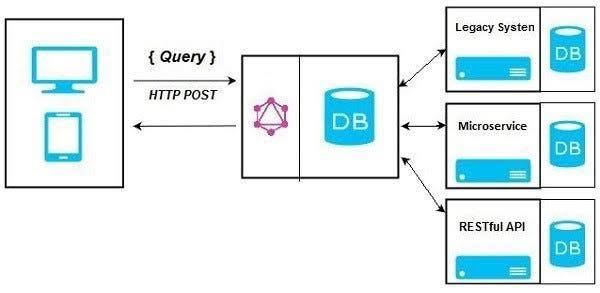
GraphQL Nested Query DoS Attack Vector.
In a REST architecture, fetching this deeply relational data would require dozens of sequential HTTP requests, which would quickly trigger rate limits and IP bans. In GraphQL, an attacker can craft a single query that nests hundreds of levels deep:
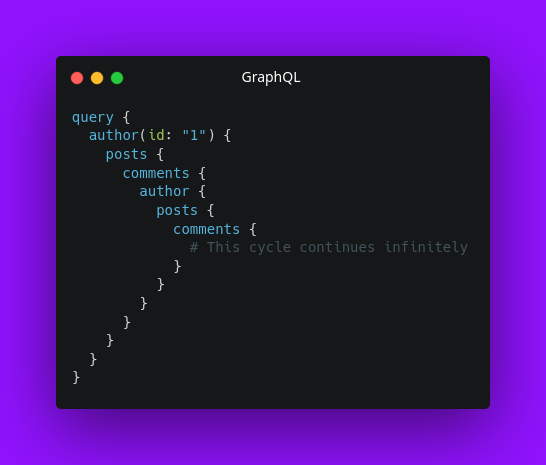
When the GraphQL engine attempts to resolve this deeply nested query, it triggers an exponential number of backend database calls. Without proper depth limiting or query cost analysis in place, a single HTTP request can easily exhaust server memory, max out CPU usage, and crash the entire database.
Rate Limiting Bypass and API Mass Assignment
Rate limiting in a RESTful world is straightforward: allow 100 requests per IP, per minute. But how do you limit GraphQL when a single HTTP request can ask the server to perform 100 different actions?
This is the harsh reality of a rate limiting bypass using GraphQL aliases. Aliases allow clients to send multiple queries of the exact same type within a single HTTP request by simply renaming the result keys. An attacker attempting to brute-force a login portal or an OTP endpoint doesn't need to send 10,000 HTTP requests; they can send a single HTTP request containing 10,000 aliased queries. The WAF registers exactly one request, while the backend blindly processes ten thousand authentication attempts.
Furthermore, this flexibility exacerbates API mass assignment vulnerabilities. In GraphQL, mutations often accept complex Input objects. If developers map these input objects directly to their backend Object-Relational Mapper (ORM) without explicitly filtering fields, attackers can inject unexpected parameters. For example, a standard UpdateProfileInput might just be meant for username and email. But if an attacker guesses the existence of an administrative flag and injects "isAdmin": true into the GraphQL payload, the backend will bind that payload directly to the database model, resulting in instantaneous privilege escalation.
Automating the Hunt: Rebuilding Your Testing Strategy
Addressing these blind spots requires a fundamental shift in how DevSecOps teams validate their application layers. Legacy Dynamic Application Security Testing (DAST) tools are completely broken against GraphQL. They are built to fuzz URI paths and standard HTTP query parameters; when faced with a single /graphql endpoint, they lack the contextual intelligence to parse the schema, construct valid queries, and test for business logic flaws.
This is where true automated API security testing becomes absolutely essential. To secure GraphQL properly, you need an offensive engine that actually understands the graph.
At Axeploit, autonomous AI agents are purpose-built for this exact challenge. Rather than relying on simple regex pattern matching, Axeploit’s engine autonomously discovers your GraphQL endpoints. If introspection is enabled, it maps the entire schema instantly. If it is disabled, the AI uses advanced heuristics and field-suggestion fuzzing to brute-force and reconstruct the graph just like a real-world attacker would.
Once the structure is understood, Axeploit generates context-aware, deeply nested payloads to validate your depth limiting configurations. It attempts alias-based rate limit bypasses and aggressively fuzzes your mutations for mass assignment and Broken Object Level Authorization (BOLA) flaws. By continuously hunting for these GraphQL-specific vulnerabilities directly inside your CI/CD pipeline, Axeploit provides developers with actionable, zero-false-positive proof of concepts (PoCs) long before the code hits production.
Conclusion
Migrating to GraphQL is one of the most effective ways to modernize your application architecture, but it requires leaving behind the safety net of traditional infrastructure-based security. When you consolidate your API into a single endpoint, you consolidate your risk. Every query becomes a complex application-layer transaction that must be parsed, validated, and authorized strictly through custom business logic.
Failing to implement robust depth limiting, query cost analysis, and strict input validation will invariably expose your platform to crippling DoS attacks and cross-tenant data leaks. In a landscape where attackers are constantly evolving, legacy scanners that only understand REST URI paths are dangerously obsolete. You must adopt automated API security testing that thinks, parses, and attacks in GraphQL. Equip your engineering teams with autonomous security tools like Axeploit, and secure your graph before someone else explores it for you.