In the hyper-accelerated landscape of 2026, engineering teams are deploying code faster than ever before. Microservice architectures allow organizations to decouple their monolithic applications, enabling autonomous DevOps teams to push updates dozens of times a day. But this unprecedented engineering velocity comes at a steep cost: a catastrophic loss of visibility. As the number of connected services explodes, the traditional perimeter dissolves. What remains is a chaotic web of endpoints that security teams can no longer manually track.
This sprawling, unmapped ecosystem is the ultimate playground for modern threat actors. It creates a massive, hidden attack surface dominated by two critical threats: Shadow APIs and Zombie APIs. While they may sound like industry buzzwords, these undocumented endpoints and forgotten legacy routes are the primary vectors for devastating data breaches today. In this technical deep dive, we will unpack the fundamental distinctions between the two, explore how attackers actively hunt them down, and explain why your current defenses are completely blind to them.
The Anatomy of the Hidden Attack Surface
To effectively secure a modern cloud environment, Cloud Architects and DevSecOps Managers must first understand that not all unknown endpoints are created equal. They generally fall into two distinct categories, each presenting unique microservice vulnerabilities.
What are Shadow APIs?
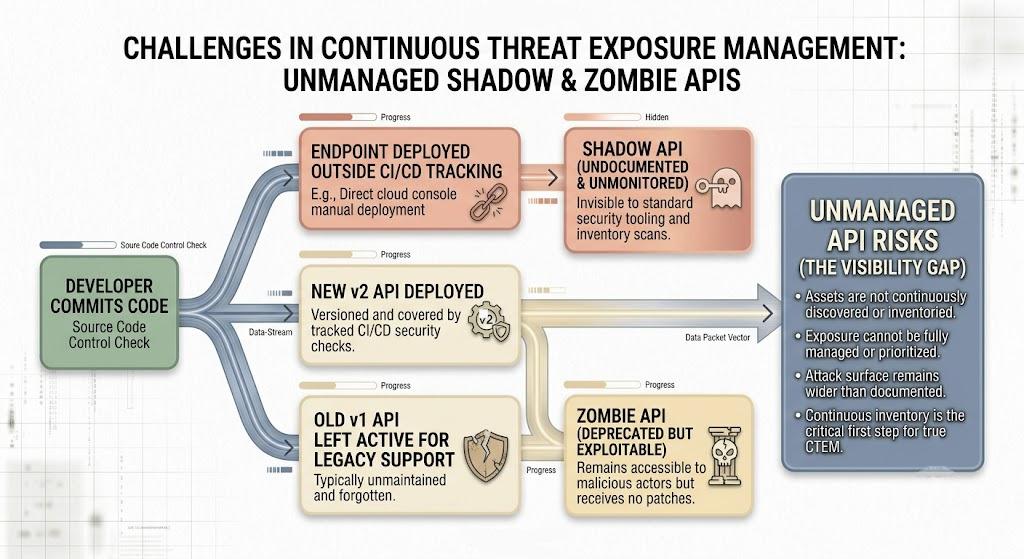
Shadow APIs are active, functional endpoints that have been deployed to production but are entirely unrecorded in the organization’s official documentation (such as OpenAPI or Swagger files). They are the ultimate undocumented endpoints.
How do they get there? Usually, they are the result of agile development bypassing security governance. A developer might spin up a temporary endpoint to test a new feature, build a custom webhook for a third-party integration, or deploy a quick internal routing service to solve a bottleneck. If that endpoint never gets logged in the central API registry, it becomes a Shadow API. Because the Security Operations Center (SOC) doesn't know it exists, it isn't monitored, it isn't audited, and it is rarely protected by standard authentication protocols.
What are Zombie APIs?
Zombie APIs, on the other hand, are the walking dead of your microservices ecosystem. These are deprecated, legacy endpoints that were supposed to be decommissioned but were inadvertently left running in production.
Consider a scenario where your engineering team upgrades from api.axeploit.com/v1/user-data to api.axeploit.com/v2/user-data. The v2 endpoint is built with modern Zero Trust authentication and strict rate limiting. However, out of fear of breaking backward compatibility for a handful of legacy mobile clients, the v1 endpoint is left active. Over time, v1 is forgotten. It misses critical security patches, relies on outdated encryption, and lacks modern access controls. This Zombie API is fully documented in old repositories, making it a highly visible target for attackers looking for the weakest link in your authorization chain.
How Threat Actors Exploit the Unknown
Hackers in 2026 do not waste their time trying to break through heavily fortified, well-documented front doors. They know that complex microservice architectures are riddled with forgotten backdoors. To find them, advanced threat groups rely on two primary techniques: aggressive fuzzing and client-side reverse engineering.
Discovery Through AI-Assisted Fuzzing
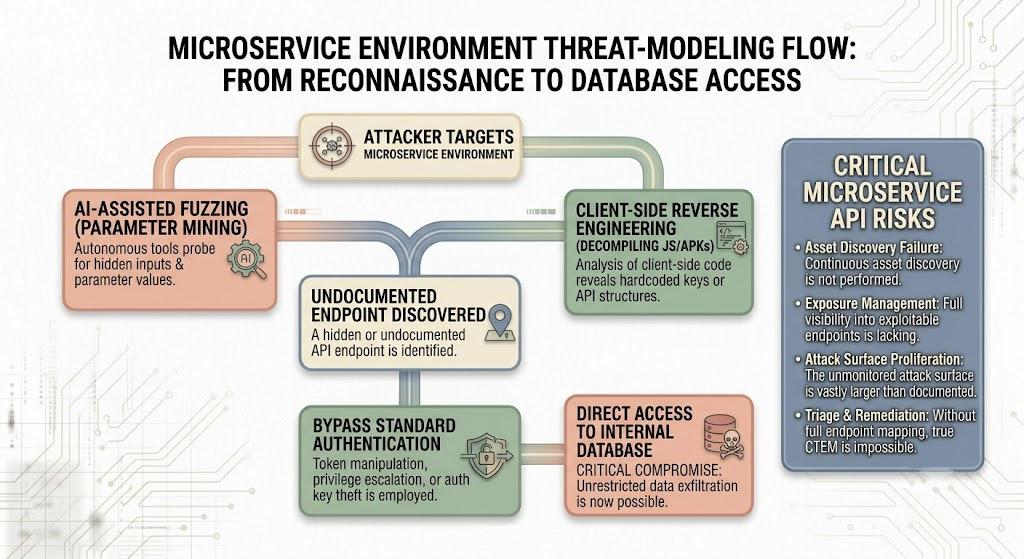
Fuzzing is the automated process of sending massive amounts of random, mutated, or dictionary-based requests to a server to see how it responds. Attackers use sophisticated, AI-driven parameter mining tools to map out hidden infrastructure.
By analyzing the structure of your known APIs, an attacker's LLM agent can accurately guess the naming conventions of your undocumented endpoints. If they see an endpoint like /api/v2/public/resource, their automated fuzzer will rapidly test permutations like /api/v2/internal/resource, /api/v2/debug/resource, or /api/v1/public/resource. When the server responds with a 200 OK or a descriptive 403 Forbidden instead of a standard 404 Not Found, the attacker has successfully mapped a Shadow or Zombie API.
Reverse Engineering the Client
Sometimes, attackers don't even need to guess. Developers frequently leave traces of undocumented endpoints baked right into the client-side code. Threat actors will routinely download your mobile applications (APKs/IPAs) or intercept your single-page web applications (SPAs) and decompile the JavaScript bundles.
Inside these bundles, they look for hardcoded staging URLs, forgotten developer comments, or experimental feature flags that point directly to Shadow APIs. Because these endpoints were never intended for public consumption, they often lack proper authorization checks (like BOLA/IDOR protections), allowing the attacker to interact with the underlying database directly.
Why Traditional API Gateways are Failing in 2026
If these endpoints are so dangerous, why isn't the API Gateway or Web Application Firewall (WAF) blocking the malicious traffic?
The harsh reality of modern API security posture management (ASPM) is that traditional gateways are structurally blind to the unknown. A legacy API Gateway operates on a positive security model based entirely on static definitions. It relies on the DevOps team to manually upload an OpenAPI or Swagger file that tells the gateway exactly what traffic is allowed. If a Shadow API is undocumented by definition, it is not in the Swagger file. Consequently, the gateway either ignores it, applies generic, weak routing rules to it, or allows it to pass through uninspected.
Furthermore, traditional WAFs are designed to protect "North-South" traffic (data moving in and out of the external network). They offer zero visibility into "East-West" traffic (microservices communicating internally with each other). If an attacker breaches a low-level service and begins probing internally for a Zombie API, the external gateway will never even see the request. Static defenses are fundamentally incapable of securing a dynamic, rapidly evolving microservice mesh.
Mastering API Security Posture Management (ASPM) with Axeploit
Securing a modern ecosystem requires a paradigm shift. You cannot protect what you cannot see, and you cannot rely on humans to perfectly document every single endpoint in an environment that changes dozens of times a day. True API discovery requires stepping away from static configuration files and moving toward dynamic, behavioral analysis.
This is exactly where Axeploit redefines the landscape of DevSecOps.
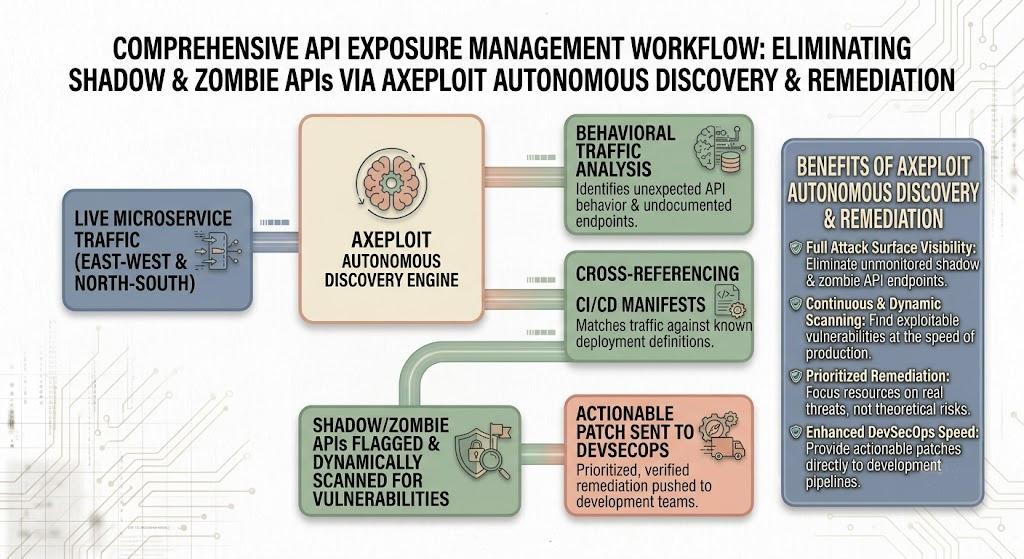
Axeploit’s autonomous discovery engine does not rely on outdated Swagger files or manual developer inputs. Instead, it natively integrates into your live environment and continuously maps your endpoints by analyzing actual behavioral traffic in real-time. By safely monitoring the live request and response payloads across both your edge networks and your internal service mesh, Axeploit physically builds a living, breathing map of your true API security posture.
When Axeploit detects traffic flowing to an endpoint that does not exist in your CI/CD documentation, it instantly flags the Shadow API. When it sees active traffic hitting a deprecated v1 endpoint that was supposed to be sunset six months ago, it instantly flags the Zombie API.
But Axeploit goes further than just visibility. Once a hidden endpoint is discovered, our automated dynamic vulnerability scanner safely probes the endpoint from the outside, exactly like an attacker would. It tests for broken object-level authorization, mass assignment, and data leakage, providing your engineering team with the exact exploit path and actionable remediation steps before a threat actor ever finds it.
Conclusion: Eliminate the Blind Spots
As long as engineering teams prioritize speed and agility, the hidden attack surface of Shadow and Zombie APIs will continue to expand. In 2026, relying on manual documentation, static Swagger files, and legacy API gateways is a guaranteed recipe for a catastrophic data breach. Your attackers are using automated, autonomous tools to map your infrastructure; you must use automated, autonomous tools to defend it.
Implementing robust API Security Posture Management (ASPM) is no longer a luxury for enterprise teams, it is an absolute necessity. You must assume that your microservice architecture contains forgotten backdoors and undocumented routes. By deploying Axeploit’s dynamic, behavior-based API discovery engine, you can illuminate your entire ecosystem in real-time. You bridge the gap between what developers think they deployed and what is actually running in production.