GitHub cut every public bug bounty payout by at least 50% on July 27, 2026. Most coverage stopped at the new numbers. The numbers are the least interesting part of this story.
What matters is why the change happened, why four major programs have now made similar moves in the same year, and what a two-tier bounty market does to the supply of human researchers that defenders quietly depend on. I think the restructuring is individually rational and collectively corrosive, and if you run a program or consume bounty-derived signal, you should plan accordingly.
The part of the story the payout tables hide
Here are the GitHub figures everyone reposted, with the context most of them skipped:
| Severity | Old public range | New public flat | Invite-only VIP tier |
|---|---|---|---|
| Critical | $20,000 to $30,000+ | $10,000 | $30,000+ |
| High | up to $20,000 | $5,000 | $20,000 |
| Medium | up to $5,000 | $2,000 | $7,500 |
| Low | up to ~$1,000 | $250 | $1,000 |
Reports submitted before the cutover are honored at the old rates, which is the right way to handle a repricing. New researchers face a HackerOne signal requirement and a cap of four initial submissions to establish a track record before getting unrestricted access. VIP qualification is explicit and cumulative: one accepted critical, or two highs, or four mediums, or seven lows in GitHub's program, with existing track record counting.
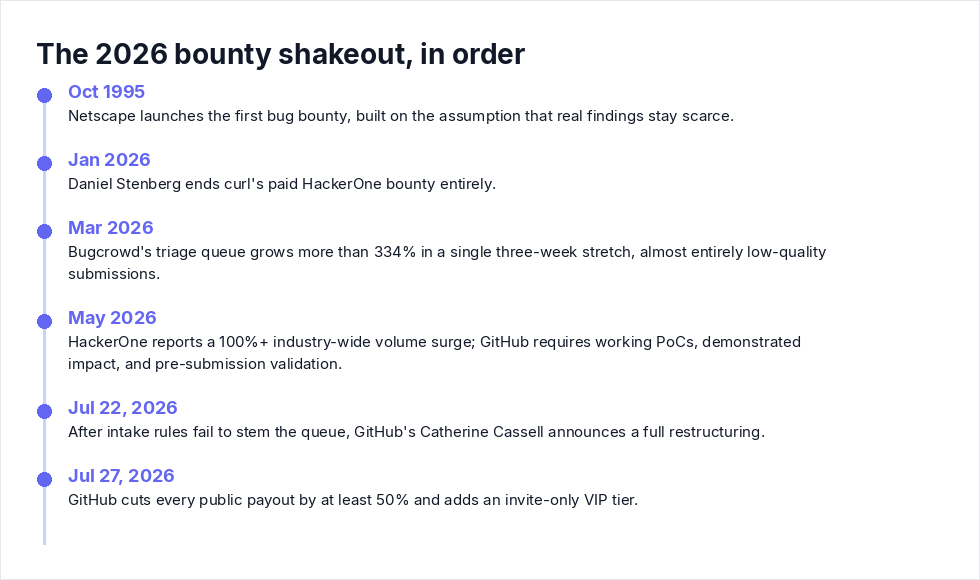
Now the context. HackerOne reported an industry-wide report volume surge of more than 100% in May 2026, after more capable AI tools shipped. Bugcrowd's triage queue grew more than 334% in a single three-week stretch in March, almost entirely low-quality submissions. Bugcrowd's team coined "sloptimism" for these reports: submitted fast and hopefully, with the author trusting the model's output more than the evidence. Daniel Stenberg ended curl's paid HackerOne bounty entirely at the end of January. TechTimes counts GitHub as the fourth major platform or program to restructure, suspend, or narrow scope in 2026, after Google, Bugcrowd, and HackerOne's own Internet Bug Bounty Program.
Bug bounties have run since Netscape launched the first one in October 1995 on one assumption: finding real vulnerabilities takes skill and effort, so supply stays limited. LLMs broke that assumption. Not by finding more real bugs, but by making a credible-looking report nearly free to produce.
Triage time is the real currency
Bugcrowd made the cleanest version of the argument in an April 2026 post: AI changed the economics of any human-validated system. Convincing content became cheap to generate. Checking whether that content is correct did not become cheaper at all.
That asymmetry is the whole story. Every bounty program is really two markets bolted together: a market for findings and a market for the scarce engineering hours that confirm or refute them. When the first market floods, the second one sets the price.
GitHub's own sequence shows the escalation. In May 2026 it required working proofs of concept, demonstrated impact, and pre-submission validation. The queue kept growing. Five weeks later, on July 22, product security engineer Catherine Cassell announced the full restructuring. GitHub declined to disclose exact submission figures, but the logic is visible from the outside: intake rules failed, so pricing and access controls took the load instead.
Do the arithmetic on your own program. Take a hypothetical 1,000 extra reports a month at even 20 minutes of engineer time each to triage, reproduce, and close out. That is over 330 engineer-hours a month spent mostly proving negatives, before a single valid finding gets paid. At that point a program has three options: pay less per report, restrict who may report, or shut down. GitHub did the first two. curl chose the third. None of these are cheap, and this is where framing matters. Triage hours are engineering spend, and security spend framed as pure cost is the first thing cut in a budget review. We have written about reframing AppSec spend as a business asset, and this is exactly the fight where that framing pays off.
Two tiers, and the missing middle
The VIP tier is defensible on its own terms. GitHub says it welcomes AI-assisted research and uses AI internally; the line it draws is at AI-generated submissions the author never verified. Paying proven researchers three to four times the public rate is a rational response to a signal-to-noise collapse.
The pipeline problem sits one level down. Look at where mediums landed: $2,000 flat, down from a $5,000 ceiling. Mediums and lows are where researchers learn. They are the reports a talented 22-year-old writes while building the instinct and the reputation that eventually produce criticals. Under the new structure, that junior faces a signal gate, a four-report cap, and half the old payout for the exact category of work that used to fund the learning curve. VIP status requires accepted findings in the program, which is a reasonable bar for GitHub and a chicken-and-egg problem for anyone starting from zero.
Researchers on forums and social media have raised precisely this concern: reputation in vulnerability research was traditionally built over time, and the new model asks for it upfront. My position is blunt. Every program that gates newcomers behind signal requirements is optimizing its own queue while free-riding on a pipeline it is actively shrinking. Senior researchers are not born at the VIP tier. They spent years submitting mediums to somebody's open program. If the whole industry copies GitHub's gating without building an on-ramp, the senior researcher pool of 2029 gets noticeably thinner, and the bugs those people would have found do not disappear. They get found by someone else, sold somewhere else, or never found at all.
The pushback I keep hearing
"GitHub is just cutting costs and blaming AI." Partly unanswerable, because GitHub did not disclose submission figures. But the pattern argues against a pure cost play. The company tried cheaper measures first, watched the queue grow anyway, and said it will keep monitoring and may tighten caps or thresholds further. Three other major programs moved the same direction in the same months. And curl, a project with a modest bounty and no CFO to please, simply walked away. Opportunists reprice. They do not usually exit.
"AI is finding real bugs, so the volume is good." Some of it is good. HackerOne's own characterization of the surge is a mix: legitimate findings, duplicates, submissions without working exploits, and theoretical scenarios that failed under scrutiny. We test AI agents for a living and the models do surface genuine issues, including business logic abuse most scanners never touch. That is not the point. A 30% hit rate still drowns a triage team if the absolute volume triples. If your team uses LLMs to draft or validate findings internally, hold that output to the same evidentiary bar you would demand from an outside researcher. Our pentester's checklist for the OWASP LLM Top 10 is a workable starting point.
What to change in your program this quarter
Instrument the intake before you touch the payouts
You cannot price what you have not measured. Start tracking four numbers weekly: not-actionable rate, duplicate rate, median hours to first response, and valid findings per researcher cohort (new versus established). My rules of thumb, adjust to your volume:
- If your not-actionable rate stays above 50% for two consecutive weeks, tighten intake requirements before touching payout tables.
- If median first response slips past 48 hours, you are paying reputational interest to the researchers you most want to keep.
- If established researchers' submission volume drops quarter over quarter, your program is becoming unattractive to exactly the wrong people.
Gate on proof, not on hope
GitHub's May 2026 move was correct; it was just too late to avoid the repricing. Require evidence at intake and automate the rejection of reports that lack it:
# example intake policy, public program
new_researcher:
  max_initial_submissions: 4
  requires:
    working_poc: true
    impact_statement: true
    affected_versions: true
  unlock_after:
    accepted_findings: 2
    min_severity: medium
triage:
  first_response_hours: 24
  auto_close_without_poc_days: 7
This is cheaper than triage headcount and fairer than silent deprioritization.
Copy GitHub's structure, not its numbers
Flat public tiers plus an invite track is a sane shape for a noisy market. Your absolute figures should reflect your own triage cost and asset value, which are not GitHub's. Two decisions I would treat as non-negotiable: honor in-flight reports at the rates in effect when they were submitted, and reserve the premium tier for validated exploit chains rather than well-written prose. Pay for proof.
Keep a junior lane open on purpose
This is self-interest dressed as generosity. Run a scoped private program or a CTF-to-program on-ramp where newcomers can build track record against a narrower target with faster feedback. Pay enough on lows and mediums that a student can justify the hours. The researchers you mentor this year are the ones who report your criticals in three years instead of selling them, and several of them are your future hires.
Stop treating the crowd as your coverage
The deeper implication of a thinning public tier is that fewer skilled eyes will review your attack surface through open programs. If your security testing strategy assumed the crowd would find what your annual assessment missed, that assumption aged badly this year. Own a real testing cadence.
If the gap here is coverage between annual tests, Axeploit's pentest workflow is built for exactly that: continuous, human-led testing that does not depend on bounty market conditions or researcher lottery luck.
Key takeaways
- AI slashed the cost of producing a plausible vulnerability report, not the cost of verifying one. Payouts now reflect triage economics, which is why GitHub cut public rates by at least half at every severity level.
- This is cross-platform, not a GitHub story: HackerOne saw industry volume jump over 100% in May 2026, Bugcrowd's queue grew over 334% in three weeks in March, and curl exited paid bounties in January.
- Two-tier gating solves your queue and starves the commons. The $2,000 medium is where senior researchers used to be made.
- Instrument your intake, gate submissions on working proof, reserve premium pay for validated impact, and never reprice in-flight reports.
- Assume less crowd coverage going forward and budget for your own continuous testing instead.