Presence is evidence. Absence is silence. Every provenance signal in your verification stack works in exactly one direction, and the tooling for erasing Google's SynthID watermark has quietly become a finished product category. If your review workflow treats "no watermark found" as exculpatory, that assumption is now a liability with a GitHub repo, a hosted tier, and a batch mode.
The removal toolchain is further along than the defense
Start with the serious artifact: wiltodelta/remove-ai-watermarks, an open-source Python library and CLI with 5.1k stars, 484 forks, and 473 commits of iteration behind it. It handles images and video, and it explicitly lists SynthID alongside C2PA, EXIF, IPTC, and XMP. This is not a proof of concept someone abandoned after a weekend. Four hundred seventy-three commits is a maintained product.
The feature split tells you where the engineering effort goes. Stripping metadata and visible badges is the easy, free part. Removing the invisible image watermark takes diffusion regeneration and requires a CUDA GPU. Video removal is described in the repo as "oracle-certified VAE regeneration" and sits behind an opt-in --invisible flag because it is lossy. The hosted version, raiw.cc, charges for invisible watermark removal while giving away the visible-mark and metadata cleaning. That pricing is a demand signal: people pay for the layer that is supposed to be durable.
Around the repo sit the web tools. Two of them, geminiwatermark.io and AISEO's SynthID Remover, run entirely in the browser with no file uploads (AISEO caps files at 50MB). A third, Humanize Image, processes on its own servers, says files are deleted after the session, and ships batch processing aimed at social media uploads. "The logo you can see is only half of it," as one of the browser tools puts it, which happens to be accurate.
The README does the expected legal framing: "This project is for lawful use on content you own. It does not target stock agency previews or other watermarks that protect third party paid content." Take that at whatever weight you give README disclaimers.
One more piece of context for scale. Vendor pages report that Google applies SynthID automatically during generation in Gemini, Imagen, and Veo, with no opt-out, toggle, or notification. If that is right, the watermarked corpus is everything those models emit. Coverage at the generator is not where this fails.
SynthID's survival claims are real, and they answer the wrong question
SynthID, built by Google DeepMind, embeds its signal in the frequency-domain patterns and pixel values of the image, distributed across the whole frame rather than parked in a header. That distribution is exactly why it survives cropping, resizing, JPEG compression, format conversion, color adjustments, and re-encoding. There is no single place to cut. "You can delete every byte of metadata and the watermark is still there, because it's the pixels themselves that carry the signal," AISEO's own explainer concedes. Their other line is blunter: "SynthID survives almost everything. Google designed it that way on purpose."
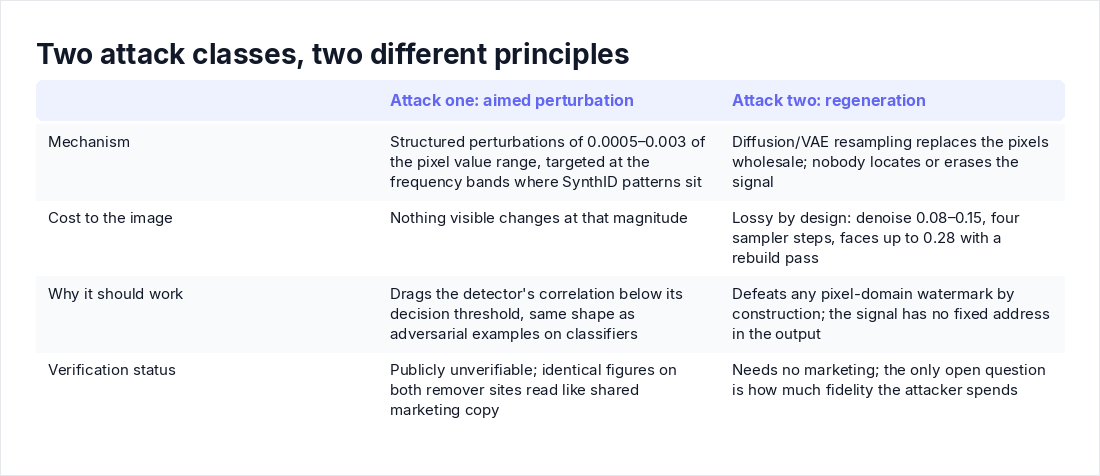
I believe the survival claims. I also think they are benchmarked against the wrong enemy. Every transform on that list is benign: a crop does not know the watermark exists, and neither does a JPEG encoder. A removal tool is an adversary. It knows where the signal lives and it gets to choose the attack. Robustness against transforms that ignore you is not robustness against an opponent who studies you. There are two attack classes in circulation right now, and they work on different principles.
Attack one: aimed perturbation below perception
Two competing remover sites describe the same technique: tiny structured perturbations, between 0.0005 and 0.003 of the pixel value range, targeted at the frequency regions where SynthID patterns are embedded. At that magnitude, nothing visible changes.
The logic is sound in principle. A watermark detector is a correlation check against an expected pattern. Add small, aimed energy in the right frequency bands and you can drag that correlation below the decision threshold while a human viewer sees the identical image. This is the same shape as adversarial examples against classifiers, except the perturbation budget here is generous because the target is a detection statistic, not a label.
Whether it actually beats Google's production detector is a separate question, and I will come back to why nobody outside Google can answer it. One detail worth flagging now: the perturbation figures are identical on both sites, same range, same precision. That reads like shared marketing copy, not two independent engineering validations. Price it accordingly.
Attack two: regeneration replaces the pixels, not the watermark
The GitHub tool takes the heavier route, and it is the one I would bet on. Diffusion regeneration pushes the image through a generative model and resamples it. The output keeps the content and loses the fingerprint. Nobody locates the watermark and erases it; the pixels carrying it are replaced wholesale. That defeats any pixel-domain watermark by construction rather than by tuning, because the signal has no fixed address in the output.
The cost is fidelity, which is why the feature hides behind an opt-in flag and gets labeled lossy in the docs. Humanize Image exposes the same tradeoff as product settings: adaptive level 6, a denoise floor of 0.08 and ceiling of 0.15, four sampler steps, and a face denoise ceiling of 0.28 with an optional diffusion rebuild pass for faces. Four sampler steps is a light touch. The whole tuning exercise is to change the image just enough to break the embedded signal and no more, and the denoise parameter is the attack budget. Faces get the higher ceiling plus a rebuild pass because faces are where viewers spot drift first. Anyone who has tuned an img2img pipeline will recognize this logic immediately. The novelty is packaging it as a cleaning service with a batch mode for social uploads.
Provenance falls in layers, and the top layer falls in seconds
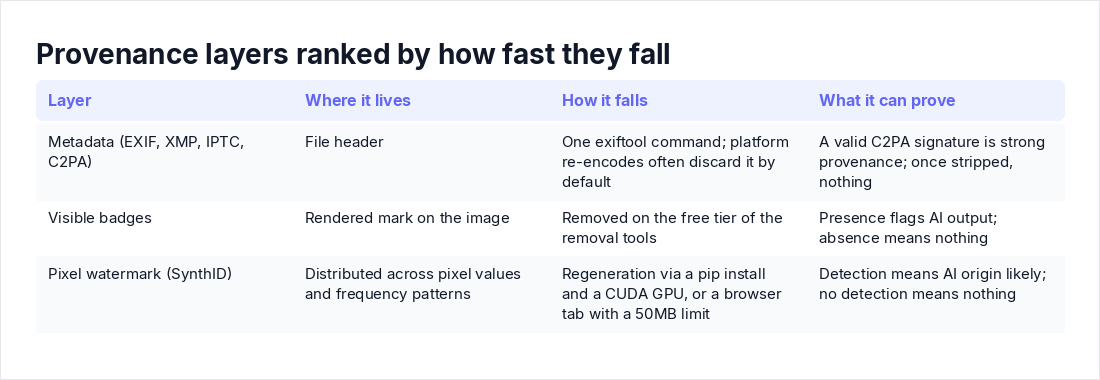
Policy conversations keep conflating these signals, so it is worth ranking them by how fast they fall.
Metadata goes first. EXIF, XMP, IPTC, and C2PA manifests live in the file header and, per AISEO's own explainer, "can be stripped in seconds." No GPU required:
exiftool -all= image.jpgA valid C2PA signature is meaningful when present. Once stripped, it testifies to nothing, and plenty of platforms re-encode uploads in ways that discard it by default.
Visible badges go second. The repo removes them on the free tier. That was never the hard problem.
Pixel watermarks go last, and until recently they required someone who understood the embedding scheme. That bar is now a pip install and a CUDA GPU, or a browser tab with a 50MB limit.
The operational consequence is the part your SOPs need to absorb. These signals are asymmetric, and the code your review queue runs should look like this:
verdict = NEUTRAL
if c2pa_signature_valid:  verdict = STRONG_PROVENANCE
if synthid_detected:      verdict = AI_ORIGIN_LIKELY
if no_watermark_found:    verdict = NEUTRAL    # never "probably human"
A detection or a valid signature moves the needle. Silence moves nothing. Any workflow that reads "no watermark found" as "probably human-made" was always wrong. The removal ecosystem just made exploiting that mistake cheap and fast.
Nobody outside Google can check the scoreboard
Here is the part the tool landing pages do not dwell on. SynthID detectors are not widely available to the public. So no remover can prove its own success, no user can confirm a watermark was present in the first place, and no newsroom or platform can audit either direction. The most honest sentence in this entire corner of the internet is buried in geminiwatermark.io's disclaimer: "We cannot guarantee complete removal in every case. Results depend on image resolution, compression level, background complexity, and the specific SynthID implementation present."
Meanwhile the repo advertises "oracle-certified" video removal. An oracle, in this context, is a detector you can query. Certifying against one implies the developers had a feedback loop to test against, which is precisely the attack surface. That leaves Google in a trap with no comfortable exit. Keep the detector closed and defenders cannot measure their exposure. Open it up and it becomes the oracle every remover on the internet optimizes against overnight. Watermark-based provenance sits on that dilemma, and no amount of frequency-domain cleverness escapes it.
The fair objection: I have not run it either
A skeptical reader should push back here, so let me do it for you. GitHub stars measure interest, not efficacy. Vendor claims are vendor claims. I have not independently verified that any of these tools defeat Google's production detector, and neither has anyone else publishing on the topic. All true.
None of it rescues the watermark. The perturbation numbers may be marketing, but regeneration needs no marketing because resampling defeats a pixel-domain signal by construction. The only open question is how much fidelity the attacker spends, and the tooling now exists to let the attacker dial that budget. The burden of proof sits with whoever claims durability, and the only publicly evaluable artifact in the whole affair is the remover.
The longer game matters more than this month's scoreboard. Watermarks already embedded in published images cannot be patched or rotated. The removal tools get 473 commits of iteration and counting. Defense ships a frozen scheme; the attack ships a moving one. Even if SynthID survives today's removers, the direction of travel is set.
What to change this week
Verification and trust-and-safety teams: rewrite the SOP line today. Watermark and provenance checks are positive-only signals. "No watermark detected" gets zero evidentiary weight in either direction, and any review queue that treats it as exculpatory needs fixing before it needs better detection.
Detection buyers: change your procurement question. Ask vendors for evaluation against regeneration attacks, not transform tables. The specific ask: "Show me detector confidence before and after a diffusion resample at denoise 0.15." If the survival table lists JPEG quality levels and crop ratios, it answers a question attackers stopped asking.
Platform engineers: assume uploaded provenance metadata is curated by whoever uploaded it. Verify C2PA at ingest, record the verdict server-side, and treat everything downstream as untrusted. Also note the data-handling split if your own staff ever clean images: two of the three tools here run in the browser and never upload the file, while Humanize Image processes on its servers. That difference is a policy decision, not a footnote.
Policy advisors: generator-side coverage is not the weak link, since vendors report SynthID is applied automatically with no opt-out. Post-hoc removal is. Regulation built on "platforms will detect the watermark" rests on the most fragile layer in the stack. The layer worth legislating is attestation at capture: signed provenance from cameras and generators, with detection treated as a tripwire rather than a foundation.
Key takeaways
- SynthID's survival claims cover benign edits. A removal tool is an adversary, and that is a different threat model with a different outcome.
- Two attack classes exist: targeted sub-perceptual perturbation (claimed, publicly unverifiable) and diffusion or VAE regeneration (works by construction, costs fidelity, wants a GPU).
- Provenance signals are one-way. Presence is evidence, absence is silence. Build classifiers and SOPs accordingly.
- A closed detector plus open removers is a losing configuration: defenders cannot measure exposure, and any queryable detector becomes an attack oracle.
- If your authenticity strategy ends at watermark detection, this quarter's project is capture-time attestation, not a better detector.