The number that matters most in CVE-2026-18431 is not the 9.8 CVSS score. It is two hours, which is how long Wordfence's internal agentic framework, Argus, needed to find six separate flaws across the Avada theme and its Fusion Builder plugin and chain them into working proof-of-concept exploit code. If you are responsible for any site running Avada, the timeline of this disclosure should bother you as much as the bug itself.
The bug: six flaws, one zero-click chain
CVE-2026-18431 lets an unauthenticated attacker execute arbitrary PHP on the server, with no clicks or logins required from anyone. The CVSS 3.1 vector is AV:N/AC:L/PR:N/UI:N/S:U/C:H/I:H/A:H: network reachable, low complexity, no privileges, no user interaction. The root weakness class is CWE-862, missing authorization, and the chain runs through a series of authorization and input-validation failures in two components that ship together, ending in an arbitrary file write. Write a file, make that file a PHP script, request it, and you own the site.
Wordfence has published only a six-step outline, withholding full technical detail so admins have time to patch. The shape of it:
- Attacker-controlled input is exposed through a public request.
- That input is passed to functionality that anonymous users should never reach.
- A privileged component gets invoked outside its intended context.
- Request data is used to influence trusted state.
- An insufficiently protected administrative operation becomes accessible.
- File-handling restrictions on what can be written, and where, are bypassed.
None of those steps sounds catastrophic alone. That is exactly how chains like this survive code review for years.
There is one prerequisite worth understanding correctly. The vulnerability records note that certain administrator-authored content must be present on the site for exploitation to succeed. Do not read that as a safety net. Wordfence's own assessment is that "the prerequisites don't narrow the pool of potential targets."
The version math is simple. Avada 7.16 and earlier, plus Fusion Builder 3.16 and earlier, are vulnerable. Both must be installed and active, and they always are: "Fusion Builder is a required plugin for the Avada theme," as Wordfence put it, "Therefore all sites running the Avada theme will also be running the Fusion Builder plugin." Any outdated Avada install is an exploitable install. Fixes shipped on August 25, 2026 in Avada 7.16.1 and Fusion Builder 3.16.1.
The installed base is enormous. Avada is the best-selling commercial WordPress theme, with reported sales north of a million licenses. Successful exploitation means full compromise: planted malware, database access, rogue admin accounts, visitors redirected to malicious sites.
Two hours from audit to working exploit
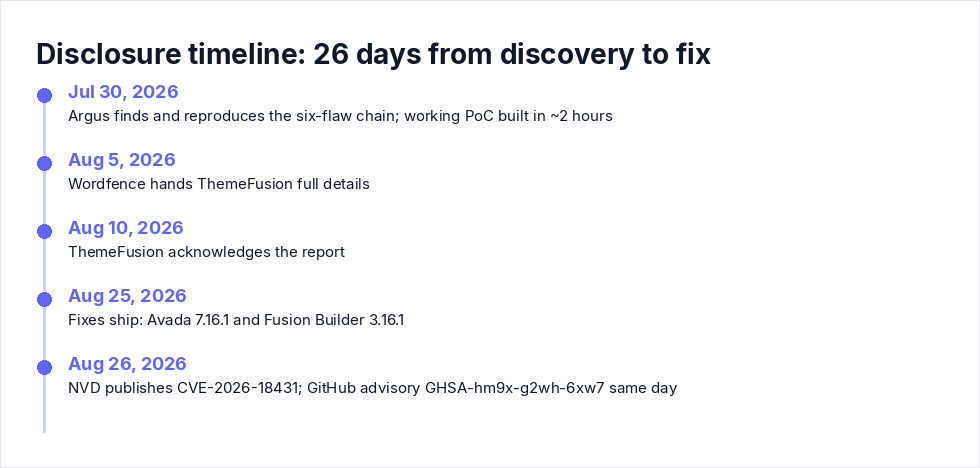
Here is the disclosure timeline. Argus, work credited to Wordfence's Alex Thomas, found and reproduced the chain on July 30. Wordfence handed ThemeFusion full details on August 5. ThemeFusion acknowledged on August 10 and shipped fixes on August 25. NVD published the CVE entry on August 26, with GitHub advisory GHSA-hm9x-g2wh-6xw7 the same day.
Twenty-six days from private discovery to shipped fix is a respectable vendor response. That is not the part to worry about.
The part to worry about is what Argus proves. Chained vulnerabilities are the class of bug human auditors are worst at catching, because each link looks minor in isolation and triage moves on. Agents do not get bored, do not anchor on severity labels, and happily spend an hour proving that step four can feed step five. Defenders now have to assume this capability exists outside of Wordfence, in less responsible hands. And even with the technical details withheld, the published six-step outline is a reconstruction blueprint. Anyone with a capable model, the 7.16 codebase, and the 7.16.1 diff has a map. Patch diffs have always been exploitation maps. The difference now is that reading them at scale is automated.
The "nothing in the wild yet" objection
As of August 27, 2026, there is no confirmed exploitation, CISA's Known Exploited Vulnerabilities catalog does not list the CVE, and its EPSS score sits at 0.64%. All true. None of it is a reason to wait.
EPSS is a snapshot computed before technical details and PoC logic circulate. KEV lags real-world abuse by definition; something has to be exploited, detected, and reported before it lands there. And the history of unauthenticated RCEs in widely deployed WordPress components is consistent: once the shape of the bug is public, mass scanning follows in days, sometimes hours. A working PoC already exists inside Wordfence. Treat your unit of measure as days.
Step 1: Confirm exposure in five minutes
Check both components. With WP-CLI:
wp theme get Avada --field=version
wp plugin get fusion-builder --field=version
Decision rule: Avada at or below 7.16, or fusion-builder at or below 3.16, means exposed. Since the plugin ships with the theme, an outdated theme answer alone is enough.
No WP-CLI? Read the headers directly (adjust paths if your docroot or slugs differ):
grep -m1 '^Version:' wp-content/themes/Avada/style.css
grep -m1 '^Version:' wp-content/plugins/fusion-builder/fusion-builder.php
If you run an agency fleet, script this across every docroot today. Do not trust a spreadsheet of which clients "probably" run Avada. Check.
Step 2: Patch first, then buy time if you must
Update to Avada 7.16.1 and Fusion Builder 3.16.1 through your normal ThemeFusion channel. Take a backup, test on staging if you have it, but do not let a change-management process stretch this into weeks. That is the old math, and the old math is what this disclosure killed.
If you genuinely cannot patch today, these mitigations raise the attacker's cost and give you detection surface. None of them fixes the chain.
- WAF virtual patching. Add rules that alert or block on unauthenticated requests attempting file writes to sensitive directories (theme, plugin, and upload paths). Without public endpoint details these rules are broad, so expect false positives and tune.
- Disable PHP execution in uploads. There is almost never a legitimate PHP file there. For nginx:
location ~* /wp-content/uploads/.*\.php {
    deny all;
}
For Apache, drop this in wp-content/uploads/.htaccess:
<FilesMatch "\.php[57]?$">
    Require all denied
</FilesMatch>- Lock down writes. The PHP-FPM user should have read-only access to everything under
wp-contentexceptuploads. At minimum, adddefine('DISALLOW_FILE_EDIT', true);towp-config.phpso a compromised admin session cannot edit theme and plugin files from the dashboard. - One mitigation that mostly does not apply here. Some advisories suggest disabling Fusion Builder if unused. For Avada sites that advice is moot, since the theme requires it. Removal only makes sense if you are migrating off Avada entirely.
Step 3: Hunt for shells, not signatures
Wordfence is withholding details, so there are no public indicators of compromise to match against. Hunt the outcome instead: attacker-written PHP, rogue accounts, persistence. Do this even if you patched immediately, especially for any window where the site ran vulnerable code after details began circulating on August 25 and 26.
# PHP and PHP-adjacent files in uploads, touched in the last 45 days
find wp-content/uploads -type f \( -name '*.php*' -o -name '*.phtml' -o -name '*.phar' \) -mtime -45 -ls

# double extensions are a classic tell
find wp-content/uploads -type f -name '*.php.*' -ls
Then verify integrity where you can:
wp plugin verify-checksums --allThat covers wordpress.org plugins. Avada is commercial, so checksum verification will not cover it; diff your copy against a fresh download from your ThemeFusion account instead. While you are at it, audit accounts and scheduled tasks:
wp user list --role=administrator --format=table
wp cron event list
Any admin you do not recognize, any cron event you cannot explain, treat as a finding. In your web access logs, pivot on unauthenticated POST requests to WordPress endpoints, spikes from single IPs, and anything unusual after August 25.
If you find something
Do not just delete the file and move on. Snapshot the disk and database first, and preserve access logs before rotation eats them. Assume everything the web process could read is compromised: database credentials, the salts and keys in wp-config.php, API tokens. Rotate all of it (changing the salts also kills every live session, which you want). Reset every admin password. If you cannot establish clean scope, rebuild from known-good sources rather than cleaning in place, and use the earliest file timestamp against your log retention to estimate dwell time.
The bigger shift: chained-flaw discovery is now automated
Zoom out. A six-flaw, two-component, zero-click chain went from "unknown" to "working exploit" in two hours, using tooling built by a defensive vendor. The same style of tooling pointed at the patch diff after disclosure will find chains like this in other products, faster than any human triage queue. If your patch process for internet-facing criticals still runs on a monthly cadence, that process is now the vulnerability. This is the case for moving from scheduled scanning to a continuous threat exposure pipeline, where newly disclosed CVEs get matched against your actual asset inventory the day they drop. And if your own team is wiring agentic tooling into security workflows, the supply-chain side of that deserves attention too; our working guide to OWASP's Agentic Skills Top 10 is a good place to start.
The root cause class in this CVE, missing authorization across a chain of endpoints, is exactly what breaks most web apps we test. If you want the auth and object-level checks described in this article run against a live application, start with Axeploit's API security checker. It will not patch Avada for you, but it will show you whether your own code has the same disease.
Key takeaways
- CVE-2026-18431 is a six-flaw, zero-click chain in Avada 7.16 and earlier plus Fusion Builder 3.16 and earlier, CVSS 9.8, ending in unauthenticated PHP execution. Update to 7.16.1 and 3.16.1 now.
- Fusion Builder is mandatory for Avada, so every outdated Avada site is exposed, and the admin-content prerequisite does not meaningfully shrink the target pool.
- Wordfence's Argus built a working PoC in about two hours. Assume equivalent capability on the attacker side and plan patch windows in days, not weeks.
- No confirmed exploitation as of August 27, 2026 and EPSS sits at 0.64%, but neither is a reason to delay. Hunt uploads for new PHP files, audit admin accounts, and diff the theme against a clean download.
- If you cannot patch immediately, block PHP execution in uploads, restrict web-user write access, and add WAF rules on file-write attempts, then patch anyway.