If you are a penetration tester, security architect, or backend developer in early 2026, you are witnessing a fundamental shift in how applications interact. The explosion of AI agents and no-code platforms has pushed teams to integrate Large Language Models (LLMs) directly into their production databases. To make this happen seamlessly, the industry rapidly adopted MCP (Model Context Protocol), a standardized, open-source framework that allows AI systems to connect with external tools and data sources.
It sounds like a developer's dream. You plug an MCP server into your no-code workflow, and suddenly your AI agent can read customer records, update tickets, and execute code. But this convenience comes at a terrifying cost. When no-code tools rely on MCP to execute direct CRUD (Create, Read, Update, Delete) operations without traditional guardrails, they inadvertently create massive, unmonitored shadow attack surfaces. Here is how attackers are weaponizing MCP, performing privilege escalation through improperly scoped servers, and exactly what you must do to lock them down.
The Rise of MCP and the Reality of CRUD Automation Risks
To understand the vulnerability, we have to look at the architecture. Before MCP became the industry standard, connecting an LLM to an internal database required custom API integrations, strict OAuth handshakes, and rigorous vendor-specific connectors. It was the classic “N x M” integration nightmare.
Model Context Protocol changed the game by acting as a universal translator. It standardized how AI clients talk to external servers. No-code and low-code platforms eagerly integrated MCP, allowing developers, and even non-technical staff to spin up automated workflows in minutes.
However, this rapid adoption introduced severe CRUD automation risks. In a traditional application, if a user wants to delete a record, the API verifies their specific identity, checks their role-based access control (RBAC), and logs the action. In an MCP-driven no-code app, the AI agent often acts on behalf of the user, executing operations through an MCP server that possesses its own broad set of permissions. If the protocol isn't strictly secured, the bouncer at the front door is completely bypassed.
Bypassing the Bouncer: How MCP Creates Shadow Attack Surfaces
One of the most critical flaws in early MCP deployments is the “Confused Deputy” problem. Traditional APIs demand explicit user authentication for every action. But MCP servers, especially those hastily integrated into no-code builders, often run with over-privileged service accounts.
When a no-code app connects to an MCP server to enable data fetching, developers frequently grant the server blanket read/write access to the entire database to ensure the AI never hits a permission error. This creates a massive shadow attack surface. The security team might have a perfectly configured Web Application Firewall (WAF) and an identity provider protecting the front-end, but sitting quietly in the background is an MCP server with God-mode access, listening for JSON-RPC messages.
Hackers know this. They don't try to brute-force your MFA-protected login portal anymore. Instead, they look for the path of least resistance: API exploitation targeting the underlying Model Context Protocol connections. If they can manipulate the instructions sent to the MCP server, they can force the server to execute malicious commands using its own elevated privileges.
The Exploit: Privilege Escalation via Improperly Scoped MCP Servers
So, how does a penetration tester or a malicious actor actually exploit this? It rarely requires a complex zero-day. It usually relies on input manipulation and abusing the trust model between the AI client and the MCP server.
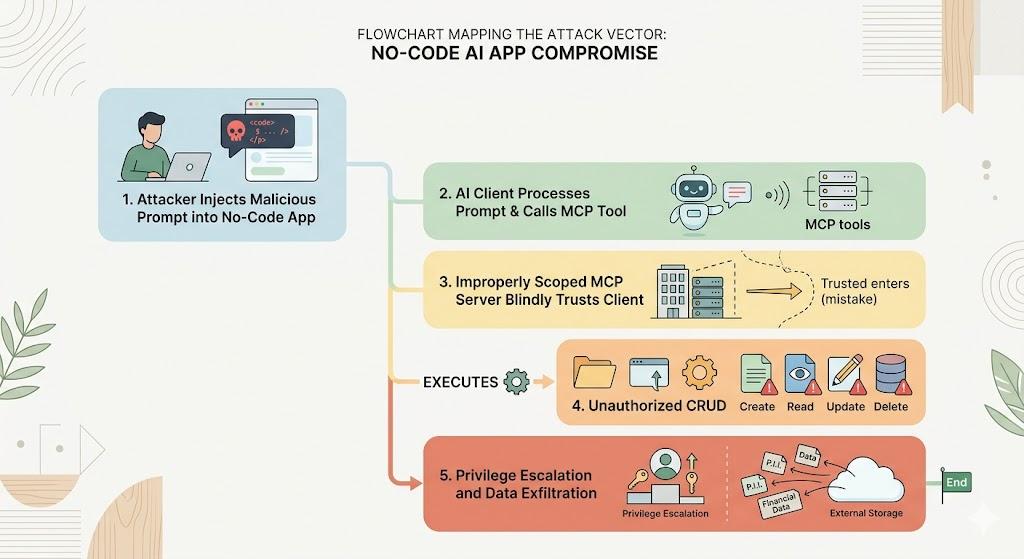
Here is the step-by-step playbook hackers use to compromise no-code environments:
- Reconnaissance and Tool Discovery: The attacker gains minimal access to the application, perhaps as a low-level authenticated user. They map the application to discover how it communicates with its backend AI assistant, looking for exposed MCP endpoints or client configuration files (like mcp.json) to understand what tools the server supports.
- Prompt Injection and Payload Delivery: Because MCP connects LLMs to your database, the attacker utilizes sophisticated Prompt Injection. They submit malicious inputs, like hidden instructions embedded within a seemingly benign text field, a chat prompt, or an uploaded document.
- The Confused Deputy Strike: The AI ingests the malicious prompt and faithfully forwards the attacker's embedded instructions to the MCP server. The attacker tricks the LLM into calling a specific tool, like a database_query or system_execute command with manipulated parameters.
- Privilege Escalation and Exfiltration: Because the MCP server lacks proper input validation and assumes any request from the trusted AI client is safe, it executes the command. The attacker suddenly elevates their privileges, bypassing their low-level user constraints to perform unauthorized CRUD operations, delete tables, or exfiltrate environment variables.
Locking Down the Protocol: Securing Your MCP Servers
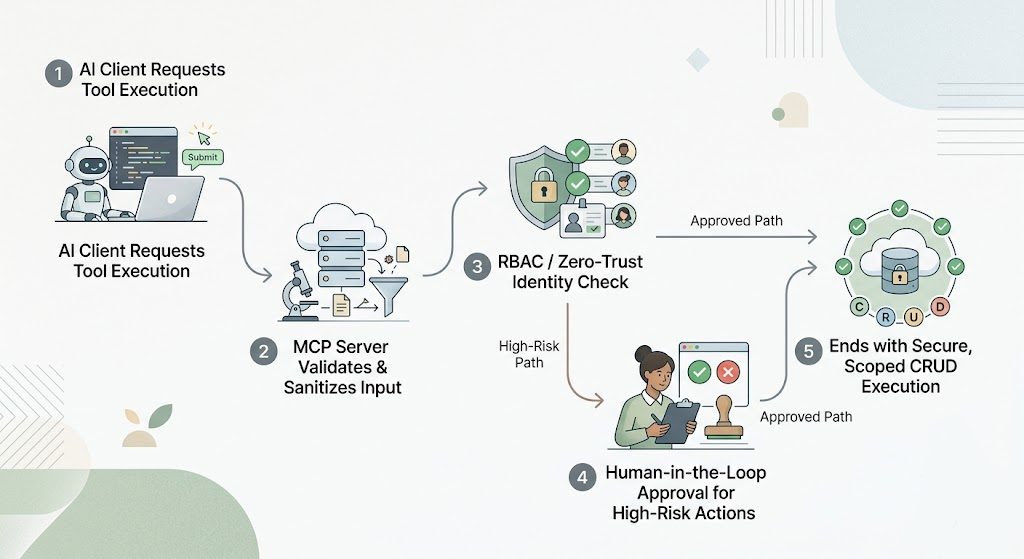
Securing MCP servers requires a fundamental shift in how backend developers and security architects view machine-to-machine communication. You cannot treat your MCP server like a trusted internal microservice. You must adopt a strict zero-trust architecture.
- Implement Strict Input Validation: Never pass raw parameters from an LLM directly into a database query or a system shell. MCP servers must validate, sanitize, and strictly type-check every single argument they receive. Treat the AI's output as highly untrusted, user-generated content.
- Enforce the Principle of Least Privilege: To ensure robust MCP server security, do not use wildcard permissions. If an MCP tool only needs to read a specific user's ticket, its database credentials must be physically incapable of deleting tables or accessing other users' records.
- Mandate Human-in-the-Loop Consent: For high-risk CRUD operations (like data deletion, infrastructure state changes, or outbound email sending), the MCP server should not execute the action automatically. It must require explicit, out-of-band cryptographic approval from the human user initiating the workflow.
How Axeploit Shuts Down MCP Vulnerabilities
No-Code vulnerabilities are uniquely dangerous because they abstract away the underlying code, making manual security reviews nearly impossible. You cannot just read a static configuration file to fully secure an improperly scoped MCP server. You have to test the live environment.
This is where the Axeploit API Security Checker becomes your ultimate DevSecOps weapon. While your developers build fast using no-code automation, Axeploit acts as your active line of defense. Our dynamic vulnerability scanner actively attacks your live, running applications exactly how a malicious hacker would.
If an MCP endpoint is exposed, or if a backend tool is susceptible to prompt-injection-driven API exploitation, Axeploit’s automated scanner will catch it. We flag the vulnerability, demonstrate the exact exploit path, and show your security architects exactly how to enforce MCP server security before the vulnerability makes it to production.
Conclusion: Trust, But Verify Your Supply Chain
AI-driven no-code development delivers incredible speed, but risks catastrophic breaches without proper visibility. Weaponizing the Model Context Protocol (MCP) has become the new frontier for advanced attackers. Hackers exploit improperly scoped servers, rapidly turning powerful productivity tools into invisible, high-privilege backdoors.
Static configurations simply cannot protect automated CRUD operations anymore. Organizations must enforce strict zero-trust architectures, mandate human-in-the-loop consent, and actively test live environments to safely leverage LLMs. Axeploit, proactive security, bridges the gap between rapid development and robust DevSecOps. We continuously scan live applications, uncovering massive shadow attack surfaces before malicious actors can exploit them.