If you are a SOC Manager or an Incident Responder navigating the threat landscape of mid-2026, you already know the sinking feeling of a glowing dashboard. Every morning, your team logs in to find hundreds, if not thousands, of critical alerts waiting in the queue. You are not losing the cybersecurity battle because of a lack of tools; you are losing it because of SOC alert fatigue.
For years, the industry believed that the solution to missing a threat was to log absolutely everything. We fed endless streams of telemetry into our dashboards, hoping that more data would equal more security. Instead, it just created noise. Today’s security teams are drowning in SIEM false positives, chasing ghosts generated by outdated legacy scanners that guess at vulnerabilities rather than proving them.
It is time to reframe the narrative. Alert fatigue is not a volume problem; it is fundamentally a data quality problem driven by uncertainty. In this article, we will explore why legacy scanning is breaking your team, and how shifting to a “No Exploit, No Report” philosophy using a verified Proof of Concept (PoC) is the only way to reclaim your SOC's efficiency.
The Root Cause: Uncertainty and Legacy Scanners
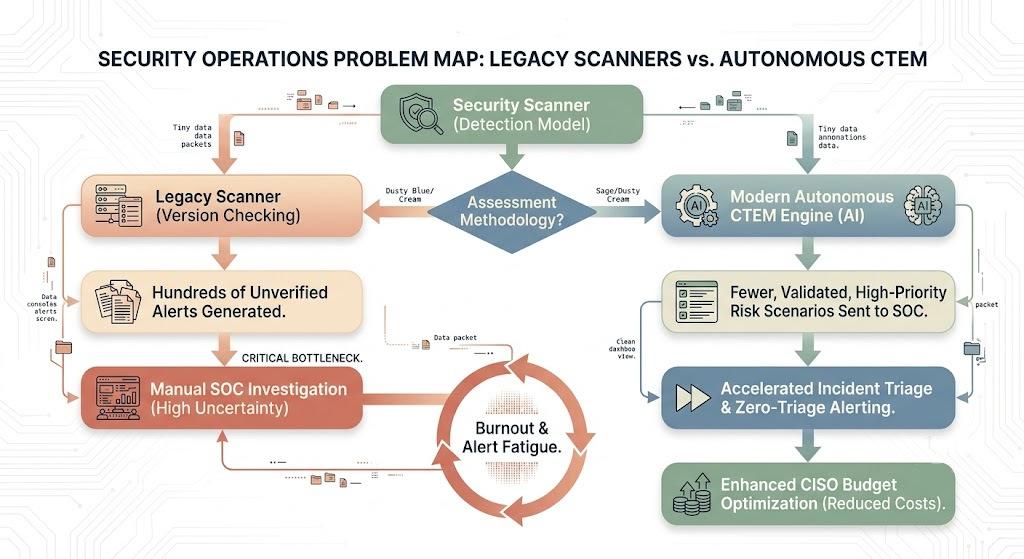
To understand why your Security Operations Center is overwhelmed, you have to look at how traditional vulnerability scanners and legacy SIEM correlation rules actually work. Most of these tools operate on a foundation of passive pattern matching and basic version checking.
When a traditional scanner looks at your perimeter or your cloud environment, it usually reads the headers, banners, or static configuration files. If it sees that a server is running an older version of a framework, it immediately flags a critical CVE. What the scanner doesn't know is whether your engineering team already applied a backported patch, whether a Web Application Firewall (WAF) is actively blocking the exploit path, or if that server is entirely isolated from the internet.
Drowning in a Sea of “Maybes”
Because legacy tools lack contextual awareness, they operate on the principle of “better safe than sorry.” They dump every potential anomaly into the SIEM. For the SOC analyst, this creates a nightmare scenario. Every alert represents a “maybe.”
- Maybe this Cross-Site Scripting (XSS) alert is real.
- Maybe this unauthenticated API endpoint is exposed to the public.
- Maybe this outdated dependency is exploitable in our specific production environment.
When an Incident Responder has to manually investigate 50 “maybes” a day, the psychological toll is immense. The burnout rate skyrockets. Worse, when a genuine, catastrophic intrusion actually happens, it is often buried under a mountain of SIEM false positives. You cannot defend a modern enterprise when your primary tool generates noise that your team is actively trained to ignore.
Shifting to a “No Exploit, No Report” Philosophy
In 2026, the velocity of software development is too high for passive guessing. Modern DevSecOps pipelines and highly dynamic microservice architectures change by the minute. To protect these environments without halting engineering momentum, we must eliminate uncertainty at the source.
This is where the “No Exploit, No Report” philosophy transforms the SOC. Instead of relying on passive signatures that guess if a vulnerability exists, modern defense platforms leverage autonomous AI agents to actively and safely attack the live environment, exactly like a cybercriminal would.
The Power of the Verified Proof of Concept (PoC)
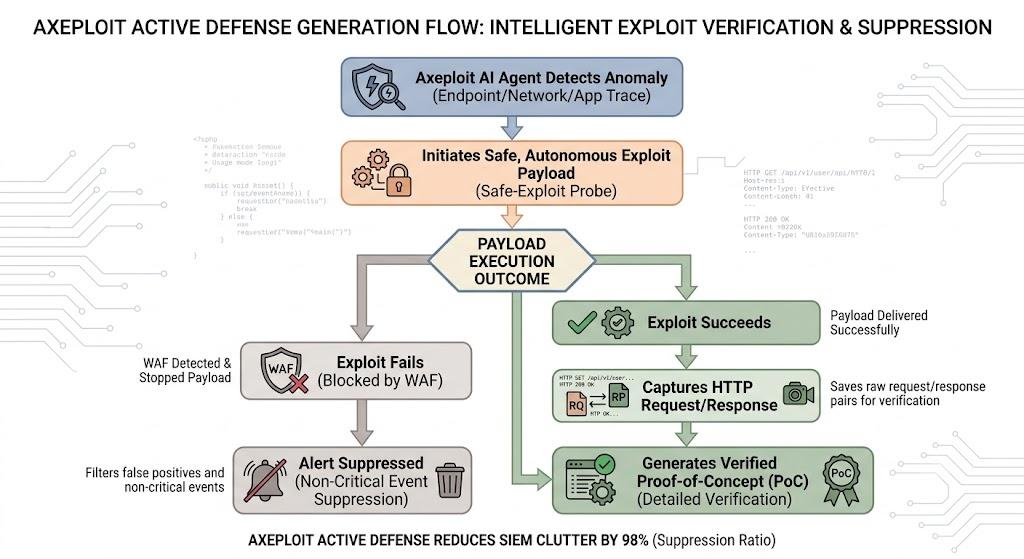
A verified Proof of Concept is the ultimate antidote to SOC alert fatigue. When an advanced platform like Axeploit discovers a potential vulnerability, it does not immediately send an alert to your SIEM. Instead, its dynamic engine takes an extra, autonomous step: it attempts to safely exploit the flaw.
If the engine suspects an API gateway is vulnerable to a Server-Side Request Forgery (SSRF), it will autonomously craft a benign payload, send it, and wait for the response. If the exploit fails, perhaps because your developers already implemented a compensating control, the system stays silent. No alert is generated. No analyst time is wasted.
However, if the exploit succeeds, the AI agent captures the exact HTTP request and the resulting HTTP response. It packages this irrefutable cryptographic proof into a highly contextualized alert.
Boosting Security Operations Center Efficiency
The transition from manual alert validation to automated vulnerability triage fundamentally changes the daily lives of your security team. When an Incident Responder opens a ticket generated by a verified PoC, they are no longer asking, "Is this real?" They already have the proof.
From Weeks to Minutes
Imagine a scenario where a new zero-day vulnerability drops for a widely used cloud logging library.
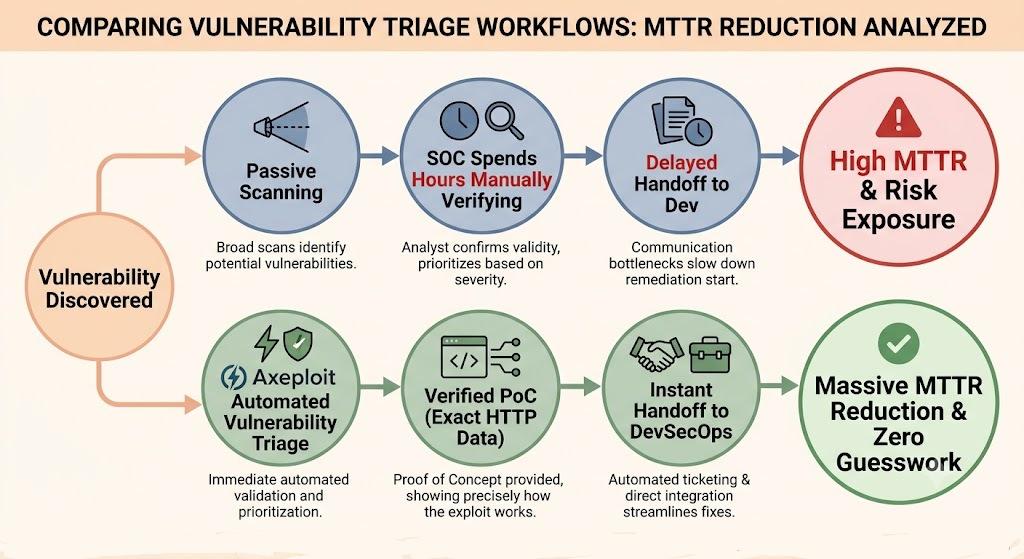
Under the old model, your legacy scanner flags 400 different containers across your multi-cloud environment as “potentially vulnerable.” Your SOC analysts must now manually track down the developers, check the configuration of each container, and manually test the endpoints. This triage process can take weeks, during which your organization remains exposed.
Under the new model, an autonomous security engine scans those 400 containers, safely tests the exploit paths in real-time, and finds that only three containers are actually exploitable from the outside. The SOC receives exactly three alerts. Inside each alert is the exact payload used to breach the container, alongside actionable remediation steps.
What used to be a grueling, multi-week investigation has collapsed into a targeted, ten-minute patching exercise. This level of security operations center efficiency is the only way to scale your defenses alongside a rapidly growing engineering department.
The Hard Metric: MTTR Reduction
For a SOC Manager, the most critical Key Performance Indicator (KPI) is the Mean Time to Remediate (MTTR). The longer a vulnerability sits in your live environment, the higher the probability of a catastrophic breach.
Uncertainty is the enemy of speed. By eliminating the triage phase of the incident response lifecycle, MTTR reduction happens naturally. When developers and security analysts are handed a verified Proof of Concept, there is no debate about whether the issue is a false positive. The engineering team can immediately replicate the attack using the provided HTTP request, apply the patch, and push the fix to production with absolute confidence.
Conclusion: Stop Guessing, Start Verifying
As we navigate the hyper-accelerated threat landscape of mid-2026, relying on passive scanners and rigid correlation rules is a guaranteed recipe for team burnout and critical security failures. Your SOC analysts are highly trained professionals; they should be spending their time actively hunting advanced persistent threats and fortifying your architecture, not acting as manual data filters for noisy software.
Alert fatigue is entirely solvable when you fix the underlying data problem. By shifting your security posture toward an active, dynamic defense model, you eliminate the SIEM false positives that are draining your resources. Implementing automated vulnerability triage ensures that every alert your team sees is actionable, proven, and accompanied by the exact data needed to fix it.
You cannot defend a modern enterprise with uncertainty. Demand proof. Axeploit’s dynamic AI agents physically test the reality of your deployed environment from the outside, operating exactly like an advanced cybercriminal to give you the verified intelligence you need.