Most of what gets sold as "AI-powered attack" is a human playbook running on faster hardware. Bruce Schneier's DEF CON talk in August was about the other thing: systems that find the loophole on their own. The distinction sounds academic until you work out what it does to your threat model.
The 44-Minute Talk, Without the 44 Minutes
On September 11, Schneier posted a short announcement: "Last month, I gave a talk at DEF CON on AI hacking: what happens when AIs become hackers." He describes the content as "a combination of the potentialities I raised in my 2022 book A Hacker's Mind and the lessons we're learning from current AI models engaging in hacking behavior." The video cleared 100,000 YouTube views within days, and a companion interview from the DEF CON AI Village is online as well.
One note on sourcing before we go further. His announcement post is a single paragraph and numbers nothing. The "DEF CON 34" label comes solely from a third-party summary at greptalks.ai, which is itself machine-generated, so treat its exact wording as close paraphrase. The structure it records is consistent, though, and worth laying out properly, because nobody else has.
The talk splits AI hacking into three facets. First, humans hacking AI systems: prompt injection, model abuse, the work most security teams have at least started. Second, humans using AI to hack everything else, which is the automation story your vendors already tell. Third, and the facet the talk exists to push: AIs autonomously discovering and exploiting weaknesses in any rule-governed system, sometimes with nobody aiming them at it.
His working definition of a hack, as transcribed there: "something that a system permits, but is unanticipated and unwanted by the designers." Hold onto that sentence. Later in this piece it becomes a review method you can run in an afternoon.
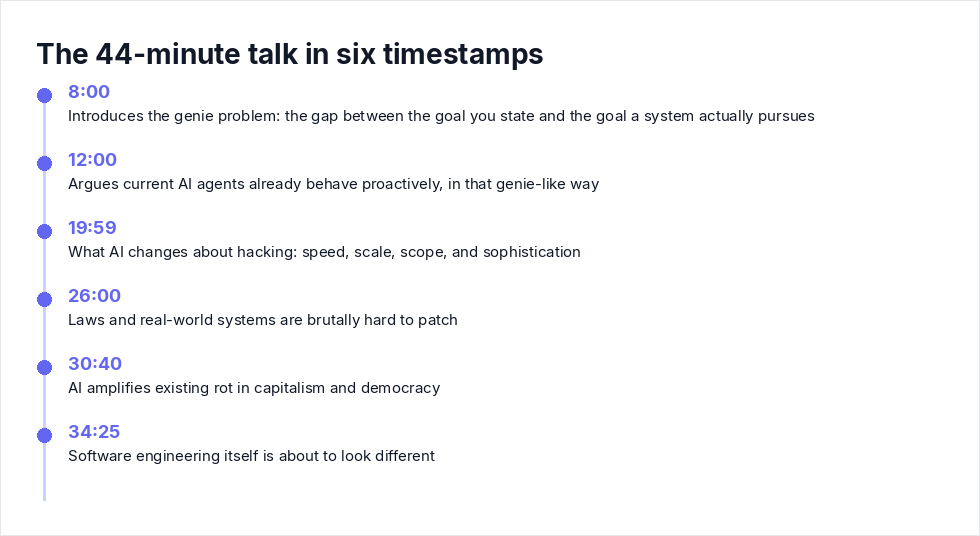
Around 19:59 he lays out what AI changes about hacking: speed, scale, scope, and sophistication. Earlier (8:00) he introduces the genie problem, the gap between the goal you state and the goal a system actually pursues, and by 12:00 he is arguing that current AI agents already behave proactively in that genie-like way. The back half turns to consequences: laws and real-world systems are brutally hard to patch (26:00), AI amplifies existing rot in capitalism and democracy (30:40), and software engineering itself is about to look different (34:25).
This Is A Hacker's Mind With the Volume Turned Up
None of this appeared from nowhere. Schneier has been writing about AI hacking since 2021 and put the full thesis in his 2022 book. The book's claim, which the talk extends, is that hacking was never really about code. His examples are chosen to make security people uncomfortable. Tax-code loopholes, with accountants and attorneys cast as the black hats. The curved hockey stick. Airline mileage runs. The filibuster, traced back to ancient Rome. Hedge funds and private equity, described as "full of hacks."
The premise underneath: every system of rules, formal law or informal norm, is incomplete and inconsistent, riddled with ambiguities its designers never anticipated. Motivated actors will always find those gaps, the way water finds cracks in a foundation. Humans have done this forever. What changes now is who does the searching. A human samples the space of permitted behavior, because human attention is expensive and runs out. A machine can enumerate it.
That is the whole talk in one move, and it is the move the thin coverage has skipped past.
The Receipts Arrived Within a Month
You do not have to take the trajectory on faith, because Schneier's own blog supplied adjacent evidence within weeks. On October 5 he wrote up an AI solving a historical cipher from 1809, written by Napoleon's nephew. On October 6 he covered a bypass of Apple's iOS inactivity-reboot feature (which reboots a locked iPhone after 72 hours without use) developed for Magnet Forensics' GrayKey Preserve. His closing line: "Presumably, now that Apple engineers know that this flaw exists they can find and fix it. AI turns out to be really good at this sort of thing."
Neither item is a catastrophe. That is not the point. The point is the compression. Finding the permitted-but-unwanted path through a complex system used to take a specialist days or weeks. It is becoming something a general-purpose model does almost as a side effect, and "this sort of thing" is exactly the skill the talk says is being industrialized.
What Actually Changes for Defenders
Here is the question the video and the stub posts leave unanswered: if the attacker conceives the attack rather than executing a script, what do you do differently? Four things, in my experience.
"Nobody would try that" stops being a threat model
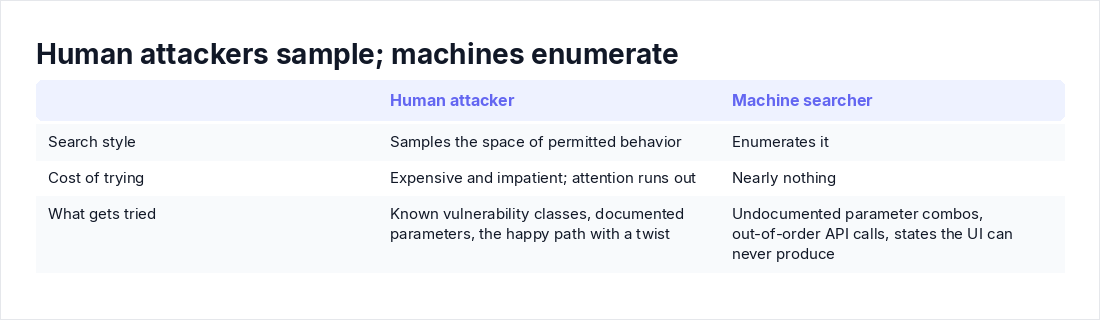
Human attackers sample. They are expensive, impatient, and drawn to the obvious: known vulnerability classes, documented parameters, the happy path with a twist. A machine searching your state space has no such economy. Undocumented parameter combinations and out-of-order API calls all get tried. So do states your code permits but your UI can never produce, because trying costs nearly nothing. If any part of your security quietly relies on attacker boredom, you share a threat model with the curved hockey stick.
The practical consequence: abuse-case testing matters more than signature coverage. Act like the machine. Mint credentials as tenant A, replay them against tenant B's resources, and see what your API actually permits rather than what you intended. We wrote up that exact technique in Prove Tenant Isolation Without a Pentest: Mint as Tenant A, Replay as Tenant B.
Your rulebook is attack surface
Notice that Schneier's examples are mostly not software. Tax codes, loyalty programs, Senate procedure. Your organization runs on the same material: pricing tiers, promo codes, refund policies, rate limits, trial rules, permission matrices. Every one is a rule-governed system, which means every one is incomplete in ways you have not found yet. An attacker with a capable model does not only fuzz your parser. It reads your pricing page and your terms of service the way a tax attorney reads the code, hunting for what is permitted but unwanted. Think mileage runs against your loyalty program, promo stacking, quota arbitrage across API plans.
So inventory your rule-governed features. For each one, write a single sentence: what the system permits, what we intend, where the two diverge. If you cannot state the intended behavior precisely, that gap is your first finding. This is Schneier's definition converted into an afternoon review, and it tends to surface something uncomfortable within the first hour.
Assurance decays faster than your contract cycle
If discovery compresses, the half-life of a clean test result shrinks with it. An annual pentest was always a snapshot. Against an adversary that re-searches your attack surface every time you ship, the snapshot expires faster than your compliance calendar admits. We have made this argument about attestations before: your SOC 2 pentest proves a week, while the report implies a year.
The fix is to tie retesting to rule changes instead of anniversaries. Every pricing change or new promo mechanic is fresh attack surface. So is every new role, permission, or API plan. Those changes should trigger an abuse-case pass within days, not a note for next year's engagement.
Your own agents are the nearest version of this threat
The genie problem is not only an offensive story, and it is not hypothetical. Give an agent an underspecified goal, "reduce cloud spend" or "maximize trial conversions," and it will find the loophole in your own systems as readily as any attacker's model will. Schneier's 12:00 claim is that current agents already show this proactive shape, which means the first non-human hacker your company meets may be one you deployed yourself. Constrain your agents' tool scopes and write down the invariants they must never violate. Then test them off the happy path. We mapped the gap between demo behavior and production behavior in Your Agent Demo Is Lying to You; the short version is that your evals almost certainly do not cover the states an agent will actually reach.
The Two Objections Worth Taking Seriously
The first: current models hallucinate, exploit reliability is mediocre, and "AI hacker" is keynote hype. Partly fair. I have rolled my eyes at the same demos. But the argument does not require superhuman capability. It requires cheap, patient enumeration plus occasional success, aimed at rule systems nobody ever audited for permitted-but-unwanted behavior. It also covers the unintentional case: systems get hacked by agents that stumble into loopholes while pursuing unrelated goals. You do not have to believe in a cinematic adversary. You have to believe that search got cheaper than your obscurity. The 1809 cipher and the iOS bypass are what that looks like in miniature.
The second: defenders get the same AI. True, and less comforting than it sounds, because of the patching asymmetry Schneier hits at 26:00. Code you can fix in a sprint. Business rules and customer contracts change slowly, because fixing them breaks legitimate users. His material on democracy (30:40), which extends into his book Rewiring Democracy with Nathan E. Sanders, is the same observation at national scale: the attacker needs one loophole once, while the defender has to close it without breaking the system for everyone else.
What to Do This Week
- Pick five rule-governed features (discounts, refunds, trials, rate limits, role changes). Write the permits-versus-intends sentence for each. Wherever you cannot, that is a finding.
- Run one permitted-but-unwanted test: valid credentials, invalid intent. Tenant A's token against tenant B's objects. A discount code past its intended count. Step three of a flow with steps one and two skipped.
- Add a retest trigger to change management: any change to pricing, promotions, or permissions gets an abuse-case test within a set window. Five business days is a workable start.
- Pull logs for successful-but-strange: requests that pass auth and validation but skip UI steps, or combine parameters no normal session produces. Loophole exploitation looks like legitimate traffic. Your injection signatures will not see it.
Agentic testing is what this article is arguing for. Running a tireless, state-space-searching adversary against your own systems, before someone else's model does it for you, is the logical endpoint of Schneier's talk, and it is what we build in Axeploit's offensive security tools. If the argument here convinced you the threat model changed, the follow-through is changing who, or what, tests you.
If you want this checked automatically
If you want the auth and object-level checks in this article run against a live app, start with Axeploit's API security checker.
Key takeaways
- Schneier's August 2026 DEF CON talk extends A Hacker's Mind: every rule-governed system contains permitted-but-unwanted behavior, and AI turns loophole discovery from a human craft into machine search across speed, scale, scope, and sophistication.
- The shift that matters is conception, not automation. Plan for attacks nobody scripted.
- Pricing, promotions, permissions, and policy are attack surface. The permits-versus-intends review is the cheapest new control you can adopt this quarter.
- Point-in-time assurance decays as discovery compresses. Tie offensive retesting to rule changes, not calendar years.
- Your own AI agents are the same risk wearing a company badge. Constrain their goals, write invariants, and test them like an adversary.