The Death of the Traditional SIEM: Why Data Logging is Yielding to Active AI Defense
If you are a CISO, SOC Director, or Security Architect operating in 2026, you already know the uncomfortable truth: your SIEM is suffocating your security team. We have spent the last decade building massive, infinitely scalable data lakes, pouring millions of dollars into ingestion fees, and configuring endless arrays of correlation rules. Yet, despite this colossal investment in logging, the cybersecurity industry is still losing the race against threat actors who move faster than our queries can execute.
Why? Because traditional Security Information and Event Management (SIEM) platforms were designed for an era that no longer exists. They are passive observers in an active warzone. As attack velocities shrink from days to minutes, the strategy of “collect everything and analyze it later” has become a profound operational liability.
This article explores the necessary SOC evolution, detailing why the industry is accelerating its SIEM migration away from passive data warehouses, and how AI cybersecurity is pioneering a new era of autonomous defense capable of severing attack chains in real time.
The Illusion of the Data Lake and Alert Fatigue
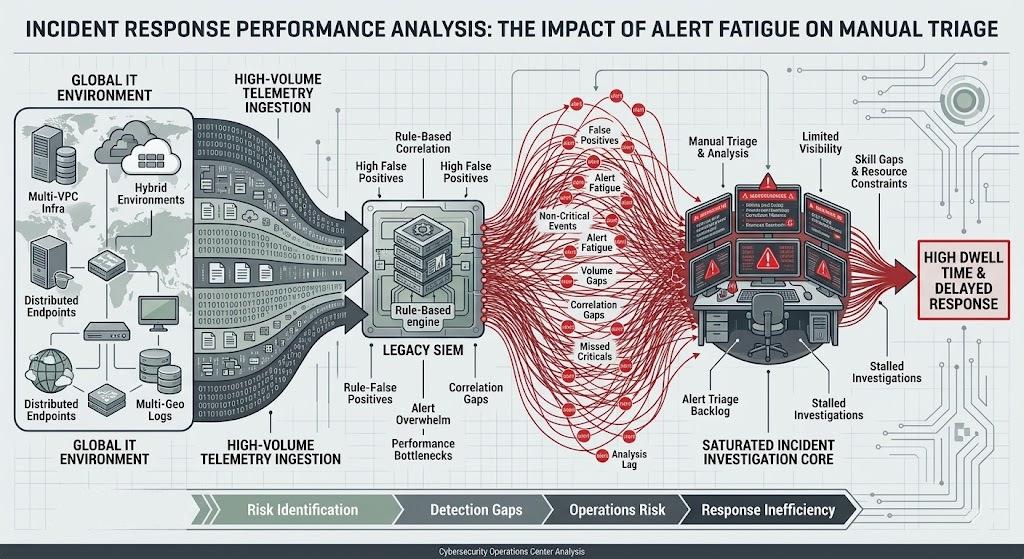
In theory, centralizing every network log, endpoint telemetry point, and cloud event into a single pane of glass sounds like perfect security. But the reality of modern SecOps is plagued by crushing alert fatigue. When your environment generates terabytes of data daily, standardizing and correlating that data requires a massive, ongoing engineering effort.
Even worse, traditional SIEMs rely heavily on static, predefined rules. If an attack signature matches a rule, an alert is generated. But in 2026, cyber threat actors use AI to automate reconnaissance, personalize phishing campaigns, and obfuscate malware dynamically. They do not follow static rules. By the time a traditional SIEM correlates disparate signals and alerts a human analyst, the threat actor has already moved laterally across your microservices.
A SIEM is only as valuable as the response it triggers. If your platform is simply a bloated data warehouse that requires a team of tired analysts to manually triage thousands of false positives, it is not a defense mechanism, it is a forensic tool for post-mortem analysis.
The SOC Evolution: From Passive Logging to Active AI
The structural shift in the security stack is undeniable: the market is rapidly moving toward cloud-based, AI-native platforms that prioritize machine learning and automated response over on-premises, rules-driven logging. This is not just a software update; it is a fundamental SOC evolution.
To combat AI-driven attacks, organizations must deploy AI cybersecurity capable of understanding deep architectural context. True threat intelligence in 2026 demands a proactive stance. It requires systems capable of executing behavioral profiling and predictive threat analytics. When a novel zero-day exploit emerges, passive systems fail because no signature exists yet. However, an AI-driven engine relies on machine learning to baseline normal operations and immediately flag the anomalous behaviors, such as unexpected lateral movement or irregular database queries, that betray an intruder's presence.
Instead of a human analyst manually querying a database at 2:00 AM, modern systems continuously retrain themselves using global attack patterns and behavioral telemetry. When a deviation occurs, the system doesn't just raise an alert, it acts.
Embracing Autonomous Defense
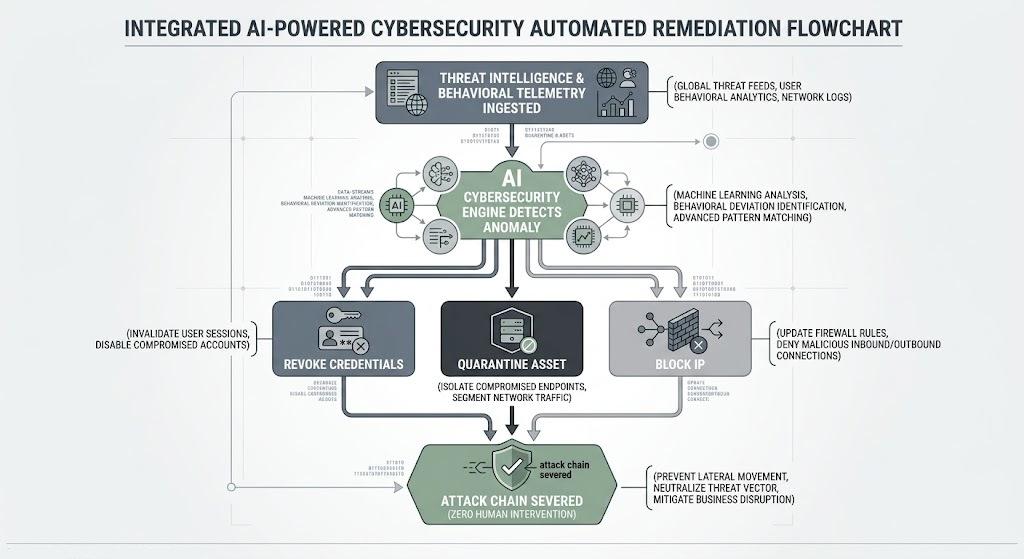
The future of SecOps is autonomous defense. This means moving beyond the “alert-only” mode and trusting AI to execute predefined, intelligent responses at machine speed.
When a cloud security tool detects unusual identity behavior or privilege escalation, it should autonomously trigger playbooks to:
- Isolate and quarantine compromised cloud workloads instantly.
- Revoke or revise access permissions dynamically.
- Block malicious external IP addresses at the edge.
- Initiate forensic data capture for further review.
By severing the attack chain autonomously, the system reduces the dwell time to near zero. It transforms the SOC analyst from a reactive alert-chaser into a strategic, proactive security architect.
Active Disruption: The Axeploit Advantage
This transition from passive observation to active engagement is precisely where Axeploit redefines the battlefield. While legacy platforms wait for logs to arrive, Axeploit physically and actively tests the reality of your deployed environment.
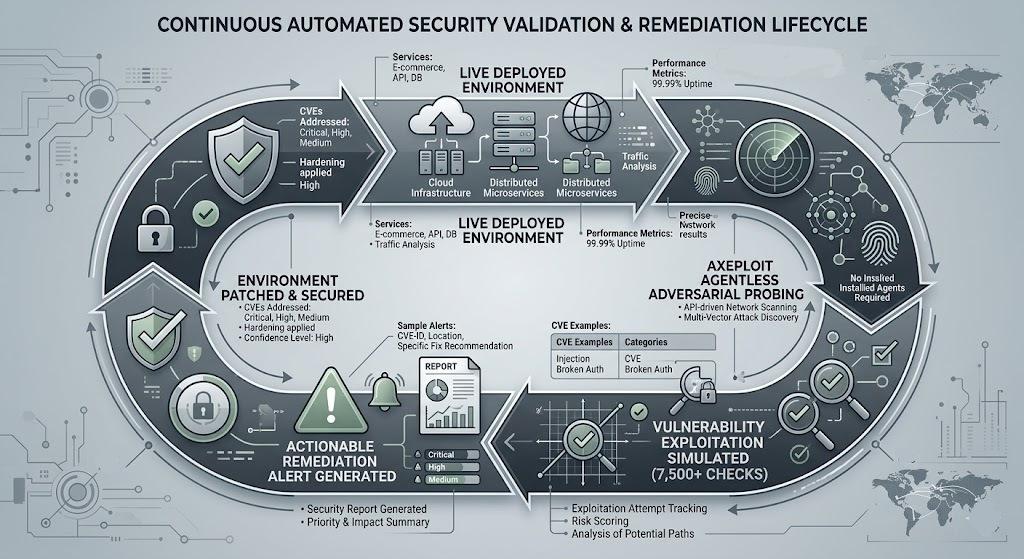
Axeploit operates exactly like an advanced cybercriminal targeting your assets. We provide the only self-service scanner equipped with active adversarial probing for AI endpoints. There are no agents to install and no SDKs to integrate. Instead, Axeploit independently signs up, navigates your platform, and actively scans for over 7,500 known vulnerabilities.
If an upstream misconfiguration exposes an API, or a deprecated module leaves a backdoor open, Axeploit’s dynamic engine discovers it before a threat actor does. We flag the exposed exploit path and provide your platform engineering team with clear, actionable remediation insights to patch the vulnerability at the source.
Redefining Your SIEM Migration Strategy
As you evaluate your security roadmap for the remainder of 2026, consider your SIEM migration not as a simple vendor swap, but as a philosophical shift. You cannot solve a machine-speed problem with human-speed analysis.
When executing this migration, leaders must separate their data storage strategy from their active threat detection strategy. Forward-thinking organizations are pushing high-volume, low-value logs into cost-effective cloud data lakes, while routing high-fidelity telemetry directly into purpose-built, AI-native insight engines.
This decoupling drastically reduces licensing costs while supercharging detection accuracy. Let your data lakes handle compliance and long-tail archiving, but let AI handle your front-line defense.